Plot No. 5, Evershine Nagar, Next To Landmark, Link Road, Malad West
Blog Category

Does your lower back hurt after sitting for hours? Do you feel a sharp pain when bending forward or getting out of bed? Sometimes, the discomfort even travels down your leg, making simple activities like walking, driving or climbing stairs difficult.

Back pain can affect anyone, from office professionals working long hours to older adults experiencing changes in their spinal discs. While occasional discomfort may settle with time, persistent pain can make everyday life frustrating.

One possible cause is a disc-related spinal condition, such as a bulging or herniated disc. These conditions may irritate nearby nerves and cause pain, tingling or numbness.

Many patients searching for a physiotherapist in Malad, Mumbai want to know whether spinal decompression therapy can help them manage their symptoms without surgery.

At PhysioHub – Sports & Neuro Rehab Centre, understanding the cause of discomfort is an important part of planning rehabilitation.

Spinal decompression is one treatment patients may hear about. But is it suitable for everyone? Let’s explore how it works, what research says about its benefits and why a personalised physiotherapy programme matters.

Can Spinal Decompression Therapy Help Relieve Disc-Related Back Pain?

Spinal decompression therapy uses controlled stretching forces to temporarily reduce loading on the spine. Some patients may experience short-term symptom relief, but research does not support routine mechanical traction for lower back pain or sciatica. A physiotherapist can assess whether it is appropriate and recommend evidence-based exercises and rehabilitation.

What Is Spinal Decompression Therapy?

Spinal decompression therapy is a non-surgical treatment that uses a specialised traction table or mechanical device to apply controlled pulling forces to the spine.

The aim is to gently separate spinal segments and temporarily change the forces acting on discs, joints and surrounding tissues.

Your spine contains soft, cushion-like structures called intervertebral discs. These discs sit between the vertebrae and help absorb pressure during daily movement.

When a disc bulges or herniates, it may irritate a nearby nerve. However, not every disc bulge causes pain, and some are found in people without symptoms.

Mechanical decompression is sometimes promoted as a way to reduce disc pressure. Yet there is limited reliable evidence that it permanently restores disc position or provides lasting relief.

Importantly, non-surgical spinal decompression is different from spinal decompression surgery, which may be considered for selected patients with persistent nerve compression.

According to the NICE clinical guidelines, traction is not recommended as a routine treatment for lower back pain with or without sciatica.

What Causes Disc-Related Back Pain, and Why Is Physiotherapy Important?

Disc-related discomfort can develop for several reasons. Sometimes symptoms appear suddenly, while in other cases they build gradually.

Common contributing factors include:

  • Age-related disc changes: Spinal discs naturally lose some water content and flexibility with age.

  • Disc herniation: Disc material can move beyond its usual boundary and sometimes irritate nearby nerves.

  • Repeated physical loading: Frequent heavy lifting or bending may contribute to symptoms in some individuals.

  • Prolonged sitting: Remaining in one position may aggravate existing back discomfort.

  • Reduced physical conditioning: Limited strength and movement tolerance can make everyday tasks harder.

  • Previous back injuries: Earlier episodes may increase the likelihood of recurring discomfort.

For example, someone working at a desk for eight hours may notice increasing stiffness by evening. Another person may experience pain while lifting a heavy suitcase.

Does this always mean a slipped disc? Not necessarily.

A qualified physiotherapist in Malad west can examine movement, muscle strength, nerve symptoms and daily activity patterns to identify possible causes.

Professional Physiotherapy Services in Malad, Mumbai can focus on improving function and helping patients return to activities they have been avoiding.

How Does Spinal Decompression Therapy Work? A Step-by-Step Explanation
physiotherapist in malad Mumbai | physiohub

Before considering any decompression procedure, a detailed assessment is necessary.

A typical clinical process may involve the following steps.

Step 1: Understanding Your Symptoms

The physiotherapist asks about your pain, medical history, previous injuries and activities that make symptoms better or worse.

They may also check whether the pain travels into your legs or affects walking.

Step 2: Physical Examination

Your posture, spinal movement, muscle strength, reflexes and sensation may be assessed.

An MRI is not always necessary. Imaging is usually considered when symptoms, examination findings or treatment decisions justify it.

Step 3: Deciding Whether Traction Is Appropriate

If mechanical traction is being considered, the clinician should explain the uncertain benefits, possible risks and other treatment options.

Current guidelines generally favour active rehabilitation over routine traction.

Step 4: Supervised Application, If Clinically Justified

During mechanical traction, a patient lies on a specialised table while a device applies controlled pulling forces.

The settings are adjusted by a trained professional. Treatment should be stopped if symptoms worsen.

Step 5: Rehabilitation and Follow-Up

Regardless of whether traction is used, recovery usually requires more than passive treatment.

A structured programme may include:

  • Gentle mobility exercises

  • Progressive core and hip strengthening

  • Walking and activity progression

  • Guidance on lifting and sitting comfortably

  • Home exercises and regular reassessment

The main goal is to help patients move confidently and manage their symptoms over time.

What Are the Potential Benefits of Spinal Decompression Therapy?

Some patients may report temporary relief following mechanical traction. However, these effects are not consistent across clinical studies.

Possible short-term effects include:

  • Temporary pain relief: Certain individuals may feel more comfortable immediately after treatment.

  • Reduced feeling of stiffness: Gentle stretching may provide a temporary sense of relaxation.

  • Improved movement comfort: Some patients may find certain movements easier for a short period.

  • Support during supervised care: When appropriate, the treatment may be discussed within a broader rehabilitation plan rather than offered alone.

These possibilities should not be confused with proven long-term benefits.

The 2021 Journal of Orthopaedic & Sports Physical Therapy clinical practice guideline found that mechanical traction generally did not add meaningful benefits for chronic lower back pain with leg symptoms when combined with other treatments.

In contrast, appropriate exercise, education and gradual return to activity remain central parts of recommended care.

  • Spinal decompression devices use controlled traction forces.

  • They do not reliably reverse disc herniation.

  • Long-term benefits remain uncertain.

  • Exercise-based physiotherapy has stronger guideline support.

  • Treatment should follow a professional assessment.

Spinal Decompression Therapy vs Other Back Pain Treatments: Which Is Better?

Not every patient needs the same treatment. The right approach depends on symptoms, clinical findings and recovery goals.

Treatment Main Purpose Important Consideration
Spinal decompression traction Apply controlled spinal stretching Not routinely recommended for lower back pain or sciatica
Exercise-based physiotherapy Improve strength, mobility and function Recommended for many patients
Manual therapy Address movement limitations and discomfort Best considered alongside exercise
Medication Manage pain and inflammation when appropriate Requires medical advice and risk assessment
Spinal decompression surgery Relieve selected cases of confirmed nerve compression Considered when clinically indicated

Patients seeking Physiotherapy in Malad, Mumbai may benefit from discussing these options before choosing a treatment.

Those exploring osteopathy in Malad or searching for a Chiropractor in Malad, Mumbai should also understand that manual treatments are not replacements for comprehensive medical assessment.

Who Is a Good Candidate for Spinal Decompression Therapy?

Not everyone with a disc problem is a suitable candidate for mechanical traction.

Patients commonly asking about this treatment include those experiencing:

  • Persistent lower back pain

  • Disc-related leg discomfort

  • Sciatica-like symptoms

  • Recurrent stiffness affecting daily activities

  • Difficulty returning to normal movement after a back pain episode

However, having these symptoms does not automatically mean traction will help.

A physiotherapist near Malad can assess whether active rehabilitation, medical referral or another treatment is more appropriate.

Patients with significant osteoporosis, spinal instability, certain fractures or other serious spinal conditions may be unsuitable for traction.

Seek urgent medical attention if back pain is accompanied by new bladder or bowel control problems, numbness around the groin, or severe or progressive leg weakness.

Patients with other conditions may require different programmes. For example, neck pain treatment in Malad, Mumbai, shoulder pain treatment in Malad, Mumbai, and ACL rehab in Malad involve different rehabilitation goals.

Similarly, individuals needing rehab exercises for knee ligament injuries or knee replacement recovery in Malad Mumbai should receive condition-specific guidance.

How Much Does Spinal Decompression Therapy Cost in Malad, Mumbai?

The cost of treatment can vary depending on the clinic, assessment requirements and overall rehabilitation plan.

Factors that may influence pricing include:

  • Initial consultation: A detailed examination may be charged separately.

  • Treatment approach: Machine-based sessions and supervised exercise programmes may have different costs.

  • Number of visits: The schedule depends on symptoms, progress and clinical need.

  • Additional rehabilitation: Strengthening, mobility training and follow-up assessments may affect overall costs.

  • Professional expertise: The therapist’s qualifications and the level of supervision may influence fees.

Instead of choosing treatment based only on session prices, ask what the programme includes and whether the proposed approach is supported by clinical evidence.

Someone searching for a Physiotherapist near me, Chiropractor Near me, or even the misspelled phrase Physiotheraphy near me should prioritise qualified professionals, transparent pricing and appropriate clinical assessment.

What Are the Latest Trends in Spinal Rehabilitation in 2026?

Spinal rehabilitation continues to move towards personalised, evidence-informed care.

Rather than relying only on machines, physiotherapy increasingly focuses on helping people understand pain and improve their ability to move.

Important approaches in 2026 include:

1. Personalised exercise programmes

Exercise plans can be adapted according to symptoms, fitness levels, physical limitations and daily routines.

2. Active rehabilitation

Patients are encouraged to build strength, improve movement tolerance and return gradually to everyday activities.

3. Digital exercise support

Video demonstrations, home exercise platforms and remote follow-ups can help selected patients practise between appointments. Emerging research supports cautious use under professional supervision.

4. Better patient education

Understanding disc-related pain can reduce unnecessary fear of movement and support informed decisions.

5. Integrated rehabilitation

Patients with neurological conditions may require Neuro physio therapy in Malad or support from a Neuro rehab centre in Mumbai.

A qualified Sports Physiotherapist in Mumbai can also help active individuals return to exercise safely after a back pain episode.

Why Choose PhysioHub – Sports & Neuro Rehab Centre in Malad?

Living with back pain can be tiring, especially when symptoms interrupt work, sleep or everyday activities.

At PhysioHub – Sports & Neuro Rehab Centre, Malad West, rehabilitation focuses on understanding each patient’s symptoms and movement needs.

Led by Dr. Pooja Mehta, PhysioHub provides physiotherapy support for musculoskeletal, sports and neurological conditions.

Patients looking for Physiotherapy in Malad can enquire about assessment, exercise-based rehabilitation, spine care and suitable treatment options.

PhysioHub’s services also cover other rehabilitation needs, including sports injuries, joint discomfort and neurological recovery.

Whether someone needs a Sports Physiotherapist in Malad, guidance for recurring back discomfort or specialist support from a Neuro rehab centre in Malad, Mumbai, the priority should be safe, individualised rehabilitation.

Patients exploring neck pain treatment in Malad Mumbai or shoulder pain treatment in Malad Mumbai can also seek appropriate assessments rather than assuming all spinal or joint symptoms require the same treatment.

FAQs About Spinal Decompression Therapy

1. Can spinal decompression therapy cure a slipped disc?

No. Mechanical decompression has not been shown to reliably cure or permanently reposition a slipped disc. Many disc-related symptoms improve with appropriate conservative care.

2. Is spinal decompression therapy painful?

Mechanical traction is intended to be controlled, but some patients may experience discomfort or worsening symptoms. The procedure should be stopped if this happens.

3. How many spinal decompression sessions are needed?

There is no established ideal number of sessions. Because routine traction is not recommended by major guidelines, repeated sessions should not be assumed necessary.

4. Can physiotherapy help disc-related back pain without surgery?

Yes. Many patients improve with exercise-based physiotherapy, education, activity changes and appropriate medical care. Surgery is considered for selected cases.

5. When should I consult a physiotherapist for back pain?

Consult a physiotherapist when pain keeps returning, limits everyday movement or fails to improve. Seek prompt medical evaluation for worsening weakness or significant nerve symptoms.

Take the First Step Towards Better Spine Health

Back pain should not have to control how you work, move or enjoy your day.

If you experience persistent lower back discomfort, leg pain or difficulty with everyday movements, getting a proper assessment is a sensible first step.

At PhysioHub – Sports & Neuro Rehab Centre, Malad West, patients can explore personalised rehabilitation options designed around their condition and recovery goals

Move with confidence. Build strength. Take care of your spine.

For more information contact:

PhysioHub -sports &neuro rehab centre
 

Imagine you’re halfway through your morning run, feeling energetic and maintaining a comfortable pace. Suddenly, your calf tightens, making every step painful. You slow down, stretch your leg, and wonder why this keeps happening.

Sound familiar?

Calf cramps are a frustrating problem for long-distance runners, marathon participants, and fitness enthusiasts. They can appear without much warning, interrupt training sessions, and leave you worried about your next run.

Many runners assume calf cramps happen only because of dehydration or low electrolytes. However, the real explanation is often more complicated. Muscle fatigue, training demands, running mechanics, and individual physical factors may all play a role.

Ignoring repeated cramps can affect your confidence and training consistency. That’s why understanding your body’s response to long-distance running matters.

With guidance from a physiotherapist in Malad, Mumbai, runners can assess muscle strength, movement patterns, and possible triggers behind recurring cramps.

At PhysioHub – Sports & Neuro Rehab Centre, sports physiotherapy in Malad focuses on identifying movement problems, improving physical capacity, and helping runners return to training with greater confidence.

Why Do Calf Cramps Occur During Long-Distance Running?

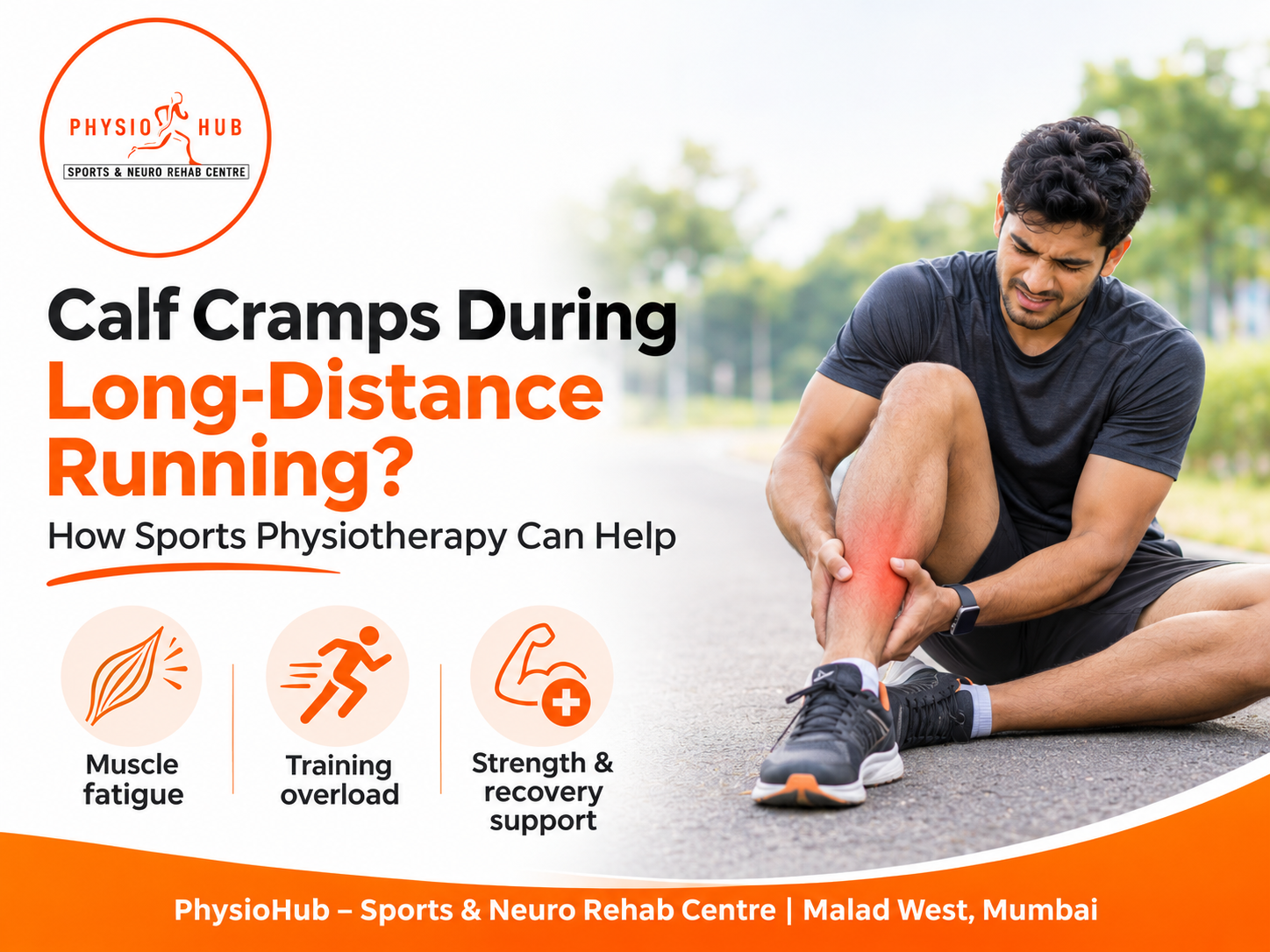
Calf cramps during long-distance running are sudden, painful, involuntary muscle contractions. They may be linked to muscle fatigue, running demands, previous cramping episodes, and individual physical factors. Sports physiotherapy helps assess possible triggers, improve calf strength and endurance, guide training changes, and develop personalised strategies to manage recurring cramps.

What Are Calf Cramps During Long-Distance Running?

A calf cramp is a sudden, uncontrollable tightening of the muscles at the back of your lower leg. It commonly affects the gastrocnemius or soleus muscle, which helps you walk, run, and push off the ground.

During long-distance running, these muscles work repeatedly to support your body and propel you forward.

When a cramp occurs, you may experience:

  • Sudden, sharp pain in the calf.

  • A tight or hard feeling in the muscle.

  • Difficulty walking or continuing to run.

  • Temporary stiffness or tenderness after the cramp.

Most exercise-related cramps settle within a short period. However, recurring cramps deserve attention, especially when they affect your training.

What Causes Calf Cramps During Long-Distance Running?

There isn’t always one clear reason for calf cramps. Research suggests exercise-associated muscle cramping can involve several interacting factors.

Some possible contributors include:

  • Muscle fatigue: Running longer or harder than your muscles are prepared for may contribute to cramping.

  • Sudden training increases: Rapid changes in running distance, speed, or intensity may place unfamiliar demands on the calves.

  • Limited muscular endurance: Your calf muscles may struggle to maintain repeated contractions throughout a long run.

  • Running mechanics: Stride patterns and movement habits can influence how much work your calf muscles perform.

  • Hydration and nutrition: These remain important for general performance and health, although dehydration or electrolyte loss does not explain every running cramp.

  • Previous cramping history: Runners who have experienced exercise-related cramps may be more likely to experience them again.

A 2026 systematic review involving 11,274 participants found that a previous history of exercise-associated cramps was associated with approximately 4.4 times higher odds of future cramping. Other proposed risk factors showed less consistent evidence.

This is why a personalised assessment can be more useful than relying on a single prevention tip.

How Does Sports Physiotherapy Help Manage Calf Cramps?

physiotherapist in malad | physiohub

Sports physiotherapy in Malad takes a structured approach to understanding why cramps may occur and what a runner can do about them.

A Sports Physiotherapist in Mumbai may use the following steps:

Step 1: Assess Muscle Strength and Flexibility

The physiotherapist examines calf strength, ankle mobility, muscle endurance, and any pain or stiffness.

This helps identify physical limitations that may affect running comfort.

Step 2: Evaluate Running Mechanics

Your walking and running movements may be assessed to understand how your calves handle repeated loading.

For example, a runner who places high demands on the forefoot may require specific calf-strengthening or technique advice.

Step 3: Develop a Strengthening Programme

Exercises may include:

  • Standing calf raises.

  • Bent-knee calf raises.

  • Controlled heel-lowering exercises.

  • Single-leg balance training.

  • Progressive calf endurance exercises.

The number of repetitions and difficulty should match the runner’s current capacity.

Step 4: Guide Recovery and Training

A physiotherapist may recommend changes to running volume, intensity, rest periods, and recovery routines.

Appropriate stretching and hands-on treatment may also be considered when clinically indicated.

Step 5: Support a Gradual Return to Running

Progress is reviewed through strength, endurance, symptoms, and running tolerance.

The aim is to help runners manage discomfort and build the capacity needed for their chosen distance.

Sports physiotherapy combines physical assessment, targeted strengthening, running-load management, and recovery guidance. Its goal is to address individual factors that may contribute to recurring calf cramps.

What Are the Benefits of Sports Physiotherapy for Runners?

Regular sports physiotherapy in Malad can support runners in several ways, particularly when cramps are frequent or affect performance.

  • Improved calf strength: Progressive exercises help muscles manage the repeated demands of running.

  • Better muscular endurance: Endurance training may help calves tolerate longer running sessions.

  • Improved movement control: Gait assessment can identify movement patterns worth addressing.

  • Personalised injury prevention: Rehabilitation considers previous injuries, physical limitations, and training goals.

  • Greater running confidence: A structured programme helps runners understand how to progress safely.

For athletes searching for a Sports Physiotherapist in Malad, an individual assessment can help identify whether calf cramps are related to training demands or require further medical investigation.

Sports Physiotherapy vs Home Remedies: Which Is Better for Calf Cramps?

Many runners try stretching, drinking water, or taking electrolytes whenever cramps occur.

These approaches may be useful in certain situations, but they do not always address recurring symptoms.

Approach Main purpose Limitations
Gentle stretching Relieves an active cramp Does not identify recurring triggers
Hydration Supports normal fluid balance May not prevent all cramps
Massage May temporarily ease muscle discomfort Limited evidence for preventing recurrence
Sports physiotherapy Assesses strength, endurance, movement, and training Requires consistent participation
Guided strength training Builds muscular capacity over time Needs appropriate progression

Evidence-based sports medicine reviews support gentle static stretching for immediate relief and individualised assessment for preventing future episodes.

If a calf suddenly cramps during running, stop, gently stretch the affected muscle, and avoid forcing yourself to continue through severe pain.

Who Should Consult a Sports Physiotherapist for Calf Cramps?

Not every occasional calf cramp requires treatment. However, repeated episodes shouldn’t become something you simply accept as part of running.

Consider consulting a physiotherapist if:

  • Your calves cramp regularly during long runs.

  • You experience repeated tightness despite adjusting your training.

  • Calf discomfort affects your running distance or speed.

  • You are preparing for a marathon or endurance event.

  • You are returning to running after a lower-limb injury.

  • You experience recurring calf problems alongside ankle or knee discomfort.

A professional assessment can also benefit runners recovering from previous injuries.

For example, someone undergoing ACL rehab in Malad may need progressive lower-limb strengthening before returning to demanding running activities.

Important: Sudden calf swelling, redness, warmth, severe persistent pain, or unusual weakness needs medical assessment. Seek urgent care for calf symptoms accompanied by chest pain or breathlessness.

How Much Does Sports Physiotherapy for Calf Cramps Cost in Malad?

The cost of physiotherapy near Malad, Mumbai depends on the type of assessment, individual treatment needs, and rehabilitation programme.

Common pricing factors include:

  • Initial consultation: A detailed assessment may involve strength, mobility, and movement testing.

  • Treatment requirements: Sessions may involve exercise therapy, manual therapy, or specialised rehabilitation techniques.

  • Number of sessions: Recurring problems may require a longer strengthening programme.

  • Individual goals: Marathon preparation and post-injury rehabilitation may involve different levels of support.

Rather than choosing treatment based only on session fees, consider the physiotherapist’s qualifications, assessment process, and approach to personalised rehabilitation.

For current consultation charges, contact PhysioHub directly.

What Are the Latest Sports Physiotherapy Trends for Runners in 2026?

Sports rehabilitation continues to evolve, with growing attention to personalised training, objective movement assessment, and rehabilitation monitoring.

Some developments relevant to runners include:

  • Wearable fitness technology: Smartwatches and fitness devices can help track running distance, heart rate, and training patterns.

  • Sensor-based gait analysis: Wearable movement sensors are being studied for their ability to assess running mechanics and loading.

  • Individualised strength programmes: Exercise plans can be adjusted according to the runner’s current capacity and rehabilitation progress.

  • Training-load monitoring: Reviewing running volume and intensity helps support gradual progression.

The American College of Sports Medicine identified wearable technology as its leading fitness trend for 2026. A systematic review published in January 2026 also highlighted the emerging use of wearable sensors in gait analysis and sports rehabilitation.

These technologies can support clinical decisions, but they do not replace professional assessment or guarantee that cramps can be prevented.

Why Choose PhysioHub – Sports & Neuro Rehab Centre in Malad?

When calf cramps repeatedly interrupt your runs, understanding the possible cause is an important first step.

At PhysioHub – Sports & Neuro Rehab Centre, runners can access physiotherapy services focused on sports rehabilitation, muscle strength, mobility, and movement recovery.

The centre is led by Dr. Pooja Mehta, who has over 17 years of experience and a background in sports physiotherapy, osteopathy, and musculoskeletal rehabilitation.

drpoojaphysiohub.com

PhysioHub’s approach includes:

  • Individual physiotherapy assessments.

  • Sports injury rehabilitation and strengthening.

  • Mobility and movement improvement.

  • Personalised exercise programmes.

  • Rehabilitation guidance based on individual goals.

Alongside sports rehabilitation, PhysioHub offers other Physiotherapy Services in Malad, Mumbai, including neck pain treatment in Malad Mumbai, shoulder pain treatment in Malad Mumbai, osteopathy in Malad, and neuro physiotherapy in Malad.

Its wider rehabilitation services also address knee replacement recovery in Malad Mumbai, rehab exercises for knee ligament injuries, and neurological conditions requiring specialised care.

For people seeking a Neuro rehab centre in Malad, Mumbai, or a Chiropractor in Malad, Mumbai, the clinic provides additional rehabilitation and manual therapy services.

The goal is to help individuals understand their physical limitations and work towards better everyday movement and sporting activity.

Frequently Asked Questions (FAQs)

1. Why do my calves cramp during long-distance running?

Calf cramps may occur due to muscle fatigue, training demands, and individual physical factors. Previous cramping episodes are also associated with a higher risk of recurrence. A sports physiotherapist can help assess possible contributing factors.

2. Can sports physiotherapy prevent calf cramps while running?

Sports physiotherapy may help reduce individual risk factors through strengthening, endurance exercises, running assessments, and training guidance. However, no treatment can guarantee complete prevention of exercise-related cramps.

3. What should I do immediately when my calf cramps during a run?

Stop running and gently stretch the affected calf. Rest until the cramp settles, and avoid pushing through severe pain. If cramps repeatedly interrupt your runs, seek professional advice.

4. Should I continue running if my calves keep cramping?

Continuing through painful or repeated cramps is not advisable. Reduce or stop the activity, assess your symptoms, and seek guidance if the problem continues. Returning gradually is generally safer than forcing yourself through discomfort.

5. When should I visit a physiotherapist for recurring calf cramps?

If calf cramps regularly affect your running distance, training routine, or comfort, consult a physiotherapist. A qualified professional can assess muscle function, identify possible triggers, and recommend a suitable rehabilitation plan.

Take the Next Step Towards Comfortable Running

Calf cramps shouldn’t repeatedly hold you back from enjoying your runs.

Whether you’re preparing for a marathon, building your running endurance, or struggling with recurring calf tightness, professional assessment can help you understand what your muscles need.

At PhysioHub – Sports & Neuro Rehab Centre, Dr. Pooja Mehta and her team provide personalised sports rehabilitation and physiotherapy services.

For more information contact:

PhysioHub -sports &neuro rehab centre

Are you experiencing neck stiffness after long office hours, knee pain while climbing stairs, or shoulder discomfort that refuses to go away? You may have considered physiotherapy but wondered, “How much will it cost, and how many sessions will I need?”

It’s a common concern, especially when you’re already managing medical expenses or recovering from an injury.

When searching for a physiotherapist in Malad, Mumbai, you’ll notice that treatment charges vary between clinics. Some offer basic pain management, while others provide specialised rehabilitation for sports injuries, neurological conditions, and post-surgical recovery.

But does paying more always mean better treatment? Not necessarily.

The right physiotherapy programme depends on your condition, the therapist’s experience, the treatment methods used, and your recovery goals.

At PhysioHub, led by Dr. Pooja Mehta, physiotherapy focuses on understanding the patient’s movement difficulties and developing an individual rehabilitation approach.

This guide explains expected physiotherapy costs in Mumbai, what influences session charges, and how to choose suitable care without compromising your recovery.

How Much Does a Physiotherapy Session Cost?

A physiotherapy session in Mumbai generally costs around ₹600 to ₹2,000, depending on the clinic, treatment complexity, therapist’s experience, and session duration. Specialist rehabilitation and home visits may cost more. The exact cost of physiotherapy in Malad Mumbai depends on your assessment, treatment plan, and number of sessions required.

What Is Physiotherapy, and What Does a Physiotherapy Session Include?

Physiotherapy is a healthcare treatment that helps people improve movement, manage pain, regain strength, and recover physical function after injury, illness, or surgery.

It combines movement exercises, hands-on techniques, patient education, and selected therapeutic equipment based on individual needs.

A typical session of physiotherapy in Malad, Mumbai may involve:

  • Physical assessment: Understanding pain, posture, joint mobility, muscle strength, and daily movement limitations.

  • Manual therapy: Hands-on techniques to support joint mobility and manage muscle discomfort when appropriate.

  • Therapeutic exercises: Guided movements designed to improve strength, flexibility, and stability.

  • Pain management: Selected treatments such as TENS, ultrasound, or laser therapy where clinically indicated.

  • Home exercise guidance: Simple exercises and activity advice to support progress between appointments.

For example, someone with neck stiffness from desk work may need posture education and strengthening exercises.

A person recovering from knee surgery may require a more detailed rehabilitation programme involving strength, balance, and walking practice.

Both need physiotherapy, but their treatment plans and costs can differ significantly.

Why Do People Need Physiotherapy Services?

Pain doesn’t always begin with a serious injury. Sometimes, it develops slowly because of daily habits, repetitive movements, or reduced physical activity.

People commonly seek Physiotherapy Services in Malad, Mumbai for:

  • Neck and shoulder pain: Prolonged laptop use, poor workstation setup, and repetitive activities can contribute to discomfort. Individuals may seek neck pain treatment in Malad Mumbai or shoulder pain treatment in Malad Mumbai.

  • Sports injuries: Running, cricket, badminton, and gym workouts can lead to muscle strains, ligament injuries, and joint problems.

  • Knee problems: Arthritis, ligament injuries, and post-surgical stiffness may affect walking and stair climbing.

  • Neurological conditions: Stroke, Parkinson’s disease, and nerve-related movement difficulties may require specialised rehabilitation.

  • Post-surgical recovery: Physiotherapy helps patients work towards restoring mobility, strength, and independence after certain surgeries.

  • Persistent back pain: Reduced mobility, muscle weakness, and prolonged sitting may contribute to recurring discomfort.

Seeking appropriate care early can help address movement problems before they become harder to manage.

How Does a Physiotherapy Treatment Plan Work at PhysioHub?

physiotherapist in Malad Mumbai | Physiohub

If you’re visiting a physiotherapy clinic for the first time, you might wonder what happens beyond the initial consultation.

At PhysioHub, rehabilitation is centred on understanding your condition and helping you work towards functional goals.

Step 1: Initial Assessment

The physiotherapist discusses your symptoms, medical history, lifestyle, and any previous injuries.

Movement, strength, flexibility, posture, and functional difficulties may also be assessed.

Step 2: Identifying Your Rehabilitation Needs

Not every patient needs the same treatment.

Someone requiring ACL rehab in Malad Mumbai may need a progressive strengthening and stability programme, while a patient with shoulder stiffness may need mobility exercises and gradual strengthening.

Step 3: Creating a Personalised Treatment Plan

The therapist recommends appropriate exercises, rehabilitation techniques, and an estimated review schedule.

Your treatment plan may change depending on your symptoms and response.

Step 4: Guided Treatment Sessions

Sessions may involve exercise therapy, movement retraining, manual techniques, or suitable therapeutic equipment.

Step 5: Monitoring Recovery

Progress is reviewed through improvements in pain, strength, joint movement, and everyday activities.

This helps determine whether continued sessions, modified exercises, or further medical assessment are needed.

What Are the Benefits of Choosing Professional Physiotherapy?

Good physiotherapy is not only about temporary pain relief. It also helps patients understand their bodies and build confidence in movement.

Important benefits include:

  • Better mobility: Helps improve joint movement and flexibility.

  • Improved strength: Supports muscles needed for walking, lifting, balance, and sports activities.

  • Pain management: Exercise-based rehabilitation can help manage certain musculoskeletal conditions.

  • Post-injury recovery: Structured rehab exercises for knee ligament injuries can support a gradual return to activity.

  • Improved independence: Neurological rehabilitation can help patients practise daily movements and functional tasks.

  • Reduced fear of movement: Guided exercises help patients understand which activities are appropriate during recovery.

  • Long-term self-management: Home exercises and movement education help patients maintain progress.

Consider someone who avoids stairs because of knee pain. The goal isn’t simply to reduce discomfort during a session. It’s to help that person build enough strength and confidence to manage everyday activities more comfortably.

That is why a well-planned rehabilitation programme matters.

Physiotherapy costs depend on the care you need, not just the equipment used. A proper assessment, individual treatment plan, supervised exercises, and progress reviews are important when comparing clinics.

Physiotherapy at a Clinic vs Home Visits: Which Is Better?

Both clinic-based physiotherapy and home visits can support rehabilitation. The better option depends on your condition, mobility, convenience, and treatment requirements.

Factor Clinic Physiotherapy Home Physiotherapy
Treatment setting Dedicated rehabilitation centre Patient’s home
Equipment Access to clinic-based equipment Mostly portable equipment
Convenience Requires travel Convenient for limited mobility
Supervision Direct therapist guidance Direct therapist guidance
Cost Generally more affordable May include travel charges
Suitable for Sports rehab, exercise programmes, specialised treatment Elderly patients, mobility limitations, selected post-surgical cases

People searching for a “physiotherapist near me” or “physiotherapy near me” should consider more than distance or price.

For example, someone seeking knee replacement recovery in Malad Mumbai may benefit from access to suitable rehabilitation equipment, while a person with severe mobility limitations may find home-based sessions more practical.

Who Should Consider Physiotherapy?

Physiotherapy can help people of different ages and activity levels.

You may benefit from an assessment if you are:

  • An office professional experiencing recurring neck or back pain.

  • An athlete seeking a Sports Physiotherapist in Malad.

  • Recovering from ACL surgery, fractures, or joint replacement.

  • Experiencing persistent shoulder or knee stiffness.

  • Looking for neuro physiotherapy in Malad Mumbai after a stroke.

  • An older adult struggling with balance or walking.

  • Managing a condition that affects everyday movement.

For complex neurological conditions, choosing a qualified team at a Neuro rehab centre in Malad, Mumbai, or a Neuro rehab centre in Mumbai may be important.

Patients exploring osteopathy in Malad or searching for a Chiropractor near me, should also check the practitioner’s qualifications, treatment approach, and suitability for their condition.

What Factors Affect Physiotherapy Session Costs in Mumbai?

The cost of physiotherapy in Mumbai varies because every patient’s rehabilitation needs are different.

Published 2026 market estimates suggest the following indicative charges. These are not PhysioHub’s confirmed prices.

Physiotherapy service Indicative cost
Initial physiotherapy assessment ₹800–₹1,800
Regular clinic follow-up ₹600–₹1,500
Specialist rehabilitation session ₹1,500–₹2,000 or more
Home physiotherapy visit ₹800–₹2,000 or more

Your final treatment cost may depend on:

  • Condition: Simple muscle discomfort and complex neurological rehabilitation require different levels of care.

  • Treatment duration: Longer or more intensive sessions may have higher charges.

  • Therapist’s expertise: Specialist experience in sports or neurological rehabilitation may affect fees.

  • Equipment: Advanced rehabilitation technology may involve additional costs.

  • Session frequency: Some patients need short-term care, while others require rehabilitation over several weeks or months.

For example, eight sessions priced at ₹1,000 each would cost ₹8,000, excluding any separate assessment charges.

Before beginning treatment, ask about the cost per session, expected frequency, review schedule, and any additional fees. Session estimates should be revised as your recovery progresses.

What Are the Latest Physiotherapy Trends in 2026?

Physiotherapy in 2026 increasingly combines traditional rehabilitation techniques with technology-supported assessment.

Some developing approaches include:

  • Personalised rehabilitation: Exercise programmes designed around individual goals and abilities.

  • Movement tracking: Wearable sensors and digital tools that help measure movement quality.

  • Technology-supported recovery: Selected clinics use specialised equipment alongside active rehabilitation.

  • Sports-specific programmes: Rehabilitation that focuses on strength, balance, agility, and safe return to sport.

  • Hybrid rehabilitation: Combining in-person assessments with remote exercise guidance where appropriate.

A 2026 review covering 55 studies found that sensor-based technologies may support movement assessment and exercise feedback. However, larger clinical studies are still needed to establish their long-term benefits.

Technology can support treatment, but it cannot replace a qualified clinical assessment.

Why Choose PhysioHub in Malad,Mumbai?

When dealing with ongoing pain or recovering from an injury, finding a physiotherapist who understands your needs is important.

PhysioHub Advance Sports Rehab & Neuro, led by Dr. Pooja Mehta, provides rehabilitation services with a focus on sports injuries, neurological conditions, and musculoskeletal recovery.

Patients may seek support for:

  • Sports injury rehabilitation and ACL recovery.f

  • Shoulder pain treatment in Malad, Mumbai.

  • Knee pain and post-surgical rehabilitation.

  • Neuro rehabilitation and movement difficulties.

  • Physiotherapy-led mobility and strengthening programmes.

PhysioHub also offers selected advanced treatment technologies, including laser therapy, shockwave therapy, and spinal decompression, when appropriate to the patient’s clinical needs.

Whether you’re comparing a Sports Physiotherapist in Mumbai, a physiotherapist in Malad West, or a Chiropractor in Malad Mumbai, prioritise professional qualifications, suitable assessment, and transparent treatment planning.

Frequently Asked Questions About Physiotherapy Costs in Mumbai

1. How much does one physiotherapy session cost in Mumbai?

A typical clinic session may cost approximately ₹600–₹2,000. Charges vary according to treatment complexity, professional expertise, and the clinic. Specialist or home-based care may cost more.

2. How many physiotherapy sessions are needed for pain relief?

There is no fixed number. Some people improve within a few sessions, while others need longer rehabilitation. Your physiotherapist will assess your progress and recommend an appropriate schedule.

3. Is physiotherapy expensive in Malad West?

Physiotherapy charges vary between clinics. Compare the assessment process, treatment quality, session duration, and professional expertise rather than choosing solely on price.

4. Is physiotherapy helpful for sports injuries and knee pain?

Yes. Physiotherapy can support strength, movement, balance, and functional recovery after many sports injuries. The programme depends on the injury, its severity, and medical advice.

5. Should I choose a physiotherapist or chiropractor for back pain?

The appropriate professional depends on your diagnosis and treatment needs. A physiotherapist can assess movement problems and provide exercise-based rehabilitation. Seek medical evaluation for severe symptoms, progressive weakness, or bladder or bowel changes.

Take the First Step Towards Better Movement with PhysioHub

Pain should not have to control your routine, work, or favourite activities.

If you’re considering physiotherapy in Malad, start with a professional assessment to understand your condition, treatment options, and likely rehabilitation costs.

At PhysioHub, Dr. Pooja Mehta and the rehabilitation team focus on helping patients work towards better mobility, strength, and confidence through individual treatment planning.

Book a physiotherapy consultation at PhysioHub Advance Sports Rehab & Neuro, Malad West, Mumbai, to discuss your condition and obtain current treatment charges.

For more information contact:

PhysioHub


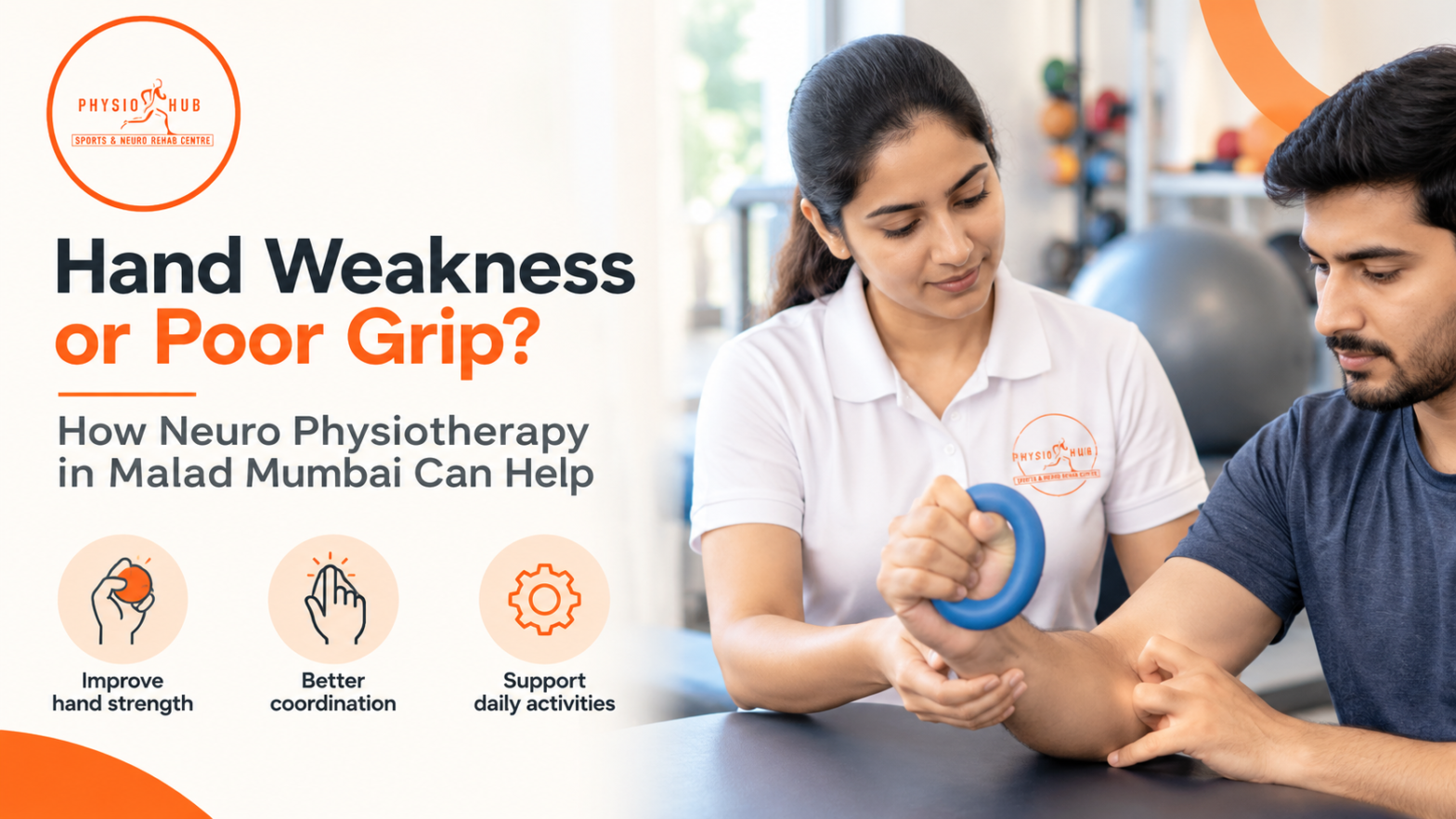
Have you started dropping your phone more often? Does opening a bottle, holding a cup, turning a key or buttoning a shirt feel harder than it used to? These may seem like small inconveniences, but when hand weakness or poor grip begins affecting everyday tasks, it deserves attention.

Hand function depends on more than muscle strength. Your brain, nerves, muscles, joints and coordination all need to work together. A change anywhere in this system may affect how firmly you grip an object or how accurately you move your fingers.

At PhysioHub, a physiotherapist in Malad, Mumbai assesses how your hand and arm are functioning rather than looking only at the symptom. For people with neurological movement difficulties, Neuro physio therapy in Malad may focus on strength, coordination, movement control and functional activities.

The aim is practical: helping you use your hand more confidently during the activities that matter in everyday life.

Can Neuro Physiotherapy Help With Hand Weakness and Poor Grip?

Neuro physiotherapy may help improve hand strength, coordination and functional movement when weakness or poor grip is associated with a neurological or nerve-related condition. Treatment begins with an assessment and may include strengthening, coordination exercises, task-specific practice and movement retraining based on the person’s abilities and rehabilitation goals.

What Is Neuro Physiotherapy for Hand Weakness?

Neuro physiotherapy is rehabilitation designed for people whose movement and physical function have been affected by the nervous system.

When the hand is involved, the problem may not simply be that the muscles are “weak.” A person may have difficulty activating certain muscles, coordinating the fingers, controlling the wrist or performing a precise movement.

For example, someone may have enough strength to squeeze a therapy ball but still struggle to pick up a coin or hold a spoon steadily.

A physiotherapist in Malad West may therefore assess the whole upper limb, including the shoulder, elbow, wrist, hand and fingers. The therapist may also look at sensation, coordination and how the hand performs during real tasks.

This helps create a rehabilitation programme based on what the person actually needs.

Hand weakness is not always only a strength problem. Neuro physiotherapy looks at strength, coordination, movement control and the ability to perform everyday tasks.

What Can Cause Weak Grip or Difficulty Holding Objects?

There are many possible reasons for changes in hand function. This is why an assessment matters before starting exercises on your own.

Possible factors may include:

  • Neurological conditions affecting movement and coordination
  • Recovery after a stroke or other neurological event
  • Peripheral nerve involvement
  • Reduced muscle activation or strength
  • Poor hand and finger coordination
  • Changes in sensation
  • Reduced wrist or finger mobility
  • Long periods of reduced hand use
  • Injury or recovery after surgery
  • Difficulty controlling the arm and hand together

You might first notice the problem during ordinary activities. A coffee mug suddenly feels heavier. Writing for several minutes becomes tiring. You struggle with buttons or zips. Objects occasionally slip from your hand.

These changes do not automatically indicate a serious neurological condition. However, persistent or worsening weakness should be medically assessed, particularly when it appears suddenly or occurs with other neurological symptoms.

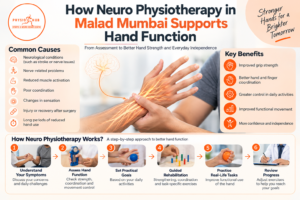
How Does Neuro Physiotherapy for Hand Function Work?

neurophysiotherapist in malad mumbai | physiohub

At a Neuro rehab centre in Malad Mumbai, rehabilitation should begin by understanding what the patient can currently do and which activities are difficult.

Step 1: Understanding Your Symptoms

Your physiotherapist may ask when the weakness started, whether one or both hands are affected and which everyday activities have become difficult.

Your medical history, previous injuries and neurological diagnosis, when applicable, are also important.

Step 2: Assessing Hand and Arm Function

The assessment may look at:

  • Grip and hand strength
  • Finger and wrist movement
  • Coordination
  • Muscle control
  • Upper-limb mobility
  • Functional use of the hand
  • Ability to grasp and release objects
  • Everyday activities that matter to the patient

Step 3: Setting Practical Goals

Goals should connect rehabilitation to daily life.

For one person, the goal might be holding a glass safely. For another, it could be writing, using a computer, cooking or returning to work.

Step 4: Guided Rehabilitation

Depending on the findings, Physiotherapy in Malad, Mumbai may involve strengthening exercises, coordination activities, repetitive task practice and functional movement training.

Exercises should be adjusted to the person rather than following the same routine for everyone.

Step 5: Practising Real-Life Tasks

Rehabilitation becomes more meaningful when it connects with everyday activities.

A therapist may incorporate safe practice involving gripping, reaching, holding, releasing or manipulating suitable objects. This can help bridge the gap between an exercise session and daily independence.

Step 6: Reviewing Progress

Hand function may change gradually. Regular reassessment allows the physiotherapist to adjust the difficulty and type of exercises according to progress.

Neuro rehabilitation usually follows a simple pathway: assess the problem, identify meaningful goals, practise targeted movements and gradually progress toward everyday activities.

What Are the Benefits of Neuro Physiotherapy for Hand Weakness?

The potential benefits depend on the underlying condition and severity of impairment. A personalised programme may support:

  • Better grip strength
  • Improved hand and finger coordination
  • Better control while grasping and releasing
  • Improved upper-limb movement
  • Greater confidence during daily activities
  • Better ability to practise functional tasks
  • Improved independence where achievable
  • Structured progression instead of random exercises

A Neuro rehab centre in Mumbai may also address other movement difficulties when hand weakness occurs alongside problems with walking, balance or general mobility.

Neuro Physiotherapy vs General Exercise: What’s the Difference?

Approach Neuro Physiotherapy General Exercise
Assessment Based on neurological and functional movement needs Usually general fitness focused
Programme Personalised to specific limitations Often follows a standard routine
Main focus Movement control, coordination and function General strength and fitness
Daily tasks Can include task-specific practice Usually not the main focus
Progression Adjusted according to response and goals Often based on exercise difficulty
Supervision Guided by a trained professional May be independent

General exercise can still play an important role in staying active. However, someone experiencing neurological hand weakness may need a more targeted approach.

Who May Need Neuro Physiotherapy for Hand Weakness?

Consider seeking professional assessment if you notice:

  • Your grip has become noticeably weaker
  • Objects frequently slip from your hand
  • One hand is harder to use than the other
  • Buttoning clothes has become difficult
  • Writing or typing has become harder
  • Holding cutlery or a cup feels challenging
  • Your fingers feel difficult to coordinate
  • Hand weakness is affecting work or hobbies
  • Hand function has changed after a neurological condition

Searching online for a Physiotherapist near me or Physiotheraphy near me may be a starting point, but the important part is finding care appropriate for your specific condition.

Sudden new weakness, particularly with facial drooping, speech difficulty, severe headache, confusion or weakness on one side of the body, requires urgent medical attention rather than waiting for a routine physiotherapy appointment.

How Much Does Neuro Physiotherapy Cost?

There is no single cost that applies to every neuro rehabilitation programme. The overall cost may vary depending on:

  • Initial assessment requirements
  • Complexity of the condition
  • Duration of each session
  • Frequency of therapy
  • Number of sessions required
  • Individual rehabilitation goals
  • Additional rehabilitation techniques required

Rather than choosing treatment based only on the lowest session price, consider whether the programme includes a detailed assessment, personalised goals and progress reviews.

For current pricing at PhysioHub, patients can contact the clinic directly before booking an assessment.

What Are the Neuro Physiotherapy Trends in 2026?

Neuro rehabilitation continues to move toward more personalised and function-focused care.

One important direction is task-specific rehabilitation. Instead of practising movement only in isolation, rehabilitation increasingly connects exercises with activities the patient actually wants or needs to perform.

Progressive strengthening, repetitive practice and measurable functional goals also remain important parts of modern rehabilitation.

Technology can support rehabilitation in selected settings, but it does not replace clinical assessment. The most useful programme is still one designed around the individual’s condition, abilities and goals.

For patients exploring physiotherapy in Mumbai, this means looking beyond equipment alone and asking how treatment will translate into better everyday function.

Why Choose PhysioHub in Malad Mumbai?

PhysioHub provides Physiotherapy Services in Malad, Mumbai for people with neurological, musculoskeletal and sports rehabilitation needs.

Care begins with an assessment so the rehabilitation plan can reflect the person’s movement difficulties and goals.

Depending on individual requirements, services include:

People searching for a physiotherapist in Malad, Sports Physiotherapist in Mumbai, Chiropractor in Mumbai, Chiropractor Near me or physiotherapy in Mumbai can consult PhysioHub in Malad West for an assessment based on their individual needs.

FAQs About Hand Weakness and Neuro Physiotherapy

1. Can neuro physiotherapy improve weak hand grip?

Neuro physiotherapy may help improve strength, coordination and functional hand use when weakness is related to a neurological or nerve-related condition. Results depend on the underlying cause, severity and individual response to rehabilitation.

2. Why do I keep dropping things from my hand?

Dropping objects can have several causes, including weakness, reduced coordination, sensory changes, pain or nerve-related problems. A professional assessment can help identify what may be affecting your grip.

3. What exercises are used for poor hand coordination?

Exercises vary according to the condition. They may include controlled gripping and releasing, finger movements, strengthening, coordination tasks and practice of everyday activities. Exercises should be selected after assessment.

4. How long does neuro physiotherapy take to improve hand function?

There is no fixed timeline. Recovery depends on the diagnosis, severity of impairment, general health, rehabilitation goals and response to therapy. Progress should be reviewed regularly.

5. When should I see a physiotherapist for hand weakness?

Consider an assessment when weakness persists, worsens or starts interfering with daily activities such as eating, dressing, writing or holding objects. Sudden weakness accompanied by other neurological symptoms requires urgent medical evaluation.

Take the Next Step Towards Better Hand Function

Small hand movements have a big role in everyday independence. If poor grip, weakness or reduced coordination is making routine tasks harder, getting the problem assessed can help you understand what is happening and what rehabilitation may be appropriate.

Visit PhysioHub, Malad West, Mumbai for personalised neurological rehabilitation with a physiotherapist in Malad, Mumbai. A structured assessment can help establish realistic goals and a rehabilitation plan focused on the activities that matter to you.

For more information contact

PhysioHub

Have you noticed small changes in your movement lately? Maybe walking feels slightly different, your balance is not as steady as before or simple daily tasks require more effort than they used to.

Many people ignore these signs thinking they are temporary. But when changes in strength, coordination or mobility start affecting daily life, getting the right guidance early can make a meaningful difference.

Neurological conditions, injuries or health changes can impact how the brain, nerves and muscles communicate with each other. This can lead to difficulty with walking, maintaining balance, controlling movements or performing routine activities.

A detailed assessment by a physiotherapist in Malad Mumbai can help understand the reason behind these challenges and create a personalised rehabilitation plan.

At Physiohub, neuro physiotherapy focuses on improving movement, strength, balance and functional independence through structured therapy approaches. Whether someone is recovering after a stroke, dealing with nerve-related weakness or facing mobility difficulties, the right rehabilitation support can help improve quality of life.

What is Neuro Physiotherapy Assessment?

A neuro physiotherapy assessment evaluates movement, muscle strength, balance, coordination and functional abilities in individuals experiencing neurological challenges. It helps identify specific limitations and creates a personalised rehabilitation plan to improve mobility, independence and daily functioning.


What is Neuro Physiotherapy Assessment?

A neuro physiotherapy assessment is a detailed evaluation process designed for individuals experiencing movement difficulties due to neurological conditions.

The nervous system controls how we move, balance and perform everyday activities. When communication between the brain, spinal cord, nerves and muscles is affected, it may result in weakness, stiffness, poor coordination or difficulty controlling movements.

During an assessment, a physiotheraphy in Malad West   studies how these changes are affecting daily activities and identifies areas that need attention.

The assessment may include:

  • Muscle strength evaluation
  • Balance and coordination testing
  • Walking and movement analysis
  • Posture assessment
  • Range of motion evaluation
  • Functional activity assessment

The goal is not only to identify the problem but also to understand how it impacts a person’s routine.

For example, a person recovering from a stroke may struggle with walking independently, while someone with a neurological condition may experience difficulty maintaining balance. A customised rehabilitation approach can address these specific concerns.


Why is a Neuro Physiotherapy Assessment Needed?

Small movement changes can sometimes indicate that the body needs additional support.

A professional assessment can help identify:

  • Changes in walking pattern or stability
  • Muscle weakness affecting daily activities
  • Difficulty maintaining balance
  • Reduced coordination
  • Stiffness or abnormal muscle tone
  • Challenges in performing routine movements
  • Reduced confidence while moving independently

Common conditions where neuro physiotherapy may help:

  • Stroke rehabilitation
  • Parkinson’s disease
  • Spinal cord injuries
  • Brain injuries
  • Multiple sclerosis
  • Nerve injuries
  • Balance disorders
  • Neurological movement problems

Ignoring these changes may make daily activities more challenging over time. Early evaluation allows therapists to understand the condition and provide suitable rehabilitation support.

Neuro physiotherapy helps with:

✓ Improving movement control
✓ Building strength and balance
✓ Supporting recovery after neurological conditions
✓ Enhancing independence in daily activities


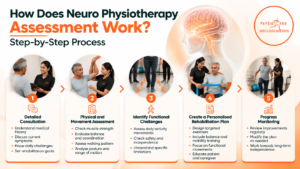
How Does Neuro Physiotherapy Assessment Work? Step-by-Step Process

neuro- physiotherapist | Physiohub

A neuro rehabilitation journey begins with understanding the person’s current abilities and challenges.

1. Detailed Consultation

The physiotherapist first discusses:

  • Medical history
  • Previous injuries or conditions
  • Current symptoms
  • Daily movement difficulties
  • Personal rehabilitation goals

This helps create a complete picture of the individual’s condition.

2. Physical and Movement Assessment

The therapist evaluates:

  • Muscle strength
  • Joint movements
  • Balance ability
  • Coordination
  • Walking pattern
  • Posture and body control

Every person’s movement pattern is different, so the assessment is personalised.

3. Identifying Functional Challenges

The focus is not only on exercises but also on daily activities.

For example:

  • Can the person walk safely?
  • Can they climb stairs?
  • Can they maintain sitting or standing balance?
  • Can they perform regular household activities?

4. Creating a Personalised Rehabilitation Plan

Based on the assessment, the physiotherapist develops a treatment approach that may include:

  • Therapeutic exercises
  • Balance training
  • Mobility exercises
  • Strengthening techniques
  • Functional movement training
  • Patient and caregiver education

5. Progress Monitoring

Recovery goals are reviewed regularly to understand improvement and modify the rehabilitation plan when needed.


Benefits of Neuro Physiotherapy

Neuro physiotherapy focuses on helping individuals regain better control over their movements and improve daily function.

Key benefits include:

  • Improved balance and coordination
  • Better muscle strength and flexibility
  • Enhanced walking ability
  • Increased confidence during movement
  • Improved functional independence
  • Better posture and body control
  • Support in returning to daily activities

For many patients and families, rehabilitation is not only about physical improvement. It is also about feeling more confident while performing everyday tasks.


Neuro Physiotherapy vs General Physiotherapy: Understanding the Difference

Aspect Neuro Physiotherapy General Physiotherapy
Main Focus Neurological movement challenges Musculoskeletal injuries and pain
Conditions Treated Stroke, nerve conditions, brain injuries Back pain, sports injuries, joint problems
Assessment Focuses on balance, coordination and nervous system function Focuses on muscles, joints and movement patterns
Treatment Goal Improve mobility and independence Reduce pain and restore physical function

Both approaches aim to improve movement, but the treatment strategy depends on the individual’s condition.

A specialised neuro physiotherapy in Malad approach is designed for people who require neurological rehabilitation support.


Who Needs a Neuro Physiotherapy Assessment?

A neuro physiotherapy assessment may be suitable for individuals experiencing:

  • Difficulty walking independently
  • Frequent balance problems
  • Weakness on one side of the body
  • Reduced coordination
  • Changes after stroke
  • Difficulty controlling movements
  • Muscle stiffness or unusual tightness
  • Problems with daily activities due to neurological conditions

Family members may also notice changes before the person experiencing them does.

For example, someone may start avoiding stairs, walking slower than usual or needing extra support during routine tasks. These small changes can be worth discussing with a professional.

A neuro rehab centre in Malad Mumbai can provide specialised evaluation and rehabilitation support based on individual needs.


Cost of Neuro Physiotherapy Assessment: Factors That Influence Pricing

The cost of neuro physiotherapy assessment and rehabilitation can vary depending on:

  • Type of neurological condition
  • Assessment complexity
  • Duration of therapy required
  • Treatment frequency
  • Rehabilitation goals
  • Techniques used during therapy

A detailed evaluation is important because every patient’s requirements are different. The focus should be on receiving appropriate care based on individual needs rather than following a standard approach.


Neuro Physiotherapy Trends in 2026

Neuro rehabilitation is becoming more personalised with advancements in assessment techniques and therapy methods.

Some emerging trends include:

  • Greater focus on personalised rehabilitation programs
  • Technology-supported movement assessment
  • Functional training based on real-life activities
  • Early rehabilitation approaches after neurological events
  • Increased awareness about preventive care and mobility support

Modern physiotherapy is moving beyond basic exercises. The focus is now on helping individuals regain confidence and independence in everyday life.


Why Choose Physiohub for Neuro Physiotherapy in Malad Mumbai?

Choosing the right rehabilitation centre matters when dealing with movement and neurological challenges.

Physiohub provides personalised physiotherapy services in Malad, Mumbai with a focus on assessment-based treatment planning.

The approach includes:

  • Detailed movement evaluation
  • Individualised rehabilitation programs
  • Advanced physiotherapy techniques
  • Patient-focused care
  • Guidance for improving daily movement patterns

At Physiohub, treatment is designed around individual movement needs with specialised services like Chiropractor in Malad, Osteopathy in Malad , and neuro rehab centre in Malad Mumbai  Whether you are dealing with spinal discomfort, joint mobility issues or recovering after an ACL injury, our personalised approach focuses on improving movement, strength and overall function. Along with Chiropractor in Mumbai, osteopathy in Malad, and sports rehabilitation support, Physiohub helps patients work towards better mobility with expert physiotherapy guidance. For quality physiotherapy in Malad Mumbai, a trusted physiotherapist in Malad West, or a reliable physiotherapist near me in Mumbai, Physiohub provides comprehensive rehabilitation solutions.

Whether you are looking for a physiotherapist in Mumbai, a specialised neuro rehab centre in Mumbai or support for neurological movement challenges, getting the right assessment is an important first step.


FAQs About Neuro Physiotherapy Assessment

1. What does a neuro physiotherapy assessment include?

A neuro physiotherapy assessment includes evaluation of muscle strength, balance, coordination, posture, walking ability and functional movements to understand rehabilitation needs.

2. When should someone visit a neuro physiotherapist?

A person should consider visiting a neuro physiotherapist if they experience balance issues, weakness, difficulty walking, coordination problems or changes in daily movement abilities.

3. Can neuro physiotherapy help after a stroke?

Yes, neuro physiotherapy can support stroke recovery by focusing on improving movement control, strength, balance and independence in daily activities.

4. How long does neuro rehabilitation take?

The duration depends on factors such as the condition, severity, individual progress and rehabilitation goals. A physiotherapist can suggest a suitable plan after assessment.

5. Where can I find a neuro physiotherapist near me in Malad?

If you are looking for a physiotherapist near me { POOJA MEHTA G POST LINK }or neuro rehabilitation support, Physiohub provides assessment and physiotherapy services in Malad Mumbai.


Take the First Step Towards Better Movement

Small changes in movement should not be ignored when they begin affecting everyday life.

A timely assessment can help understand the cause and guide the right rehabilitation approach.

Connect with Physiohub, your trusted physiotherapist in Malad, Mumbai, for personalised neuro physiotherapy assessment and movement support.

Book your consultation today and take a step towards improved mobility and confidence.

For more information contact:

PhysioHub

Can Physiotherapy Help Balance Problems? For many people, the answer depends on what is causing the unsteadiness in the first place. Feeling unstable while walking, stumbling often, or worrying about falling can slowly affect confidence and independence. These issues may be linked to muscle weakness, reduced coordination, joint stiffness, neurological conditions, or changes in walking patterns.Balance problems can happen because of muscle weakness, reduced coordination, joint stiffness, neurological conditions, or changes in walking patterns. If you are looking for a Physiotherapist in Malad Mumbai for Balance Problems, an assessment can help identify what is affecting your stability and movement.

Balance problems are not always caused by age alone. Muscle weakness, reduced coordination, joint stiffness, poor vision, nerve problems, neurological conditions, medication effects, and changes in walking patterns can all contribute.

Globally, falls remain a major health concern. The World Health Organization estimates that around 37.3 million falls each year are serious enough to require medical attention, with adults over 60 experiencing the greatest number of fatal falls.

Working with a physiotherapist in Malad, Mumbai can help identify the movement-related factors affecting your stability. At PhysioHub, rehabilitation is planned around the individual rather than using the same set of exercises for everyone.

The goal is simple: help you move with more control, confidence, and independence.

 Can Physiotherapy Help With Balance Problems and Frequent Falls?

Yes. Physiotherapy can help people with balance problems by assessing strength, walking, coordination, mobility, and movement control. Treatment may include balance exercises, strengthening, gait training, functional exercises, and neurological rehabilitation. The exact programme depends on the cause of the balance problem, the person’s abilities, and their individual rehabilitation goals.

What is Balance Rehabilitation for Frequent Falls?

Balance rehabilitation is a structured physiotherapy approach designed to improve the way your body controls movement while standing, walking, turning, reaching, or changing direction.

Good balance depends on several systems working together. Your muscles need enough strength to support your body, while your joints require good mobility for controlled movement. At the same time, the brain and nerves process information from the eyes, inner ear, and body position to help maintain balance.

When one or more of these systems are affected, a person may feel unstable.

A physiotherapist in Malad, Mumbai may therefore assess more than whether you can simply “stand on one leg.” The assessment can look at walking speed, turning, lower-limb strength, coordination, posture, reaction to movement, and your confidence during everyday activities.

For people living with neurological conditions, Neuro physiotherapy in Malad may also focus on retraining movement patterns and improving functional independence.

What Causes Balance Problems and Frequent Falls?

There is rarely one reason that applies to everyone. Common factors include:

  • Weakness in the legs, hips, or core muscles
  • Reduced ankle or hip mobility
  • Difficulty coordinating movements
  • Changes after a stroke or neurological condition
  • Parkinson’s disease and other movement disorders
  • Peripheral nerve problems
  • Reduced sensation in the feet
  • Poor posture or altered walking patterns
  • Joint pain that changes the way a person walks
  • Vision or inner-ear problems
  • Fear of falling after a previous fall
  • Reduced activity following illness, surgery, or prolonged bed rest
  • Certain medicines or multiple medical conditions

Current NICE guidance recommends considering factors such as gait, balance, mobility, muscle strength, neurological findings, vision, hearing, medication, footwear, long-term conditions, and concerns about falling when a comprehensive falls assessment is required.

This matters because giving everyone the same “balance exercises” may miss the actual reason they are struggling.

Imagine someone who feels fine walking straight ahead but becomes unsteady whenever they turn quickly. Another person may struggle mainly when getting out of a chair. Their rehabilitation needs may be very different.

How Does Physiotherapy for Balance Problems Work?

Physiotherapist in malad mumbai | Physiohub

Treatment usually starts with understanding why you are losing balance.

Step 1: Discuss your symptoms and fall history

Your physiotherapist may ask:

  • When did the balance problem begin?
  • Have you fallen recently?
  • Do you feel dizzy or simply unstable?
  • Does the problem happen indoors, outdoors, or on stairs?
  • Are you recovering from a stroke or another neurological condition?
  • Has your confidence in walking changed?

Even a fall that did not cause an injury can be worth discussing.

Step 2: Assess your movement

The assessment may include:

  • Walking pattern
  • Standing balance
  • Lower-limb strength
  • Joint mobility
  • Coordination
  • Transfers such as sitting to standing
  • Turning and changing direction
  • Ability to step over obstacles
  • Functional activities related to your daily routine

If neurological symptoms are present, a Neuro rehab centre in Malad may provide a more focused assessment of movement control and functional ability.

Step 3: Identify the main problems

For one person, weak hip muscles may be a major factor. For another, the challenge may be coordination after a stroke.

Understanding the cause allows rehabilitation to become more specific.

Step 4: Begin progressive exercises

Exercises may include:

  • Supported standing activities
  • Weight shifting
  • Stepping exercises
  • Strength training
  • Walking practice
  • Direction changes
  • Coordination exercises
  • Functional tasks
  • Controlled obstacle practice

Modern falls guidance supports progressive exercise programmes tailored to a person’s abilities and goals, with attention to balance, coordination, strength, and power.

Step 5: Gradually increase difficulty

Holding onto a support may be appropriate at first. As control improves, the task may be progressed safely.

The goal is not to perform complicated exercises for the sake of it. The goal is to make daily movement easier and safer. Balance rehabilitation usually involves assessment, identifying the cause of instability, targeted exercises, walking practice, and regular progression. The programme should match the person’s condition, confidence, and everyday movement needs.

What Are the Benefits of Physiotherapy for Balance Problems?

A personalised Physiotherapy in Malad programme may help with:

  • Improving leg and core strength
  • Developing better standing control
  • Improving coordination
  • Practising safer walking
  • Building confidence while turning or changing direction
  • Improving sit-to-stand movements
  • Practising stairs and everyday tasks
  • Improving mobility after neurological conditions
  • Reducing fear around movement
  • Supporting greater independence

One important benefit is confidence.

Someone who has fallen before may begin avoiding activity because they are worried it will happen again. But less movement can sometimes lead to further weakness.

Professional rehabilitation can create a safer environment to gradually rebuild movement confidence rather than simply telling someone to “be more careful.”

Physiotherapy vs Other Options for Balance Problems

Different treatments serve different purposes.

Approach Main Focus When It May Be Considered
Physiotherapy Strength, balance, walking and functional movement Weakness, reduced mobility, altered gait and movement problems
Neuro physiotherapy Movement affected by neurological conditions Stroke, Parkinson’s disease and other neurological problems
Medical assessment Identifying medical causes New symptoms, unexplained falls, dizziness or medication-related concerns
Occupational therapy Daily activities and home safety Difficulty managing daily tasks or environmental fall risks
Chiropractic care Mainly musculoskeletal assessment and management Selected joint or mechanical musculoskeletal concerns
Osteopathy Musculoskeletal assessment and manual approaches Selected mobility and musculoskeletal problems

A Chiropractor in Malad,Mumbai or osteopathy in Malad may be appropriate for certain musculoskeletal concerns, but they are not automatically substitutes for neurological or falls assessment.

Similarly, a Sports Physiotherapist in Mumbai may be especially relevant when balance or movement problems are related to a sports injury rather than a neurological condition.

The right approach depends on what is actually causing the problem.

Who Needs Physiotherapy for Balance Problems?

Consider an assessment if you or a family member:

  • Has fallen more than once
  • Frequently trips or stumbles
  • Feels unstable while walking
  • Needs furniture or walls for support
  • Has difficulty turning quickly
  • Feels unsure on stairs
  • Has become weaker after hospitalisation
  • Has reduced mobility after stroke
  • Has Parkinson’s disease or another neurological condition
  • Avoids going outside because of fear of falling
  • Has difficulty standing up from a chair
  • Has noticed a major change in walking

The 2025 NICE falls guideline recommends comprehensive assessment for certain higher-risk people, including those with two or more falls in the previous year, and gait and balance assessment when impairment is present

However, sudden severe balance problems should not simply be treated as a physiotherapy issue. New one-sided weakness, facial drooping, speech difficulty, loss of consciousness, sudden severe headache, or sudden inability to walk requires urgent medical evaluation.

How Much Does Balance Physiotherapy Cost in Malad?

There is no single price that applies to every patient because rehabilitation needs can differ considerably.

Pricing may depend on:

  • Initial assessment duration
  • Complexity of the condition
  • Whether neurological rehabilitation is required
  • Length of each session
  • Frequency of treatment
  • Need for specialised equipment
  • Home-based versus clinic-based sessions
  • Duration of the rehabilitation programme

For example, someone with mild weakness after a period of inactivity may need a very different plan from someone recovering from a stroke.

A consultation with a physiotherapist in Malad, Mumbai can help determine the type and likely frequency of rehabilitation before committing to a longer programme.

Treatment packages should ideally follow an assessment rather than being chosen only by session count.

What Are the Balance Rehabilitation Trends in 2026?

Balance rehabilitation is becoming increasingly personalised rather than relying only on general exercise sheets.

1. More objective movement tracking

Wearable devices and movement sensors are being explored for monitoring mobility, balance, and fall-related movement patterns.

A 2026 review of fall-detection and prevention technologies highlighted growing use of wearable and environmental sensors for fall-related monitoring

2. Wearable feedback during rehabilitation

Research published in 2025 also described smart wearable systems that can provide movement data and real-time feedback during balance rehabilitation, although accessibility, accuracy, and cost remain important considerations.

3. More individualised exercise plans

Current clinical guidance emphasises progressive exercise based on a person’s specific needs, preferences, abilities, and goals rather than using the same programme for everyone

4. Greater focus on real-life movement

Modern rehabilitation increasingly connects exercises with daily tasks—getting out of a chair, turning, walking outdoors, climbing steps, or navigating obstacles.

Technology can support rehabilitation, but it does not replace clinical assessment. The person’s needs still come first.

Why Choose PhysioHub in Malad, Mumbai?

At PhysioHub, balance rehabilitation begins by understanding the person behind the symptoms.

Someone recovering after a stroke may want to walk independently around their home again. An older adult may simply want to feel confident visiting the market without worrying about falling. These goals matter because rehabilitation should connect with real life.

PhysioHub provides access to Physiotherapy in Malad and neurological rehabilitation with treatment plans based on assessment, movement ability, and individual goals.

Patients looking for a Neuro rehab centre in Malad , Mumbai or Neuro physio therapy in Malad can receive structured rehabilitation focused on mobility, strength, coordination, walking, and functional independence.

PhysioHub also provides broader rehabilitation services for people searching for a physiotherapist in Mumbai, including sports rehabilitation and ACL rehab in Malad,Mumbai  Where appropriate for separate musculoskeletal concerns, services such as a Chiropractor in Malad and osteopathy in Malad, Mumbai may form part of a broader care approach.

The aim is not simply to complete exercises. It is to help patients use those improvements when standing, walking, working, exercising, or managing everyday activities.

FAQs

1. Can physiotherapy improve poor balance?

Yes. Physiotherapy can address movement-related factors such as weakness, coordination, walking difficulty, reduced mobility, and poor postural control. The treatment plan depends on the underlying cause.

2. What exercises are used for balance problems?

Exercises may include weight shifting, strengthening, stepping, controlled standing, walking practice, direction changes, coordination work, and functional activities. Exercises should be selected and progressed according to the individual’s ability.

3. When should I see a physiotherapist after a fall?

Consider an assessment if you have repeated falls, ongoing unsteadiness, difficulty walking, reduced confidence, or weakness after a fall. Falls involving injury, loss of consciousness, or sudden neurological symptoms require appropriate medical assessment.

4. Can neuro physiotherapy help after a stroke?

Neuro physiotherapy can support recovery of movement, strength, coordination, walking, balance, and functional activities after stroke. Progress varies depending on the type and severity of neurological impairment and other individual factors.

5. How long does balance rehabilitation take?

There is no fixed timeline. Someone with mild weakness may progress differently from a person recovering from a neurological condition. Your physiotherapist can reassess progress and adjust the programme as your abilities change.

Take the First Step Towards Better Balance

You should not have to accept repeated falls or constant unsteadiness as something you simply have to live with.

If walking feels less secure, you have experienced repeated falls, or a neurological condition has affected your movement, consider an assessment with a physiotherapist in Malad, Mumbai at PhysioHub.

A personalised rehabilitation plan can focus on the areas that matter most to you—whether that means walking more confidently, improving strength, managing stairs, or becoming more independent in everyday life.

Book an appointment with PhysioHub in Malad West, Mumbai, for personalised balance, mobility, and neuro rehabilitation support.

Dealing with back pain, neck stiffness, joint discomfort, or a sports injury can make even simple daily activities feel difficult. Many people also get confused about whether they should visit a chiropractor or choose physiotherapy first. Understanding Chiropractic Care vs Physiotherapy in Malad can help you make a better decision based on your symptoms, movement problems, and recovery goals. Chiropractic care usually focuses more on improving joint and spinal mobility through hands-on techniques, while physiotherapy often combines exercises, strengthening, mobility work, movement correction, and rehabilitation.

If you are searching for a physiotherapist in Malad, Mumbai, the right treatment should not be chosen only by the name of the therapy. It should begin with a proper assessment of your strength, flexibility, posture, movement, pain triggers, and daily routine.

At PhysioHub in Malad Mumbai, treatment is planned around the individual. Whether you need physiotherapy, chiropractic care, sports rehabilitation, or neuro rehabilitation, the aim is to help you move better and return to your daily activities with greater confidence.

That is often when people begin searching for a physiotherapist in Malad, Mumbai or wondering whether they should visit a chiropractor instead.

Both chiropractic care and physiotherapy can support movement and recovery, but they work in different ways. Chiropractic treatment often focuses more on joint and spinal mobility through hands-on techniques. Physiotherapy usually takes a broader rehabilitation approach involving exercises, strength, mobility, balance, movement training, education, and functional recovery.

So which one should you choose?

The answer depends on your symptoms, physical assessment, activity level, medical history, and goals. At PhysioHub in Malad Mumbai, the aim is to first understand why movement has become difficult and then choose the right combination of care for your needs.

Chiropractic Care vs Physiotherapy

Chiropractic care mainly focuses on improving joint and spinal mobility using hands-on techniques, while physiotherapy combines exercise, strengthening, mobility work, movement correction, education, and rehabilitation. The right option depends on your symptoms, injury, physical assessment, activity level, and recovery goals. In some cases, both approaches may complement each other.

What is Chiropractic Care vs Physiotherapy?

Chiropractic care is a hands-on approach commonly used for musculoskeletal problems involving the spine, joints, and restricted movement. Depending on the person, treatment may include joint mobilisation, manipulation, soft-tissue techniques, and movement advice.

Physiotherapy focuses on improving movement, strength, physical function, and independence. A therapist may use exercises, strengthening, manual therapy, balance work, mobility training, gait training, posture correction, and activity-specific rehabilitation.

Imagine someone who works at a desk for eight hours every day and develops recurring neck stiffness.

Hands-on treatment may help improve restricted joint movement. But what if weak upper-back muscles, long sitting hours, and poor movement habits are also contributing to the problem? In that case, exercise and lifestyle changes may be just as important.

This is why good Physiotherapy in Malad does not focus only on the painful area. It looks at how your whole body moves and what may be keeping the problem going.

Why Does the Difference Between Chiropractic Care and Physiotherapy Matter?

The difference matters because the same symptom can have different causes.

Two people may both complain of lower back pain, but one may have limited spinal movement while the other may have weakness, poor lifting technique, reduced activity tolerance, or a combination of these factors.

Your treatment may depend on:

  • Type of problem: A sports injury needs a different plan from long-term neck stiffness.
  • Muscle strength: Weak muscles may reduce joint control during everyday movement.
  • Joint mobility: Restricted movement may make tasks such as turning, bending, or reaching uncomfortable.
  • Balance: Balance training may be important after neurological conditions or injury.
  • Work habits: Long sitting hours, repetitive work, and poor movement variety can influence symptoms.
  • Previous surgery: Recovery often requires gradual strengthening and functional training.
  • Sports demands: A runner, footballer, or gym-goer may need sport-specific rehabilitation.
  • Neurological conditions: Stroke or other neurological problems may affect walking, coordination, and movement control.

For example, someone searching for a Chiropractor in Malad ,Mumbai  because their back feels stiff every week may need more than repeated hands-on treatment. Strengthening, mobility exercises, movement education, and activity changes may also be useful.

The best approach is usually the one based on assessment rather than assumptions.

How Do Chiropractic Care and Physiotherapy Work?

 Physiotherapist in malad mumbai | Physiohub

Treatment should begin by understanding the problem before deciding what technique to use.

Step 1: Your symptoms are discussed

Your therapist may ask:

  • When did the pain or stiffness begin?
  • What movements make it worse?
  • Does anything relieve it?
  • Have you had an injury or surgery?
  • Does the problem affect work, sleep, walking, or exercise?
  • What would you like to return to comfortably?

These questions may sound simple, but they help build a clearer picture of what is affecting you.

Step 2: Your movement is assessed

Depending on your condition, the therapist may check:

  • Joint movement
  • Muscle strength
  • Flexibility
  • Balance
  • Walking pattern
  • Posture
  • Functional activities
  • Sports movements
  • Neurological function

A Sports Physiotherapist in Mumbai, for example, may assess jumping, running, landing, or change-of-direction ability before deciding whether an athlete is ready to return to sport.

Step 3: Contributing factors are identified

Pain is not always coming from one isolated area.

Knee pain during running may sometimes be influenced by hip strength, ankle mobility, training load, or movement control.

Likewise, shoulder pain may involve weakness, limited mobility, repetitive overhead work, or poor load management.

Step 4: Treatment is personalised

Physiotherapy may include:

  • Strengthening exercises
  • Mobility exercises
  • Manual therapy
  • Movement retraining
  • Balance exercises
  • Gait training
  • Home exercises
  • Return-to-work or return-to-sport planning

Chiropractic care may include joint mobilisation or manipulation where suitable after assessment.

For lower back pain, NICE guidance recommends considering manual therapy such as mobilisation or spinal manipulation only as part of a treatment package that also includes exercise.

Step 5: Treatment progresses with you

Rehabilitation should not stay the same from the first visit to the last.

As your strength, confidence, and movement improve, exercises can gradually become more challenging.

Someone completing ACL rehab in Malad, for example, may move from early knee mobility and muscle activation to strength work, balance drills, jumping, running, and eventually sport-specific movements.

Chiropractic care often focuses on restoring joint and spinal mobility, while physiotherapy usually combines movement, strengthening, exercise, and rehabilitation. In many cases, hands-on care works best when it is supported by active rehabilitation.

What Are the Benefits of Chiropractic Care and Physiotherapy?

The exact benefits depend on your condition and treatment plan, but rehabilitation may help you:

  • Improve joint mobility
  • Build muscle strength
  • Improve flexibility
  • Improve balance and coordination
  • Move with greater confidence
  • Return to work or daily activity
  • Recover after sports injuries
  • Improve walking ability
  • Regain function after surgery
  • Prepare safely for return to sport
  • Understand movements that trigger symptoms
  • Reduce repeated overload during daily activities

For a person recovering from a neurological condition, the goals may look very different.

At a Neuro rehab centre in Malad,Mumbai  treatment may focus on walking, balance, coordination, muscle control, transfers, and functional independence.

WHO estimates that around one in three people worldwide lives with a condition that could benefit from rehabilitation, showing how broad the need for rehabilitation has become.

Chiropractic Care vs Physiotherapy: What’s the Difference?

Area Chiropractic Care Physiotherapy
Main focus Joint and spinal mobility Movement, strength and function
Common methods Mobilisation, manipulation, manual techniques Exercise, strengthening, mobility, manual therapy and rehabilitation
Exercise May be included Usually a major part of treatment
Sports rehabilitation May support mobility Commonly includes progressive sports rehabilitation
Post-surgery rehabilitation Usually not the main focus Frequently used
Neurological rehabilitation Generally limited A major area within physiotherapy
Balance and gait training Less commonly used Common where required
Long-term approach Mobility and movement support Strength, function, independence and movement capacity

Neither approach automatically replaces the other.

For some people, improving joint mobility may be useful first. For others, strength and movement training may be the bigger priority.

The important question is not, “Which one is better?”

A better question is, “What does my body actually need?”

Who Is a Good Candidate / Who Needs This?

You may benefit from assessment if you are dealing with:

  • Recurring back or neck discomfort
  • Joint stiffness
  • Restricted movement
  • Sports injuries
  • Muscle weakness
  • Balance problems
  • Walking difficulties
  • Reduced confidence after injury
  • Recovery after orthopaedic surgery
  • Neurological movement problems
  • Difficulty returning to exercise
  • Posture-related discomfort
  • Repeated ankle or knee injuries

Someone recovering from ligament surgery may need structured ACL rehab in Malad, Mumbai 

A person recovering after a stroke may benefit more from Neuro physiotherapy in Malad, Mumbai  where the focus may include repeated movement practice, walking, strength, balance, and functional activities.

Someone with stiffness or movement restriction may also ask about osteopathy in Malad or chiropractic care as part of a broader rehabilitation plan.

When should you seek medical care first?

Some symptoms should not be treated like routine muscle pain.

Seek medical assessment if you develop severe or rapidly increasing weakness, loss of bladder or bowel control, major trauma, unexplained fever, unexplained weight loss, or worsening neurological symptoms.

What Does Chiropractic Care or Physiotherapy Cost in Malad, Mumbai?

There is no standard price that applies to every patient because rehabilitation needs vary.

The cost of seeing a physiotherapist in Malad, Mumbai may depend on:

  • Initial assessment
  • Type of injury
  • Complexity of the condition
  • Session duration
  • Sports rehabilitation requirements
  • Neurological rehabilitation needs
  • Manual treatment required
  • Equipment or technology used
  • Number of sessions
  • One-to-one rehabilitation needs

A person with mild neck stiffness may need a very different plan from someone recovering after ACL surgery or stroke.

Instead of looking only at the price per session, ask what the treatment includes.

Will your strength be assessed? How will progress be tracked? Can your exercise plan change as you improve?

Those details often matter more than simply comparing session rates.

What Are the Physiotherapy and Rehabilitation Trends in 2026?

Physiotherapy in 2026 is increasingly moving toward personalised, active, and goal-based rehabilitation.

Patients are no longer expected to simply receive passive treatment while lying on a treatment table. Modern care often encourages people to become active participants in their recovery.

Important trends include:

  • Exercise-led rehabilitation: Strength and gradual loading are becoming central parts of many treatment plans.
  • Movement assessment: Therapists increasingly assess how people walk, run, lift, squat, or perform sport-specific tasks.
  • Return-to-sport testing: Athletes may be assessed for strength, balance, movement control, and confidence before returning.
  • Technology-supported rehabilitation: Digital exercise tracking and objective testing can help monitor progress.
  • Integrated care: Physiotherapy, chiropractic care, manual therapy, and osteopathy in Malad, Mumbai  may be combined where clinically appropriate.
  • Growing neurological rehabilitation needs: Stroke and neurological conditions continue to increase the need for structured rehabilitation.

WHO reports that low back pain affected about 619 million people globally in 2020 and remains the leading cause of disability worldwide.

This is one reason rehabilitation is increasingly focused not only on temporary pain relief, but also on restoring movement and function.

Why Choose PhysioHub in Malad, Mumbai?

At PhysioHub, treatment begins with understanding the person, not simply naming the painful body part.

Someone visiting for back stiffness may need a very different plan from an athlete returning after injury.

A desk professional may require mobility work, strengthening, manual therapy, and changes to daily habits.

An athlete may need support from a Sports Physiotherapist in Mumbai with progressive strength work and return-to-sport training.

A person recovering after stroke may need structured rehabilitation through a Neuro rehab centre in Malad, focusing on balance, walking, coordination, and independence.

PhysioHub provides access to services including Physiotherapy in Malad, Chiropractor in Malad, osteopathy in Malad, sports rehabilitation, ACL rehab in Malad, and Neuro physio therapy in Malad.

If you are searching for a physiotherapist in Mumbai, it helps to choose a clinic where progress is assessed and treatment can evolve as your body improves.

The goal is simple: help you return to the activities that matter to you with better movement, strength, and confidence.

If you’re searching for physiotherapy near me, PhysioHub in Malad West offers personalised care for back pain, neck pain, sports injuries, post-surgery recovery, and movement problems. A proper assessment helps identify what is causing the issue so the right mix of exercises, mobility work, manual therapy, and rehabilitation can be planned for your recovery.

FAQs

1. Should I see a chiropractor or physiotherapist for back pain?

It depends on what is contributing to your pain. Chiropractic care may focus on joint and spinal mobility, while physiotherapy commonly includes exercise, strengthening, mobility work, and education. An assessment can help identify the most appropriate approach.

2. Can physiotherapy and chiropractic care be combined?

Yes. For some patients, hands-on techniques may help improve mobility while physiotherapy exercises work on strength, movement control, and long-term function.

3. Is chiropractic care only used for back pain?

No. Chiropractic techniques may also be used for certain musculoskeletal and joint mobility concerns. However, treatment should always depend on assessment and clinical suitability.

4. How many physiotherapy sessions will I need?

There is no fixed number. The duration of treatment depends on the condition, how long symptoms have been present, strength, activity level, surgery history, rehabilitation goals, and how you respond to treatment.

5. When should I see a sports physiotherapist?

Consider seeing a sports physiotherapist if pain or injury is limiting training, strength, running, jumping, or performance. A Sports Physiotherapist in Mumbai can assess the problem and guide a gradual return to activity.

Start Your Recovery With PhysioHub

Still wondering whether you need physiotherapy, chiropractic care, sports rehabilitation, osteopathy, or neurological rehabilitation?

You do not need to figure it out alone.

Start with a proper assessment at PhysioHub in Malad Mumbai. Your symptoms, movement, strength, lifestyle, and goals can be assessed before a personalised rehabilitation plan is recommended.

If you are looking for a trusted physiotherapist in Malad, Mumbai, contact PhysioHub and take the next step toward moving more comfortably and confidently.

Sciatica can turn ordinary moments into uncomfortable ones. Sitting through a workday, getting out of the car, bending to wear shoes, or even sleeping comfortably can become difficult when pain travels from the lower back into the hip or leg. Some people describe it as a burning sensation. Others feel tingling, numbness, weakness, or a sharp electric-like pain running down one side. The natural question is: should you rest, exercise, visit a physiotherapist in Malad, Mumbai, or consult a Chiropractor in Malad

There is no single treatment that is right for everyone. Sciatica is a symptom linked to irritation or pressure around the sciatic nerve, and treatment should depend on what is causing that irritation, how long symptoms have been present, and whether there is weakness or loss of function.

At PhysioHub, the focus of Physiotherapy in Malad is not simply temporary pain relief. A proper assessment looks at movement, strength, nerve-related symptoms, posture, daily activities, and the factors that may be slowing recovery.

 When Should You Consider Physiotherapy or Chiropractic Care for Sciatica?

You should consider physiotherapy for sciatica when pain, tingling, numbness, or restricted movement persists, affects daily activities, or keeps returning. Chiropractic or manual therapy may help selected patients, but evidence-based guidelines recommend combining manual techniques with exercise, education, and an individual rehabilitation programme rather than relying on manipulation alone.

What Is Sciatica?

Sciatica describes pain and other symptoms caused by irritation or compression of the sciatic nerve or the nerve roots that form it.

The sciatic nerve runs from the lower back through the buttock and down the leg. When one of the nerve roots becomes irritated, symptoms may travel along this pathway.

A slipped or herniated disc is one of the most common causes. Spinal narrowing, known as spinal stenosis, spondylolisthesis, and certain back injuries may also contribute

Sciatica may cause:

  • Lower back or buttock pain
  • Pain travelling into the thigh, calf, or foot
  • Tingling or pins and needles
  • Numbness
  • Leg or foot weakness
  • Difficulty sitting, bending, walking, or lifting

Not everyone with lower back pain has sciatica. That is why an assessment with a qualified physiotherapist in Malad, Mumbai can be useful before starting random exercises found online.

What Causes Sciatica and Why Is Proper Assessment Important?

Two people may both say, “My sciatica is painful,” yet the reason behind their symptoms can be very different.

Common causes and contributing factors include:

  • Disc irritation or herniation: A spinal disc may irritate a nearby nerve root.
  • Spinal stenosis: Reduced space around spinal nerves may contribute to symptoms.
  • Spondylolisthesis: One vertebra can move relative to another and irritate nearby structures.
  • Reduced strength and movement tolerance: Long periods of inactivity may make returning to normal movement harder.
  • Repeated bending or lifting: Certain repeated movements may aggravate an already sensitive nerve.
  • Previous back injury: An earlier injury may influence movement patterns and load tolerance.

A good assessment also checks whether symptoms actually fit a typical sciatica pattern.

For example, imagine someone who develops leg pain after sitting at a desk for eight hours every day. Another person may experience symptoms only while walking for ten minutes. Their treatment programmes should not automatically look the same.

NICE recommends assessment, self-management advice, maintaining normal activities where possible, and exercise selected according to the person’s needs and abilities. Routine scans are not recommended for every person with low back pain or sciatica unless imaging is likely to change management.

How Does Physiotherapy for Sciatica Work Step by Step?

Step 1: Detailed Assessment

Your physiotherapist first asks where the pain starts, where it travels, what movements aggravate it, and whether numbness or weakness is present.

Movement, spinal mobility, leg strength, flexibility, balance, and functional tasks may also be assessed.

Step 2: Identify Irritating Movements

The aim is not necessarily to avoid movement altogether.

Instead, the therapist identifies which positions or activities increase symptoms and how they can be temporarily modified while recovery progresses.

Step 3: Begin Appropriate Movement

Gentle movement is usually encouraged rather than prolonged bed rest. The NHS advises people with sciatica to remain active as much as possible and gradually introduce exercise.

Exercises may focus on mobility, strength, trunk control, hip function, or nerve-related movement depending on the assessment.

Step 4: Add Manual Therapy When Appropriate

Manual therapy may include joint mobilisation, selected spinal manipulation, or soft-tissue techniques.

This is where a Chiropractor in Malad may be considered for suitable patients. However, current NICE guidance recommends manual therapy only as part of a broader programme that includes exercise rather than as a stand-alone treatment.

Step 5: Gradually Return to Normal Activity

Treatment should eventually help you return to work, walking, exercise, sport, or other activities without constantly worrying about triggering symptoms. Sciatica rehabilitation is usually more effective when treatment is based on an individual assessment. Exercise, education, gradual activity, and selected hands-on techniques may work together rather than relying on one treatment alone.

What Are the Benefits of Physiotherapy for Sciatica?

A structured programme of Physiotherapy in Malad may help patients:

  • Reduce pain-related movement restriction
  • Improve spinal and hip mobility
  • Restore leg and core strength
  • Improve confidence during bending and walking
  • Return gradually to work and exercise
  • Understand which movements are safe
  • Reduce unnecessary fear of activity
  • Build a long-term self-management routine

WHO describes exercise, education, some physical therapies, and person-centred care as important parts of non-surgical management for persistent low-back problems. It also notes that low back pain affected around 619 million people globally in 2020, highlighting how widespread these conditions are.

Physiotherapy vs Chiropractic Care vs Other Options for Sciatica

Approach Main Focus When It May Be Considered
Physiotherapy Exercise, movement, strength, education and functional recovery Persistent pain, movement limitation, weakness or recurring symptoms
Chiropractic/manual therapy Mobilisation or manipulation of selected joints May complement exercise in appropriately assessed patients
Osteopathy Hands-on assessment and movement-based treatment Selected musculoskeletal problems as part of broader management
Medication Short-term symptom management When recommended by a doctor or pharmacist
Specialist medical care Imaging, injections or surgery where appropriate Severe, progressive or persistent cases that require further investigation

If you are considering osteopathy in Malad, physiotherapy, or chiropractic care, the important question is not simply which treatment sounds stronger. It is whether the chosen treatment matches your symptoms and clinical findings.

Who Is a Good Candidate for Physiotherapy or Chiropractic Care?

You may benefit from seeing a physiotherapist in Malad, Mumbai if:

  • Sciatica has lasted for several weeks Physiotherapy in mumbai | Physiohub
  • Pain is limiting work or sleep
  • You avoid bending or walking because of symptoms
  • Leg strength feels reduced
  • Symptoms repeatedly return
  • You want guidance on exercising safely
  • You are returning to sport or gym activity

A Sports Physiotherapist in Mumbai may be especially useful when sciatica or back pain affects running, training, lifting, or return to competitive sport.

PhysioHub also provides acl rehab in Malad for knee rehabilitation and Neuro physiotherapy in Malad for appropriate neurological movement problems. Patients with neurological conditions may require the structured services of a Neuro rehab centre in Malad rather than routine musculoskeletal treatment.

When Should You Seek Urgent Medical Care?

Sciatica sometimes requires immediate medical assessment rather than routine physiotherapy.

Seek urgent hospital care if you develop numbness around the genitals or anus, sudden bladder or bowel control changes, severe or worsening weakness in both legs, or sciatica affecting both sides. These can indicate serious nerve compression requiring emergency evaluation.

How Much Does Sciatica Physiotherapy Cost in Malad?

There is no single price for sciatica rehabilitation because the treatment plan can vary considerably.

Cost may depend on:

  • Initial assessment requirements
  • Severity and duration of symptoms
  • Number of sessions required
  • Type of rehabilitation provided
  • Whether manual therapy is appropriate
  • Exercise progression and follow-up needs
  • Whether sports or neurological rehabilitation is required

Instead of choosing treatment based only on the lowest session price, ask what is included in the assessment and rehabilitation plan.

A qualified physiotherapist in Mumbai should explain the expected treatment approach before recommending an ongoing programme.

What Are the Physiotherapy and Rehabilitation Trends in 2026?

Rehabilitation in 2026 is becoming increasingly personalised and measurable.

One growing area is digital rehabilitation. Telerehabilitation, wearable sensors, video-guided programmes, and movement-tracking technologies are increasingly being studied as ways to support patients outside the clinic.

A 2025 systematic review of 10 randomised trials involving 461 people found that telerehabilitation programmes for low-back pain showed improvements in pain, disability, or quality of life in several included studies, although researchers noted that longer-term evidence is still needed.

Research published in 2026 also highlights wearable sensors as tools for tracking gait, mobility, and functional activity during rehabilitation.

These tools are useful, but they do not replace clinical reasoning. Technology works best when it supports a personalised treatment plan rather than providing the same exercise programme to everyone.

Why Choose PhysioHub in Malad, Mumbai?

At PhysioHub, the aim is to understand how pain is affecting your actual life—not simply where it hurts.

Someone who needs to sit through long office hours may have different rehabilitation goals from a runner trying to return to training. Treatment should reflect those differences.

PhysioHub provides access to services including:

  • Physiotherapy in Malad
  • Chiropractor in Malad
  • osteopathy in Malad
  • Sports rehabilitation
  • Neurological rehabilitation
  • Post-operative rehabilitation
  • acl rehab in Malad
  • Movement and strengthening programmes

If you are looking for a physiotherapist in Malad, Mumbai, the first step is a proper assessment followed by a treatment plan based on your symptoms, function, and recovery goals.

FAQs About Sciatica, Physiotherapy and Chiropractic Care

1. Can a physiotherapist treat sciatica?

Yes. Physiotherapy may include education, movement modification, graded exercises, strengthening, mobility work, and selected manual therapy. Treatment should be personalised to the cause and severity of symptoms.

2. Is a chiropractor good for sciatica?

Manual therapy or spinal manipulation may help some appropriately selected patients. However, evidence-based guidelines recommend using manual therapy as part of a treatment package that also includes exercise rather than relying on manipulation alone.

3. Should I rest completely when I have sciatica?

Usually, prolonged inactivity is not recommended. Gentle movement and returning gradually to normal activities are generally encouraged when safe and tolerable.

4. Do I need an MRI before starting physiotherapy for sciatica?

Not necessarily. NICE advises against routine imaging in non-specialist settings unless the scan is likely to change clinical management. Your clinician can recommend further investigation if your symptoms or examination suggest it is needed.

5. How do I choose between physiotherapy and chiropractic care?

Start with a professional assessment. If weakness, movement limitation, poor strength, or recurring symptoms are present, rehabilitation exercises are usually important. Manual or chiropractic techniques may be added when clinically appropriate.

Take the First Step Towards Better Movement

Sciatica does not always mean you need to stop moving or live around your pain. The right assessment can help you understand what is happening and what you can safely do next.

If back or leg pain is affecting your work, sleep, walking, or exercise, consult PhysioHub for Physiotherapy in Malad, a Chiropractor in Malad, osteopathy in Malad, Neuro physio therapy in Malad, ACL rehab in Malad, and support from a Neuro rehab centre in Malad.

📍 PhysioHub, Malad, Mumbai — consult a physiotherapist in Malad, Mumbai for personalised rehabilitation and movement-focused care.

Sciatica can make everyday life surprisingly difficult. A short walk feels uncomfortable, sitting through a workday becomes tiring, and even getting out of bed may trigger pain that travels from the lower back into the hip or leg. This is where consulting a Physiotherapist in Malad, Mumbai can be useful. Physiotherapy focuses on understanding how your spine, hips, muscles, nerves and daily movement patterns are working together.

For some people, the discomfort is mild and occasional. For others, it may feel sharp, burning or electric, with tingling, numbness or weakness in the leg. When symptoms keep returning, simply resting or applying temporary pain relief may not address the movement problem behind them.

At PhysioHub in Malad, Mumbai, physiotherapy for sciatica begins with an individual assessment rather than a one-size-fits-all exercise routine. The goal is to understand your symptoms, improve comfortable movement, gradually rebuild strength and help you return to everyday activities with greater confidence.

With the right assessment and rehabilitation plan, many people can learn how to manage their symptoms more effectively and reduce unnecessary fear around movement.

 How Can Physiotherapy Help With Sciatica?

A physiotherapist can help manage sciatica by assessing spinal movement, muscle strength, nerve sensitivity, posture and daily activities. Treatment may include personalised exercises, mobility work, strengthening, nerve mobility exercises, manual therapy and activity guidance. The exact programme depends on the cause, severity and individual symptoms.

What Is Sciatica?

Sciatica describes symptoms caused when the sciatic nerve or the nerve roots that form it become irritated or compressed.

The sciatic nerve runs from the lower back through the buttock and down the leg. When it becomes irritated, symptoms commonly affect one side of the body.

A person may experience:

  • Sharp or burning pain travelling down the leg
  • Pain starting around the lower back or buttock
  • Tingling or pins and needles
  • Numbness
  • Leg or foot weakness
  • Discomfort that becomes worse with certain movements
  • Difficulty sitting, walking or standing for long periods

The NHS notes that sciatica commonly affects the buttock and back of one leg and may include pain, tingling, numbness or weakness.

It is also worth remembering that not every episode of lower back pain is sciatica. This is one reason a proper assessment matters.

What Causes Sciatica and Why Does It Need Attention?

Sciatica is a symptom rather than a single disease. Different problems can irritate or place pressure on the nerve.

Common causes may include:

  • Disc-related problems: A spinal disc may irritate or compress a nearby nerve root.
  • Spinal stenosis: Narrowing around the spaces where spinal nerves travel can contribute to symptoms.
  • Spondylolisthesis: One vertebra moving forward relative to another may sometimes affect nearby nerves.
  • Back injuries: Certain injuries may irritate structures around the sciatic nerve.
  • Reduced movement or deconditioning: Long periods of inactivity can sometimes make returning to normal movement more difficult.

Sciatica should also be assessed because leg pain can have different causes. A physiotherapist needs to determine whether the symptoms appear related to the spine, nerve irritation, hip movement, muscles or another condition.

According to the World Health Organization, low back pain affected around 619 million people worldwide in 2020 and remains the leading cause of disability globally. Rehabilitation plays an important role in helping people remain active and return to meaningful daily activities.

How Does Physiotherapy for Sciatica Work? Step by Step

 Physiotheraphy in malad , mumbai | Physiohub|

At PhysioHub, Physiotherapy in Malad, Mumbai begins with a detailed assessment of your symptoms, spinal movement, hip mobility, muscle strength and nerve sensitivity.

Step 1: Detailed Discussion

Your physiotherapist may ask:

  • Where does the pain begin?
  • How far does it travel down the leg?
  • Do you experience numbness or tingling?
  • Which movements make symptoms better or worse?
  • Does sitting affect the pain?
  • Is your work physically demanding or desk-based?
  • Have you experienced similar symptoms before?

These small details can help identify patterns.

Step 2: Movement Assessment

The physiotherapist may then assess:

  • Lower-back movement
  • Hip mobility
  • Muscle strength
  • Leg movement
  • Balance
  • Walking pattern
  • Functional movements such as bending or standing
  • Nerve sensitivity where appropriate

Imaging is not automatically required for every person with back pain or sciatica. NICE guidance recommends that imaging should not routinely be offered in non-specialist settings unless the result is likely to change management.

Step 3: Symptom-Appropriate Movement

Early treatment may focus on movements that feel comfortable and help the patient gradually return to normal activity.

The aim is usually not complete bed rest.

NICE recommends advice on self-management and encourages people with low back pain with or without sciatica to continue normal activities where appropriate.

Step 4: Mobility and Strengthening

As symptoms allow, rehabilitation may include exercises for:

  • Core strength
  • Hip muscles
  • Lower-back control
  • Leg strength
  • Flexibility
  • Balance
  • Functional movement

The exercises should progress according to the patient’s response rather than following the same routine for everyone.

Step 5: Nerve Mobility Exercises

Some patients may benefit from carefully selected nerve mobility exercises.

These movements are designed to help the nervous system tolerate movement more comfortably. They should be prescribed after assessment because aggressive stretching is not appropriate for every case.

Step 6: Manual Therapy When Appropriate

Manual therapy may sometimes be used alongside exercise.

NICE recommends considering mobilisation, manipulation or soft-tissue techniques for low back pain with or without sciatica as part of a treatment package that includes exercise, rather than as a stand-alone solution.

What Are the Benefits of Physiotherapy for Sciatica?

Depending on the individual and the cause of symptoms, physiotherapy may help with:

  • Improving spinal and hip mobility
  • Building core and leg strength
  • Improving confidence during movement
  • Reducing stiffness
  • Improving walking tolerance
  • Improving sitting and standing strategies
  • Supporting a gradual return to work
  • Teaching safer lifting and movement techniques
  • Developing an exercise programme for long-term management
  • Helping patients understand which activities they can safely continue

One of the most valuable parts of physiotherapy is education.

When someone has experienced sharp pain down the leg, they may naturally become afraid to bend, walk or exercise. A gradual rehabilitation programme can help them understand which movements are safe and how to progress without rushing. Sciatica rehabilitation is not only about reducing pain. A good programme looks at movement, strength, nerve sensitivity, posture, daily habits and the activities you want to return to. Treatment should be personalised and adjusted according to how your symptoms respond.

Physiotherapy vs Chiropractic vs Osteopathy for Sciatica

Patients often wonder whether they should choose physiotherapy, chiropractic care or osteopathy.

Approach Main Focus May Include
Physiotherapy Movement, strength and functional recovery Exercise therapy, mobility work, manual therapy, education and activity progression
Chiropractic Care Joint and musculoskeletal function Selected manual techniques, mobility work and movement advice
Osteopathy Musculoskeletal movement and body mechanics Manual techniques, mobility-based approaches and movement assessment
Self-treatment alone Temporary symptom management Rest, activity modification or general exercises without personalised assessment

There is no universal answer for every patient.

Someone searching for a Chiropractor in Malad ,Mumbai or osteopathy in Malad Mumbai may benefit from first understanding what is actually causing or contributing to their symptoms.

At PhysioHub, different rehabilitation approaches can be considered according to the assessment rather than automatically choosing one technique.

Who Should Visit a Physiotherapist for Sciatica?

You may consider seeing a physiotherapist if:

  • Pain travels from your back or buttock into your leg
  • Sitting for long periods repeatedly triggers symptoms
  • You experience recurring episodes of sciatica
  • Your movement feels restricted
  • You have returned to work but symptoms keep interfering
  • Walking or standing tolerance has reduced
  • You feel uncertain about which exercises are safe
  • Symptoms are improving but you want structured rehabilitation

People involved in sport may also require a more performance-focused approach.

A Sports Physiotherapist in Mumbai may assess not only the painful area but also strength, movement control and the physical demands of returning to sport.

PhysioHub also provides sports rehabilitation services, including ACL rehab in Malad Mumbai, for individuals recovering from knee injuries who need structured return-to-activity training.

When Is Sciatica an Emergency?

Some symptoms require urgent medical attention rather than routine physiotherapy.

Seek urgent medical care if sciatica occurs with symptoms such as:

  • Severe or worsening weakness in both legs
  • Numbness around the genital or saddle region
  • New difficulty controlling urination
  • New loss of bowel control
  • Severe symptoms affecting both sides

These may indicate a serious spinal problem that needs immediate assessment.

How Much Does Physiotherapy for Sciatica Cost in Malad?

There is no single price for sciatica rehabilitation because treatment needs vary.

Pricing may depend on:

  • Initial assessment requirements
  • Complexity of the condition
  • Duration of each session
  • Number of sessions required
  • Whether manual therapy is included
  • Whether specialised rehabilitation is required
  • Individual recovery goals

Some people may need only guidance and a short rehabilitation programme, while others with persistent symptoms may require longer-term care.

Rather than choosing treatment based only on the lowest session price, consider whether the programme includes proper assessment, progression and follow-up.

What Are the Physiotherapy Trends for Sciatica in 2026?

Physiotherapy in 2026 is becoming increasingly focused on active, personalised and function-based rehabilitation.

Instead of relying only on passive treatments, rehabilitation programmes increasingly emphasise:

  • Individual exercise prescription
  • Strength and movement training
  • Patient education
  • Return-to-work planning
  • Sports-specific rehabilitation
  • Goal-based progress tracking
  • Combining manual therapy with active exercise when appropriate
  • Encouraging safe activity rather than prolonged rest

This approach is consistent with modern clinical guidance that places exercise, self-management and continued activity at the centre of rehabilitation for many people with low back pain and sciatica.

For people with more complex neurological movement problems, access to a Neuro rehab centre in Malad may also provide specialised assessment.

Neuro physiotherapy in Malad can be relevant when weakness, balance difficulties, walking problems or neurological conditions require a dedicated rehabilitation approach beyond routine musculoskeletal physiotherapy.

Why Choose PhysioHub in Malad, Mumbai?

At PhysioHub, rehabilitation starts with understanding the person behind the symptoms.

Dr. Pooja Mehta and the PhysioHub team focus on assessing movement, strength, mobility and functional limitations before planning treatment.

Depending on individual needs, services may include:

  • Physiotherapy in Malad
  • Sports physiotherapy and rehabilitation
  • Neuro rehabilitation
  • Chiropractic techniques where appropriate
  • Osteopathy in Malad
  • Post-surgical rehabilitation
  • ACL rehab in Malad
  • Strength and mobility programmes
  • Gait and movement rehabilitation

For someone looking for a physiotherapist in Mumbai, choosing a clinic close to home can also make consistent rehabilitation easier.

PhysioHub is located in Malad West, Mumbai, making it convenient for people looking for structured physiotherapy, sports rehabilitation or neurological rehabilitation in the area.

Frequently Asked Questions About Sciatica Physiotherapy

1. Can a physiotherapist help with sciatica?

Yes. A physiotherapist can assess movement, strength, nerve-related symptoms and daily activities before creating a personalised rehabilitation plan. Treatment may involve exercises, mobility work, education and manual therapy where appropriate.

2. What exercises are best for sciatica?

There is no single best exercise for everyone. The right exercise depends on the cause, symptom pattern, mobility and strength of the individual. Exercises should ideally be selected after an assessment.

3. Should I rest if I have sciatica?

Prolonged bed rest is generally not the preferred approach for most uncomplicated cases. Staying appropriately active and gradually returning to normal activities is commonly recommended, depending on symptoms and medical advice.

4. How long does sciatica take to improve with physiotherapy?

Recovery time varies. Some episodes improve within weeks, while persistent or complex cases can take longer. The cause of symptoms, severity, general health and consistency with rehabilitation can all affect recovery.

5. When should I visit a physiotherapist in Malad for sciatica?

Consider an assessment when pain repeatedly travels into the leg, affects walking or sitting, keeps returning or limits normal activities. Early assessment can help you understand your symptoms and determine an appropriate rehabilitation plan.

Take the Next Step Towards Comfortable Movement

Living with recurring leg and lower-back pain can affect work, sleep, exercise and even simple daily routines. You do not have to guess which stretches or online exercises are right for you.

If you are looking for a physiotherapist in Malad, Mumbai, PhysioHub can assess your symptoms and create a rehabilitation plan based on your movement, strength and individual goals.

Book an assessment with Dr. Pooja Mehta at PhysioHub Sports & Neuro Rehab Centre, Malad West, Mumbai, and take the first step towards moving with greater comfort and confidence.

Finding the right physiotherapist in Malad can make a big difference when pain, injury, stiffness, weakness or movement difficulty starts affecting your daily life. Many people ignore pain in the beginning, hoping it will settle on its own. But when back pain affects office work, knee pain makes walking difficult, a sports injury stops training, or stroke recovery becomes slow after hospital discharge, proper physiotherapy care becomes important.

PhysioHub in Malad, Mumbai offers complete physiotherapy care for people who need pain relief, stroke rehabilitation, sports injury rehab, post-surgery recovery, spine care, osteopathy support and guided movement training. Whether you are a working professional with neck pain, a senior citizen with balance issues, a fitness enthusiast recovering from an ACL injury, or a family member looking for stroke recovery physiotherapy in Malad, the right treatment plan can help improve comfort, mobility and confidence.

This blog explains how physiotherapy works, who needs it, what conditions it can support, and how to choose the right physiotherapy clinic in Malad for long-term recovery.

A physiotherapist in Malad helps people recover from pain, stiffness, stroke-related weakness, sports injuries, post-surgery limitations and mobility problems through assessment, manual therapy, exercise therapy, balance training, neuro rehab, posture correction and recovery planning. At PhysioHub Malad, treatment is planned based on the patient’s condition, lifestyle, movement ability and recovery goals.

Physiotherapy is not only for pain. It also supports stroke recovery, balance, walking, posture, sports rehab and post-surgery movement.

People commonly search for physiotherapy in Malad when they have back pain, neck pain, knee pain, shoulder pain, sciatica, joint pain or chronic pain.

Stroke rehabilitation in Malad may include walking practice, balance training, muscle control, posture correction and caregiver education.

Sports injury physiotherapy can help with ACL rehab in malad, ligament injury, ankle sprain, knee injury and safe return to activity.

A good physiotherapy centre in Malad West should focus on proper assessment, personalized treatment and long-term prevention, not just temporary pain relief.

Complete Physiotherapy Care in Malad: What It Means

Complete physiotherapy care means looking at the full problem, not just the painful area. For example, knee pain may be linked to weak hip muscles, poor walking pattern, old injury, excess load, poor footwear or postural imbalance. Similarly, back pain may be related to long sitting hours, weak core muscles, stress, poor lifting habits or reduced spine mobility.

At a good physiotherapy clinic in Malad, treatment usually starts with understanding the patient’s pain, movement, daily routine, work habits, medical history and recovery goals. This helps the physiotherapist create a plan that is practical and safe.

Complete physiotherapy care in Malad may include:

Pain assessment
Posture and movement analysis
Manual therapy
Exercise therapy
Strength training
Balance and coordination training
Neuro physiotherapy
Sports injury rehab
ACL rehab
Post-surgery physiotherapy
Spine rehabilitation
Osteopathy support
Education for home exercises
Long-term prevention planning

This approach is helpful because every patient is different. A working professional with lower back pain needs a different plan than a stroke patient learning to walk again. A senior citizen with balance problems needs different care than a football player recovering from a ligament injury.

Why People Search for a Physiotherapist in Malad

People in Malad, Malad West, Evershine Nagar, Orlem, Link Road, Mindspace, Goregaon and Kandivali often look for physiotherapy support because they want care that is close, accessible and reliable.

Common reasons people search locally include:

Pain affecting office work
Difficulty walking or climbing stairs
Sports injury during gym, running, cricket or football
Stroke recovery after hospital discharge
Post-surgery stiffness or weakness
Neck pain due to laptop or mobile use
Back pain because of long sitting hours
Knee pain in senior citizens
Shoulder pain while lifting or sleeping
Sciatica pain travelling down the leg
Need for guided rehab instead of random exercises

Many users search terms like physiotherapy in Malad, best physiotherapist in Malad West, physiotherapy centre in Malad West, pain relief physiotherapy in Malad or complete physiotherapy care near me in Malad West. These searches show that people want nearby treatment with proper guidance.

Pain Relief Physiotherapy in Malad

Pain is one of the most common reasons people visit a physiotherapist. But pain relief physiotherapy in Malad should not be limited to temporary comfort. The goal should be to understand why the pain started and how to reduce the chances of it returning.

1. Back Pain Physiotherapy in Malad

Back pain is common among working professionals, drivers, homemakers, gym-goers and senior citizens. It may happen due to long sitting, poor posture, weak core muscles, disc-related issues, muscle tightness or improper lifting.

Back pain physiotherapy in Malad may include:

Spine mobility exercises
Core strengthening
Posture correction
Manual therapy
Ergonomic advice
Stretching for tight muscles
Safe bending and lifting training
Home exercise planning

For people searching for lower back pain physiotherapy in Malad or spine physiotherapy in Malad West, a proper assessment is important before starting exercises.

2. Neck Pain Physiotherapy in Malad

Neck pain is often linked with laptop work, mobile use, stress, poor sleeping posture or long travel. Some people also experience headache, shoulder tightness or tingling in the arm.

Neck pain physiotherapy in Malad may focus on posture, neck mobility, shoulder strength, upper back movement and daily work habits.

3. Knee Pain Physiotherapy in Malad

Knee pain can affect walking, stairs, squatting and exercise. It may happen due to arthritis, muscle weakness, ligament injury, poor alignment, old injury or overuse.

Knee pain physiotherapy in Malad may include strengthening, balance training, mobility work, walking correction and pain management techniques.

4. Shoulder Pain Physiotherapy in Malad

Shoulder pain may make it hard to lift the arm, sleep comfortably, wear clothes or do gym exercises. Physiotherapy can help by improving shoulder mobility, muscle control and strength.

5. Sciatica and Joint Pain Physiotherapy

Sciatica pain usually travels from the lower back to the hip or leg. Joint pain may affect the knees, shoulders, hips, ankles or wrists. Sciatica pain physiotherapy in Malad and joint pain physiotherapy in Malad should always be based on the patient’s symptoms, nerve signs, strength and movement pattern.

Stroke Rehabilitation in Malad

Stroke recovery is one of the most important areas of physiotherapy. After a stroke, a person may experience weakness on one side of the body, poor balance, walking difficulty, hand stiffness, reduced coordination, fear of falling or trouble doing daily activities.

Stroke rehabilitation in Malad may help patients work on movement, walking, posture, balance and independence. It is not only about doing exercises. It is about helping the patient relearn safe and useful movements for daily life.

1. What Stroke Rehab May Include

Stroke recovery physiotherapy in Malad may include:

Muscle activation exercises
Sitting and standing balance training
Walking practice
Weight shifting exercises
Posture correction
Hand and arm movement practice
Fall prevention training
Daily activity training
Caregiver education
Home exercise guidance

Families often search for physiotherapy for stroke patients in Malad after hospital discharge because they want structured support. A neuro rehab centre in Malad can help patients follow a planned recovery routine instead of depending on random exercises.

2. Why Neuro Physiotherapy Matters

Neuro physiotherapy in Malad focuses on conditions related to the brain, nerves and movement control. This may include stroke, paralysis, balance problems, Parkinson’s-related movement difficulty, nerve weakness or walking issues.

A neuro rehab centre in Malad should focus on realistic goals. one patient, the goal may be sitting without support. For another, it may be walking safely at home. For someone else, it may be improving stair climbing or reducing fall risk.

Sports Injury Physiotherapy in Malad

Sports and fitness injuries are common among runners, gym-goers, football players, cricketers, dancers and active adults. Pain after a workout should not always be ignored, especially if it affects movement, swelling, strength or performance.

Sports injury physiotherapy in Malad can help with:

Knee injuries
ACL rehab
Ligament injuries
Ankle sprain
Muscle strain
Shoulder injury
Tennis elbow
Running injuries
Post injury rehab
Return-to-sport training

1. ACL Rehab in Malad

The ACL injuries are common in sports that involve sudden turning, jumping, landing or quick direction changes. ACL rehab in Malad may be needed before surgery, after surgery or in selected non-surgical cases depending on medical advice.

In ACL rehabilitation usually focuses on:

Reducing swelling
Restoring knee movement
Improving quadriceps and hamstring strength
Balance and stability training
Walking correction
Gradual running drills
Jumping and landing control
Safe return-to-sport planning

A sports physiotherapist in Malad can guide the patient through different rehab stages instead of rushing back to activity too early.

2. Why Sports Rehab Should Be Structured

Many sports injuries repeat because people return to activity before the body is ready. Pain may reduce, but strength, balance, coordination and control may still be weak. This is why injury recovery physiotherapy in Malad should include testing, progression and prevention.

Osteopathy and Chiropractor-Related Searches in Malad

Many people searching for back pain, neck pain or spine stiffness also search for osteopathy in Malad or chiropractor in Malad. These searches usually come from people looking for hands-on care, spine mobility, posture correction and relief from muscle or joint stiffness.

Osteopathy may include gentle manual techniques to improve body movement and reduce mechanical stress. Chiropractic-style care is often searched by people with spine-related discomfort. However, for safe recovery, manual therapy should be supported with proper assessment, exercise therapy, posture correction and strengthening.

At a physiotherapy-led setup, hands-on care works best when combined with active rehab. This helps the patient not only feel better but also move better.

Post-Surgery Physiotherapy in Malad

After surgery, many patients feel stiffness, swelling, weakness, fear of movement or difficulty returning to daily life. Post surgery physiotherapy in Malad can support recovery after medical clearance.

It may be useful after:

Knee surgery
ACL reconstruction
Shoulder surgery
Fracture fixation
Spine-related procedures
Hip or knee replacement
Sports injury surgery

The focus is usually on safe movement, swelling control, strength, walking, balance and gradual return to daily activities.

Step-by-Step Guide: How Physiotherapy Treatment Works

Step 1: Assessment

The physiotherapist checks your pain, movement, strength, posture, balance, walking pattern and medical history. This helps identify the possible cause of the problem.

Step 2: Goal Setting

Your goals are discussed clearly. For example, a working professional may want to sit without back pain. A stroke patient may want to walk safely. A sports person may want to return to training.

Step 3: Treatment Planning

A personalized treatment plan is created. It may include manual therapy, exercise therapy, neuro rehab, sports rehab, osteopathy support or post-surgery recovery exercises.

Step 4: Guided Sessions

During sessions, the physiotherapist guides you through safe movements and corrects your form. This is important because wrong exercises may increase pain.

Step 5: Home Exercise Plan

You may receive simple exercises to continue at home. These exercises are usually selected based on your condition and recovery level.

Step 6: Progress Review

Your progress is monitored. The plan may be changed as pain reduces, strength improves or your movement becomes better.

Step 7: Prevention and Long-Term Care

The final goal is not only recovery but also prevention. You learn how to move, sit, lift, exercise and manage your body better.

Benefits of Physiotherapy in Malad

Physiotherapy can help different people in different ways depending on the condition.

The working professionals, it may help reduce back pain, neck pain, posture strain and stiffness caused by long sitting hours.

In sports and fitness enthusiasts, it may help with injury recovery, strength, movement control and safe return to activity.

For stroke patients and families, it may support walking practice, balance, posture, muscle control and confidence.

The senior citizens, it may help with joint pain, balance, fall prevention, mobility and daily comfort.

For post-surgery patients, it may support safe movement, strength recovery and return to routine.

For people searching locally, choosing a physiotherapy centre in Malad West can make regular follow-ups easier and more consistent.

Actionable Checklist Before Visiting a Physiotherapist

Use this checklist before your first visit:

Carry medical reports, scans or prescriptions if available.
Note when the pain started and what increases it.
Mention any previous injury, surgery or medical condition.
Wear comfortable clothes for movement assessment.
Do not hide symptoms like numbness, weakness or balance issues.
Ask what exercises are safe for your condition.
Follow the home plan consistently.
Do not compare your recovery speed with others.
Inform the physiotherapist if any exercise increases pain.
Keep your recovery goals realistic and clear.

Common Mistakes Patients Should Avoid

Mistake 1: Waiting Too Long

Many people visit a physiotherapist only after the pain becomes severe. Early care may help prevent the problem from becoming more difficult to manage.

Mistake 2: Doing Random Online Exercises

Exercises on the internet may not suit every condition. A stretch that helps one person may worsen pain for another.

Mistake 3: Stopping Treatment When Pain Reduces

Pain relief is only one part of recovery. Strength, flexibility, balance and movement control also need attention.

Mistake 4: Ignoring Stroke Rehab After Discharge

After hospital discharge, stroke patients often need continued rehab. Without guided therapy, walking, balance and independence may remain limited.

Mistake 5: Returning to Sports Too Early

In sports injuries, pain may reduce before the body is fully ready. Returning too soon can increase the risk of re-injury.

Mistake 6: Not Following Home Exercises

Physiotherapy sessions help, but home exercises play a big role in progress. Consistency matters.

Mistake 7: Choosing Only Based on “Near Me”

Location is important, but the quality of assessment, experience, treatment planning and communication also matter.

Complete Physiotherapy Care in Malad for Better Pain Relief, Stroke Recovery and Injury Rehabilitation

Pain, stiffness, weakness or difficulty in movement can affect everyday life more than people realize. A person with back pain may struggle to sit at work, a senior citizen may feel unsafe while walking, a sports person may stop training because of a knee injury, and a stroke patient may need guided support to regain balance, strength and confidence. This is where choosing the right physiotherapist in Malad becomes important.

PhysioHub Malad offers complete physiotherapy care for people dealing with pain, stroke recovery, sports injuries, ACL rehab, post-surgery weakness, spine problems, joint stiffness and mobility issues. The focus is not only on reducing pain, but also on understanding the root cause, improving movement, building strength and helping patients return to their daily routine safely.

For people searching for physiotherapy in Malad, neuro rehab centre in Malad, osteopathy in Malad, chiropractor in Malad, ACL rehab in Malad or physiotherapist in Mumbai, PhysioHub provides patient-focused rehabilitation based on proper assessment and personalized treatment planning.

Whether you are a working professional with neck or back pain, a fitness enthusiast recovering from a ligament injury, a stroke patient working on walking recovery, or a senior citizen looking for better balance and joint comfort, physiotherapy can support your recovery journey.

With guided exercises, manual therapy, neuro physiotherapy, posture correction, sports rehab and recovery education, PhysioHub aims to help patients move better, feel stronger and live with more confidence. If pain or limited movement is affecting your life, timely physiotherapy care can make recovery safer, smarter and more effective.

Case Study Example

A 42-year-old working professional from Malad West had lower back pain for almost three months. The pain increased during long sitting hours and after driving. He tried pain-relief sprays and random stretches, but the pain kept coming back.

During physiotherapy assessment, the main issues were poor sitting posture, weak core muscles, tight hip muscles and reduced spine mobility. His treatment plan included spine mobility work, manual therapy, core strengthening, posture correction and simple office-based movement breaks.

After a few weeks of consistent sessions and home exercises, he was able to sit more comfortably, drive with less discomfort and return to light fitness activity. The key reason for improvement was not one single exercise. It was a complete plan based on assessment, daily routine and gradual strengthening.

This example shows why back pain physiotherapy in Malad should focus on the cause, not only the pain.

Expert Insights

Expert Insight 1: Pain Is a Signal, Not Just a Symptom

Pain tells you that something needs attention. It may come from muscles, joints, nerves, posture, weakness or overuse. Treating only the painful spot may not solve the full problem.

Expert Insight 2: Stroke Rehab Needs Patience and Repetition

Stroke recovery often improves through repeated, guided practice. Small progress matters. Sitting better, standing longer or taking safer steps can be meaningful milestones.

Expert Insight 3: Sports Rehab Should Include Return-to-Activity Planning

A sports person should not return only because pain is less. Strength, control, balance and confidence should also be checked.

Expert Insight 4: Manual Therapy Works Better With Exercise

Hands-on treatment may reduce stiffness and improve movement, but long-term recovery usually needs active exercises and lifestyle correction.

Expert Insight 5: Local Access Improves Consistency

Choosing a physiotherapist in Mumbai may feel confusing because there are many options. For people living near Malad, a trusted physiotherapist in Malad can make regular visits easier, which supports better consistency.

PhysioHub Malad offers complete physiotherapy care for pain relief, stroke recovery, sports injury rehab, ACL rehab, osteopathy support, spine care and post-surgery recovery. Whether you need physiotherapy in Malad West for back pain, knee pain, stroke recovery or sports injury treatment, the best approach is a personalized plan based on proper assessment and guided rehab.

FAQs

1. Which is the best physiotherapist in Malad for pain relief?

The best physiotherapist in Malad is someone who assesses your condition properly, explains the cause of pain, gives a personalized treatment plan and guides you with safe exercises. PhysioHub Malad offers physiotherapy care for pain relief, stroke rehab, sports injuries and recovery.

2. What conditions can physiotherapy in Malad help with?

Physiotherapy in Malad can help with back pain, neck pain, knee pain, shoulder pain, joint pain, sciatica, sports injuries, stroke recovery, post-surgery stiffness, balance problems and mobility issues.

3. Where can I get stroke rehabilitation in Malad West?

You can look for a neuro rehab centre in Malad that offers stroke recovery physiotherapy, balance training, walking practice, posture correction and caregiver guidance. PhysioHub Malad provides rehab support for stroke recovery patients and families.

4. How does physiotherapy help in stroke recovery?

Physiotherapy helps stroke patients work on muscle control, sitting balance, standing, walking, posture, coordination and daily activity movement. The goal is to improve safety, independence and confidence.

5. Is physiotherapy useful after a sports injury?

Yes, sports injury physiotherapy in Malad can help with pain control, strength recovery, flexibility, balance, movement correction and safe return to activity. It is useful for knee injuries, ankle sprain, ligament injury, muscle strain and ACL rehab.

6. What is ACL rehab in Malad?

ACL rehab in Malad is a structured physiotherapy program for people with ACL injury or after ACL surgery. It focuses on knee movement, strength, balance, walking, running progress and safe return to sports.

7. Can physiotherapy help with back pain?

Yes, back pain physiotherapy in Malad may help by improving spine mobility, posture, core strength, flexibility and movement habits. Treatment depends on the cause and severity of pain.

8. What is the difference between physiotherapy, osteopathy and chiropractor care?

Physiotherapy focuses on assessment, exercise, movement recovery and rehabilitation. Osteopathy often uses hands-on techniques for body movement and mechanical balance. People searching for chiropractor in Malad usually look for spine or joint-related manual care. For long-term results, hands-on treatment should be combined with exercise and posture correction.

9. Do senior citizens need physiotherapy?

Yes, senior citizens may benefit from physiotherapy for knee pain, joint stiffness, balance problems, walking difficulty, fall prevention and mobility recovery. A safe and gentle plan is important.

10. When should I visit a physiotherapy clinic in Malad?

You should visit a physiotherapy clinic in Malad if pain lasts for more than a few days, movement becomes difficult, you feel weakness, walking is affected, pain keeps returning, or you need recovery after stroke, surgery or injury.

11. Can physiotherapy help after surgery?

Yes, post surgery physiotherapy in Malad can help restore movement, reduce stiffness, improve strength and support return to daily activities after medical clearance.

12. Is physiotherapy treatment painful?

Physiotherapy should not be forcefully painful. Some exercises may feel challenging, but treatment should be guided, safe and adjusted according to your condition.

13. How many physiotherapy sessions are needed?

The number of sessions depends on the condition, severity, age, healing stage, consistency and goals. A simple pain issue may need fewer sessions, while stroke rehab or ACL recovery may need longer structured care.

14. Can I do physiotherapy exercises at home?

Yes, but only after proper guidance. Home exercises should match your condition. Wrong exercises may delay recovery or increase pain.

15. Is PhysioHub suitable for complete physiotherapy care in Malad?

PhysioHub Malad is suitable for people looking for complete physiotherapy care in Malad for pain relief, stroke recovery, neuro physiotherapy, sports injury rehab, osteopathy support, ACL rehab and post-surgery recovery.

Pain, injury, stroke recovery and movement problems can affect daily life in many ways. The some people struggle to sit at work. Some cannot walk confidently after stroke. The stop sports because of knee or ligament injury. On senior citizens lose confidence because of balance issues.

The right physiotherapist in Malad can help you understand the problem, follow a safe treatment plan and work towards better movement. Physiotherapy is not only about reducing pain. It is about helping you move better, recover safely and return to daily activities with more confidence.

If you are searching for physiotherapy in Malad, neuro rehab centre in Malad, osteopathy in Malad, ACL rehab in Malad, sports injury physiotherapy in Malad or a physiotherapist in Mumbai with local access in Malad West, PhysioHub can be a trusted choice for complete rehab-focused care.

If pain, stiffness, stroke recovery, sports injury or post-surgery weakness is affecting your daily life, visit PhysioHub Malad for a proper physiotherapy assessment and personalized recovery plan. Start your recovery with guided care, safe exercises and the right support for your condition.