
Plot No. 5, Evershine Nagar, Next To Landmark, Link Road, Malad West
Blog Category

Sciatica can make everyday life surprisingly difficult. A short walk feels uncomfortable, sitting through a workday becomes tiring, and even getting out of bed may trigger pain that travels from the lower back into the hip or leg. This is where consulting a Physiotherapist in Malad, Mumbai can be useful. Physiotherapy focuses on understanding how your spine, hips, muscles, nerves and daily movement patterns are working together.

For some people, the discomfort is mild and occasional. For others, it may feel sharp, burning or electric, with tingling, numbness or weakness in the leg. When symptoms keep returning, simply resting or applying temporary pain relief may not address the movement problem behind them.

At PhysioHub in Malad, Mumbai, physiotherapy for sciatica begins with an individual assessment rather than a one-size-fits-all exercise routine. The goal is to understand your symptoms, improve comfortable movement, gradually rebuild strength and help you return to everyday activities with greater confidence.

With the right assessment and rehabilitation plan, many people can learn how to manage their symptoms more effectively and reduce unnecessary fear around movement.

 How Can Physiotherapy Help With Sciatica?

A physiotherapist can help manage sciatica by assessing spinal movement, muscle strength, nerve sensitivity, posture and daily activities. Treatment may include personalised exercises, mobility work, strengthening, nerve mobility exercises, manual therapy and activity guidance. The exact programme depends on the cause, severity and individual symptoms.

What Is Sciatica?

Sciatica describes symptoms caused when the sciatic nerve or the nerve roots that form it become irritated or compressed.

The sciatic nerve runs from the lower back through the buttock and down the leg. When it becomes irritated, symptoms commonly affect one side of the body.

A person may experience:

  • Sharp or burning pain travelling down the leg
  • Pain starting around the lower back or buttock
  • Tingling or pins and needles
  • Numbness
  • Leg or foot weakness
  • Discomfort that becomes worse with certain movements
  • Difficulty sitting, walking or standing for long periods

The NHS notes that sciatica commonly affects the buttock and back of one leg and may include pain, tingling, numbness or weakness.

It is also worth remembering that not every episode of lower back pain is sciatica. This is one reason a proper assessment matters.

What Causes Sciatica and Why Does It Need Attention?

Sciatica is a symptom rather than a single disease. Different problems can irritate or place pressure on the nerve.

Common causes may include:

  • Disc-related problems: A spinal disc may irritate or compress a nearby nerve root.
  • Spinal stenosis: Narrowing around the spaces where spinal nerves travel can contribute to symptoms.
  • Spondylolisthesis: One vertebra moving forward relative to another may sometimes affect nearby nerves.
  • Back injuries: Certain injuries may irritate structures around the sciatic nerve.
  • Reduced movement or deconditioning: Long periods of inactivity can sometimes make returning to normal movement more difficult.

Sciatica should also be assessed because leg pain can have different causes. A physiotherapist needs to determine whether the symptoms appear related to the spine, nerve irritation, hip movement, muscles or another condition.

According to the World Health Organization, low back pain affected around 619 million people worldwide in 2020 and remains the leading cause of disability globally. Rehabilitation plays an important role in helping people remain active and return to meaningful daily activities.

How Does Physiotherapy for Sciatica Work? Step by Step

 Physiotheraphy in malad , mumbai | Physiohub|

At PhysioHub, Physiotherapy in Malad, Mumbai begins with a detailed assessment of your symptoms, spinal movement, hip mobility, muscle strength and nerve sensitivity.

Step 1: Detailed Discussion

Your physiotherapist may ask:

  • Where does the pain begin?
  • How far does it travel down the leg?
  • Do you experience numbness or tingling?
  • Which movements make symptoms better or worse?
  • Does sitting affect the pain?
  • Is your work physically demanding or desk-based?
  • Have you experienced similar symptoms before?

These small details can help identify patterns.

Step 2: Movement Assessment

The physiotherapist may then assess:

  • Lower-back movement
  • Hip mobility
  • Muscle strength
  • Leg movement
  • Balance
  • Walking pattern
  • Functional movements such as bending or standing
  • Nerve sensitivity where appropriate

Imaging is not automatically required for every person with back pain or sciatica. NICE guidance recommends that imaging should not routinely be offered in non-specialist settings unless the result is likely to change management.

Step 3: Symptom-Appropriate Movement

Early treatment may focus on movements that feel comfortable and help the patient gradually return to normal activity.

The aim is usually not complete bed rest.

NICE recommends advice on self-management and encourages people with low back pain with or without sciatica to continue normal activities where appropriate.

Step 4: Mobility and Strengthening

As symptoms allow, rehabilitation may include exercises for:

  • Core strength
  • Hip muscles
  • Lower-back control
  • Leg strength
  • Flexibility
  • Balance
  • Functional movement

The exercises should progress according to the patient’s response rather than following the same routine for everyone.

Step 5: Nerve Mobility Exercises

Some patients may benefit from carefully selected nerve mobility exercises.

These movements are designed to help the nervous system tolerate movement more comfortably. They should be prescribed after assessment because aggressive stretching is not appropriate for every case.

Step 6: Manual Therapy When Appropriate

Manual therapy may sometimes be used alongside exercise.

NICE recommends considering mobilisation, manipulation or soft-tissue techniques for low back pain with or without sciatica as part of a treatment package that includes exercise, rather than as a stand-alone solution.

What Are the Benefits of Physiotherapy for Sciatica?

Depending on the individual and the cause of symptoms, physiotherapy may help with:

  • Improving spinal and hip mobility
  • Building core and leg strength
  • Improving confidence during movement
  • Reducing stiffness
  • Improving walking tolerance
  • Improving sitting and standing strategies
  • Supporting a gradual return to work
  • Teaching safer lifting and movement techniques
  • Developing an exercise programme for long-term management
  • Helping patients understand which activities they can safely continue

One of the most valuable parts of physiotherapy is education.

When someone has experienced sharp pain down the leg, they may naturally become afraid to bend, walk or exercise. A gradual rehabilitation programme can help them understand which movements are safe and how to progress without rushing. Sciatica rehabilitation is not only about reducing pain. A good programme looks at movement, strength, nerve sensitivity, posture, daily habits and the activities you want to return to. Treatment should be personalised and adjusted according to how your symptoms respond.

Physiotherapy vs Chiropractic vs Osteopathy for Sciatica

Patients often wonder whether they should choose physiotherapy, chiropractic care or osteopathy.

Approach Main Focus May Include
Physiotherapy Movement, strength and functional recovery Exercise therapy, mobility work, manual therapy, education and activity progression
Chiropractic Care Joint and musculoskeletal function Selected manual techniques, mobility work and movement advice
Osteopathy Musculoskeletal movement and body mechanics Manual techniques, mobility-based approaches and movement assessment
Self-treatment alone Temporary symptom management Rest, activity modification or general exercises without personalised assessment

There is no universal answer for every patient.

Someone searching for a Chiropractor in Malad ,Mumbai or osteopathy in Malad Mumbai may benefit from first understanding what is actually causing or contributing to their symptoms.

At PhysioHub, different rehabilitation approaches can be considered according to the assessment rather than automatically choosing one technique.

Who Should Visit a Physiotherapist for Sciatica?

You may consider seeing a physiotherapist if:

  • Pain travels from your back or buttock into your leg
  • Sitting for long periods repeatedly triggers symptoms
  • You experience recurring episodes of sciatica
  • Your movement feels restricted
  • You have returned to work but symptoms keep interfering
  • Walking or standing tolerance has reduced
  • You feel uncertain about which exercises are safe
  • Symptoms are improving but you want structured rehabilitation

People involved in sport may also require a more performance-focused approach.

A Sports Physiotherapist in Mumbai may assess not only the painful area but also strength, movement control and the physical demands of returning to sport.

PhysioHub also provides sports rehabilitation services, including ACL rehab in Malad Mumbai, for individuals recovering from knee injuries who need structured return-to-activity training.

When Is Sciatica an Emergency?

Some symptoms require urgent medical attention rather than routine physiotherapy.

Seek urgent medical care if sciatica occurs with symptoms such as:

  • Severe or worsening weakness in both legs
  • Numbness around the genital or saddle region
  • New difficulty controlling urination
  • New loss of bowel control
  • Severe symptoms affecting both sides

These may indicate a serious spinal problem that needs immediate assessment.

How Much Does Physiotherapy for Sciatica Cost in Malad?

There is no single price for sciatica rehabilitation because treatment needs vary.

Pricing may depend on:

  • Initial assessment requirements
  • Complexity of the condition
  • Duration of each session
  • Number of sessions required
  • Whether manual therapy is included
  • Whether specialised rehabilitation is required
  • Individual recovery goals

Some people may need only guidance and a short rehabilitation programme, while others with persistent symptoms may require longer-term care.

Rather than choosing treatment based only on the lowest session price, consider whether the programme includes proper assessment, progression and follow-up.

What Are the Physiotherapy Trends for Sciatica in 2026?

Physiotherapy in 2026 is becoming increasingly focused on active, personalised and function-based rehabilitation.

Instead of relying only on passive treatments, rehabilitation programmes increasingly emphasise:

  • Individual exercise prescription
  • Strength and movement training
  • Patient education
  • Return-to-work planning
  • Sports-specific rehabilitation
  • Goal-based progress tracking
  • Combining manual therapy with active exercise when appropriate
  • Encouraging safe activity rather than prolonged rest

This approach is consistent with modern clinical guidance that places exercise, self-management and continued activity at the centre of rehabilitation for many people with low back pain and sciatica.

For people with more complex neurological movement problems, access to a Neuro rehab centre in Malad may also provide specialised assessment.

Neuro physiotherapy in Malad can be relevant when weakness, balance difficulties, walking problems or neurological conditions require a dedicated rehabilitation approach beyond routine musculoskeletal physiotherapy.

Why Choose PhysioHub in Malad, Mumbai?

At PhysioHub, rehabilitation starts with understanding the person behind the symptoms.

Dr. Pooja Mehta and the PhysioHub team focus on assessing movement, strength, mobility and functional limitations before planning treatment.

Depending on individual needs, services may include:

  • Physiotherapy in Malad
  • Sports physiotherapy and rehabilitation
  • Neuro rehabilitation
  • Chiropractic techniques where appropriate
  • Osteopathy in Malad
  • Post-surgical rehabilitation
  • ACL rehab in Malad
  • Strength and mobility programmes
  • Gait and movement rehabilitation

For someone looking for a physiotherapist in Mumbai, choosing a clinic close to home can also make consistent rehabilitation easier.

PhysioHub is located in Malad West, Mumbai, making it convenient for people looking for structured physiotherapy, sports rehabilitation or neurological rehabilitation in the area.

Frequently Asked Questions About Sciatica Physiotherapy

1. Can a physiotherapist help with sciatica?

Yes. A physiotherapist can assess movement, strength, nerve-related symptoms and daily activities before creating a personalised rehabilitation plan. Treatment may involve exercises, mobility work, education and manual therapy where appropriate.

2. What exercises are best for sciatica?

There is no single best exercise for everyone. The right exercise depends on the cause, symptom pattern, mobility and strength of the individual. Exercises should ideally be selected after an assessment.

3. Should I rest if I have sciatica?

Prolonged bed rest is generally not the preferred approach for most uncomplicated cases. Staying appropriately active and gradually returning to normal activities is commonly recommended, depending on symptoms and medical advice.

4. How long does sciatica take to improve with physiotherapy?

Recovery time varies. Some episodes improve within weeks, while persistent or complex cases can take longer. The cause of symptoms, severity, general health and consistency with rehabilitation can all affect recovery.

5. When should I visit a physiotherapist in Malad for sciatica?

Consider an assessment when pain repeatedly travels into the leg, affects walking or sitting, keeps returning or limits normal activities. Early assessment can help you understand your symptoms and determine an appropriate rehabilitation plan.

Take the Next Step Towards Comfortable Movement

Living with recurring leg and lower-back pain can affect work, sleep, exercise and even simple daily routines. You do not have to guess which stretches or online exercises are right for you.

If you are looking for a physiotherapist in Malad, Mumbai, PhysioHub can assess your symptoms and create a rehabilitation plan based on your movement, strength and individual goals.

Book an assessment with Dr. Pooja Mehta at PhysioHub Sports & Neuro Rehab Centre, Malad West, Mumbai, and take the first step towards moving with greater comfort and confidence.

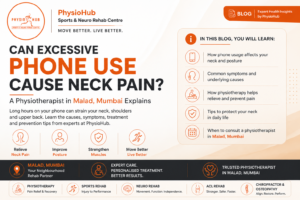
You pick up your phone to answer one message, check social media or finish a work task. A few minutes later, your head is still bent forward, your shoulders feel tight and your neck begins to ache.

This is common among students, office workers, business owners and anyone who spends long hours on screens. The phone itself is not always the only cause. Long screen time, limited movement, weak muscles, stress and poor sleep may all contribute.

A physiotherapist in Malad, Mumbai can help identify why the pain keeps returning. Instead of simply asking you to “sit straight,” the assessment looks at your neck, shoulders, upper back, strength, mobility and daily routine.

At PhysioHub, treatment is personalised because two people with similar neck pain may need different approaches.

Can Excessive Phone Use Cause Neck Pain?

Physiotherapist in malad| Physiohub

Yes, excessive phone use may contribute to neck pain, especially when you look down for long periods without changing position. It can increase fatigue in the neck and shoulder muscles. However, phone use is rarely the only cause. Strength, activity levels, sleep, stress and previous injuries may also influence symptoms.

What Is Phone-Related Neck Pain?

Phone-related neck pain is discomfort that begins or becomes worse after prolonged smartphone use. It is often called “tech neck” or “text neck,” although these are common descriptions rather than formal medical diagnoses.

When you look down, the muscles supporting your head remain active. Holding this position briefly is usually manageable. Staying there for a long time and taking few movement breaks may lead to fatigue and stiffness.

A physiotherapist in Malad, Mumbai will assess how long you remain in one position, how your body moves and whether your muscles have enough endurance for daily demands.

Phone-related neck pain is usually linked to screen time, limited movement, muscle fatigue, stress and individual physical factors—not one “bad” posture alone.

Why Does Your Neck Hurt After Using Your Phone?

Several everyday factors may contribute:

  • Long periods in one position: Even a comfortable posture can become tiring.
  • Repeated downward viewing: Looking towards your lap increases the work done by the muscles behind your neck.
  • Low screen position: Holding your phone near your waist encourages more neck bending.
  • Limited movement breaks: Muscles often feel better when positions change regularly.
  • Weak neck and upper-back muscles: Low endurance can make your neck tire quickly.
  • Upper-back stiffness: A stiff upper back may cause the neck to work harder.
  • Stress and poor sleep: Both may increase tension and pain sensitivity.
  • Previous injury: An old neck or shoulder problem may become irritated.
  • Combined screen exposure: Laptop work followed by phone use increases total static time.

How Does Physiotherapy for Phone-Related Neck Pain Work?

Visiting a physiotherapist in Malad, Mumbai begins with understanding your symptoms and routine.

Step 1: Discussing your symptoms

Your physiotherapist may ask when the pain started, what makes it worse, whether it affects sleep or driving and how much time you spend using your phone or computer.

For example, does your discomfort begin after ten minutes of scrolling, or only after a full day of desk work? These details help identify the activities contributing to your symptoms.

Step 2: Assessing movement

The assessment may include:

  • Neck rotation and bending
  • Upper-back mobility
  • Shoulder movement
  • Shoulder-blade control
  • Muscle strength and endurance
  • Nerve-related symptoms when relevant

The aim is not to force you into one “perfect” posture. It is to identify restrictions, weakness and movements that trigger symptoms.

Step 3: Creating a personalised plan

Depending on the findings, Physiotherapy in Malad may include:

  • Neck and upper-back mobility exercises
  • Neck and shoulder strengthening
  • Shoulder-blade control exercises
  • Movement and posture education
  • Ergonomic changes
  • Manual therapy when appropriate
  • A personalised home exercise programme

Step 4: Building strength and endurance

Your neck may feel comfortable for a few minutes but become painful after several hours. This may be an endurance problem rather than simple muscle tightness.

A physiotherapist in Malad, Mumbai may gradually strengthen your neck, shoulders and upper back so they can manage work, travel and phone use more comfortably.

Step 5: Returning to normal activity

The goal is not to stop using your phone. That would be unrealistic for most people.

Rehabilitation helps you change positions more often, notice early warning signs and build enough physical capacity for work, study and everyday life.

Effective treatment combines assessment, strengthening, mobility work, education and practical changes to daily screen habits.

What Are the Benefits of Physiotherapy for Tech Neck?

Working with a physiotherapist in Malad, Mumbai may help you:

  • Reduce neck and shoulder discomfort
  • Improve neck movement
  • Build muscle strength and endurance
  • Improve upper-back mobility
  • Develop better shoulder control
  • Understand which habits trigger symptoms
  • Return to work and exercise with confidence
  • Reduce dependence on temporary relief
  • Learn exercises suited to your condition
  • Manage discomfort before it becomes more limiting

Physiotherapy is not simply about correcting how you sit. It helps your body become stronger and better prepared for the demands of modern screen use.

Physiotherapy vs Other Options for Phone-Related Neck Pain

Option Main purpose Possible benefit Limitation
Physiotherapy Assessment, exercise and rehabilitation Addresses mobility, strength and habits Requires active participation
Rest Temporarily reduces activity May calm a flare-up Does not build strength
Massage Relaxes tight muscles May provide short-term comfort Relief may not last
Online exercises Offers general movement ideas Convenient and accessible May not suit your condition
Chiropractor in Malad Hands-on care for selected problems Some people prefer manual treatment Requires proper assessment and screening
Osteopathy in Malad Broader movement assessment May support mobility Should not replace medical evaluation
Pain medication Temporary symptom relief May help during a flare-up Does not address movement habits

The right option depends on your symptoms, medical history and personal goals. In many cases, active rehabilitation is more useful than relying only on temporary relief.

Who Needs Physiotherapy for Phone-Related Neck Pain?

You may benefit from consulting a physiotherapist in Malad, Mumbai if:

  • Neck pain keeps returning after phone use
  • Your shoulders feel heavy by evening
  • Pain affects work, study or sleep
  • You struggle to turn your head while driving
  • You experience headaches with neck stiffness
  • Pain travels into the shoulder blade or arm
  • You notice tingling or numbness
  • Home stretches provide only temporary relief
  • Symptoms continue despite changing your phone position

Students, office workers, gamers, drivers, healthcare professionals and content creators may be more likely to experience problems because of prolonged screen use.

How Much Does Neck Pain Physiotherapy Cost in Malad?

The cost of treatment with a physiotherapist in Malad, Mumbai depends on:

  • Severity and duration of symptoms
  • Length of the initial assessment
  • Number of sessions required
  • Type of treatment used
  • Need for specialised rehabilitation
  • Clinic appointments or home sessions
  • Follow-up and exercise progression

Someone with mild stiffness may need a short programme. A person with long-term pain, headaches or arm symptoms may require a more detailed assessment and gradual rehabilitation.

The cheapest session is not always the best value. A clear assessment and practical home programme may help reduce repeated spending on temporary treatments.

What Are the Neck-Pain Physiotherapy Trends in 2026?

Physiotherapy in 2026 is becoming more personalised, active and connected to everyday life.

Less fear around posture

Modern rehabilitation is moving away from the idea that one posture is always harmful. The focus is now on changing positions, improving strength and gradually building tolerance.

More active rehabilitation

Exercise, education and a gradual return to activity are central parts of treatment. Hands-on techniques may still be used, but they are often combined with strengthening and self-management.

Whole-body assessment

A physiotherapist in Malad, Mumbai may assess the upper back, shoulders, work habits, sleep and physical activity instead of looking only at the painful area.

This whole-body approach is important because neck discomfort may be influenced by more than one joint or muscle.

Why Choose PhysioHub in Malad, Mumbai?

PhysioHub begins by listening to your experience. Does the pain start after a few minutes of scrolling, after a long workday or only when you are tired and stressed?

Dr. Pooja Mehta, Sports Physiotherapist, focuses on personalised assessment and practical rehabilitation. Treatment may include mobility work, strengthening, movement correction, hands-on techniques and guided home exercises.

People looking for a physiotherapist in Malad, Mumbai can receive care for neck pain, back pain, sports injuries and post-operative recovery.

PhysioHub also supports patients searching for ACL rehab in Malad or a Sports Physiotherapist in Mumbai. Its wider rehabilitation services may be helpful for people looking for a Neuro rehab centre in Malad or Neuro physio therapy in Malad for movement, balance and walking difficulties.

Whether you are comparing a physiotherapist in Mumbai, a Chiropractor in Malad or osteopathy in Malad, the first step should be a careful assessment based on your symptoms and goals.

Frequently Asked Questions About Phone-Related Neck Pain

1. Can excessive phone use permanently damage your neck?

Phone use does not automatically cause permanent damage. However, long periods without movement may contribute to recurring discomfort, stiffness and muscle fatigue.

2. How should I hold my phone to reduce neck pain?

Bring the screen closer to eye level, support your arms and change position regularly. You do not need to maintain one rigid posture throughout the day.

3. Can a physiotherapist in Malad, Mumbai treat tech neck?

Yes. A physiotherapist in Malad, Mumbai can assess your neck, upper back, shoulders, muscle endurance and screen habits before creating a personalised treatment plan.

4. Are neck stretches enough for phone-related pain?

Not always. Some people need mobility exercises, while others may need strengthening, endurance exercises or changes to their daily routine.

5. When should I see a physiotherapist for neck pain?

Book an assessment when pain keeps returning, affects sleep or work, or occurs with headaches, tingling, numbness or arm discomfort.

Book Your Neck Pain Assessment at PhysioHub

Your phone is an important part of modern life, but neck pain does not have to become part of your routine.

A qualified physiotherapist in Malad, Mumbai can help identify why your symptoms keep returning and guide you through a practical recovery plan.

Book your consultation at PhysioHub Sports Rehab Centre in Malad, Mumbai and take the first step towards more comfortable movement.

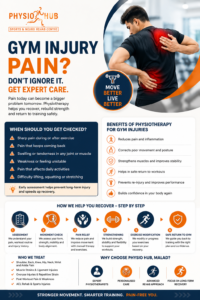
Gym injuries can happen to anyone. You may be new to workouts, lifting heavier than usual, trying a new exercise, or training regularly for strength and fitness. Sometimes, one wrong movement is enough. Other times, pain slowly builds because of repeated strain, poor form, or not giving the body enough recovery. If the pain keeps returning or affects your movement, consulting a trusted physiotherapist in Malad, Mumbai can help you understand the cause and recover safely.

At first, it is easy to ignore the pain. Many people say, “It is just soreness,” or “I will rest for two days and start again.” Sometimes that works. But what if the pain comes back every time you squat, lift, run, push, pull, or stretch?

That is when your body may need proper attention.

Gym soreness is common after a tough workout. But sharp pain, swelling, weakness, numbness, joint instability, or pain that keeps returning is not something to push through.

A trusted physiotherapist in Malad, Mumbai can help you understand whether your gym pain is normal soreness, poor technique, overuse, or an injury that needs rehab.

At Physio Hub in Malad, Mumbai, physiotherapy focuses on pain relief, movement correction, strength rebuilding, and safe return to workouts.


Gym injuries should be checked by a physiotherapist if pain is sharp, keeps returning, causes swelling, limits movement, affects walking or lifting, or feels worse during exercise. Physiotherapy helps assess the injury, reduce pain, correct technique, rebuild strength and guide safe return to gym training.

What is Physiotherapy for Gym Injuries?

Physiotherapy for gym injuries is a planned treatment and rehabilitation approach for pain or injury caused by workouts. This may include weight training, cardio, functional training, sports drills, or general fitness exercises.

It helps you understand why the pain started and what your body needs to recover safely.

The goal is not just to stop pain for a few days. The goal is to help you move better, train smarter, and reduce the risk of the same injury happening again.

Gym injuries may affect:

  • Shoulder
  • Neck
  • Lower back
  • Knee
  • Hip
  • Wrist
  • Elbow
  • Ankle
  • Tendons
  • Muscles
  • Ligaments

A physiotherapist in  Mumbai may check how your body moves during exercises like squats, lunges, deadlifts, push-ups, overhead presses, planks, running, or jumping.

For example, shoulder pain during an overhead press may be linked to poor shoulder blade control. Knee pain during squats may come from weak hips or poor knee alignment. Back pain during deadlifts may happen because of poor lifting form, weak core control, stiff hips, or sudden overload.Physiotherapy for gym injuries helps treat pain, correct movement faults and guide safe return to workouts without repeated injury.

Why Do Gym Injuries Happen?

Gym injuries usually happen when the body is asked to do more than it is ready for. Sometimes it is a sudden strain. Sometimes it is a small mistake repeated again and again.

Common causes include:

  • Lifting too heavy too soon
  • Poor exercise technique
  • Skipping warm-up
  • Overtraining without enough rest
  • Weak core muscles
  • Poor shoulder or hip mobility
  • Muscle imbalance
  • Poor squat or deadlift form
  • Incorrect posture during lifting
  • Returning to gym too early after injury
  • Lack of supervision
  • Repeating the same workout too often
  • Ignoring early pain signals
  • Poor footwear during training
  • Weak glutes, calves or shoulder stabilizers

Think of someone who increases deadlift weight quickly because they feel motivated. The first few sets may feel fine. But later, the lower back starts hurting. Or imagine a person doing shoulder workouts daily without enough recovery. Slowly, overhead movements become painful.

Does that mean gym training is bad? Not at all.

Exercise is helpful. Strength training is important. But the body needs good form, gradual progress, rest, mobility, and balanced strength.

The problem is not exercise. The problem is often poor progression, poor form, or ignoring pain for too long.

How Does Physiotherapy for Gym Injuries Work Step by Step with a Physiotherapist in Malad, Mumbai

Physiotherapist in Malad, Mumbai

Physiotherapy for gym injuries starts by understanding the pain and how it affects your workout. A good physiotherapist will not simply tell you to stop everything. The aim is to help you recover safely and return to training with confidence.

Step 1: Injury and Pain Assessment

The physiotherapist first understands your pain pattern.

They may ask:

  • When did the pain start?
  • Which exercise triggered it?
  • Is the pain sharp or dull?
  • Does it happen during or after workouts?
  • Is there swelling or weakness?
  • Does pain affect daily activity?
  • Did you increase weight recently?
  • Have you had this injury before?

These questions help identify whether the pain is due to overload, poor technique, weakness, stiffness, or a specific injury.

For example, pain that starts suddenly during a heavy lift may need a different approach than pain that slowly builds over weeks. Pain with swelling may need more caution than mild post-workout soreness.

Step 2: Movement and Technique Check

The therapist may assess basic gym movements to see how your body is loading the joints and muscles.

This can include:

  • Squat pattern
  • Deadlift movement
  • Lunge control
  • Shoulder press movement
  • Push-up form
  • Plank control
  • Hip mobility
  • Ankle mobility
  • Shoulder blade movement
  • Core stability
  • Balance and coordination

Sometimes, the painful area is not the real cause.

For example, knee pain during squats may come from weak hips or poor ankle mobility. Shoulder pain during lifting may be linked to weak upper-back muscles. Lower back pain may happen because the hips are stiff and the spine is doing extra work.

This is why proper movement assessment matters. Without it, people may keep treating the painful area while missing the actual reason.

Step 3: Pain Relief and Mobility Care

If pain is high, the first goal is to reduce discomfort and make movement safer.

Physiotherapy may include:

  • Manual therapy
  • Soft tissue release
  • Joint mobility work
  • Stretching guidance
  • Pain-relieving modalities
  • Taping if needed
  • Activity modification
  • Exercise technique correction

This stage helps calm the pain and reduce stiffness.

But pain relief is only the beginning. If the injury happened because of poor form, weakness, or overload, those issues must also be corrected. Otherwise, pain may return when you restart training.

Step 4: Strength and Stability Training

Once pain reduces, strengthening becomes an important part of rehab.

Exercises may focus on:

  • Core muscles
  • Glutes and hips
  • Shoulder stabilizers
  • Quadriceps and hamstrings
  • Calves
  • Upper back
  • Neck stabilizers
  • Foot and ankle muscles

The plan is progressed slowly, based on pain, control, and confidence.

A good physiotherapist in Malad, Mumbai will not simply say, “Stop gym forever.” Instead, they guide you on what to pause, what to modify, and when to progress.

For example, if squats hurt, you may start with controlled bodyweight movements before adding load again. If overhead press hurts, shoulder mobility and stability may be improved first.

Step 5: Exercise Modification

This is one of the most practical parts of physiotherapy.

The physiotherapist may suggest temporary changes such as:

  • Reducing load
  • Reducing range of motion
  • Avoiding painful exercises temporarily
  • Improving warm-up
  • Changing grip or stance
  • Adjusting workout frequency
  • Adding mobility work
  • Using controlled tempo
  • Improving recovery time

This allows you to stay active without repeatedly irritating the injured area.

For many gym-goers, this feels reassuring. You do not always have to stop everything. You just need the right modification at the right time.

Step 6: Return-to-Gym Plan

The final stage is returning to full training safely.

This may include:

  • Gradual load progression
  • Form correction
  • Strength testing
  • Mobility checks
  • Workout planning
  • Pain monitoring
  • Injury prevention exercises
  • Sport-specific or gym-specific drills

A return-to-gym plan helps you avoid doing too much too soon. It also gives you clarity. You know what exercise to start with, how much weight to use, and when to progress.

Physiotherapy helps gym injuries through assessment, pain relief, movement correction, strengthening, exercise modification and safe return-to-training planning.

Benefits of Physiotherapy for Gym Injuries by a Physiotherapist in Malad, Mumbai

Physiotherapy can help you recover safely and avoid repeated setbacks.

Key benefits include:

  • Reduces pain and stiffness
  • Identifies the root cause of injury
  • Corrects poor exercise technique
  • Improves muscle strength
  • Improves joint mobility
  • Helps prevent re-injury
  • Supports safe return to gym
  • Improves posture and movement control
  • Reduces fear of lifting again
  • Improves balance and coordination
  • Helps after ligament or tendon injury
  • Supports sports performance
  • Builds long-term body confidence
  • Reduces dependence on painkillers
  • Helps you train smarter

For example, someone with shoulder pain during bench press may need shoulder blade strengthening, mobility work, and load correction.

Someone with back pain during deadlifts may need hip mobility, core control, and lifting technique correction.

A person with knee pain after gym squats may need hip strengthening, ankle mobility, and squat pattern training.

For athletes and active individuals, a Sports Physiotherapist in Mumbai can help with safe return-to-training and performance-focused rehab.

The goal is not only to reduce pain. It is to help you feel confident in your body again.

Physiotherapy vs Other Options for Gym Injuries

Option Main Focus Best For Limitation
Physiotherapy Pain relief, movement correction, strengthening and rehab Gym injuries, recurring pain, return to workouts Needs consistency
Rest only Temporary symptom relief Mild pain or fatigue Does not correct form or weakness
Painkillers Short-term pain control Temporary discomfort Does not treat root cause
Massage Muscle relaxation Tightness and soreness May not fix movement faults
General gym training Fitness and strength Healthy individuals May worsen injury if not modified
Chiropractic care Spine and joint alignment focus Selected spine-related issues Not suitable for every gym injury
Osteopathy Whole-body mobility and manual care Posture and movement concerns Needs proper assessment

Many people search for a Chiropractor in Malad or osteopathy in Malad when they have gym-related pain, stiffness, or posture concerns. These may help in selected cases after proper evaluation.

However, Physiotherapy in Malad is often more complete for gym injuries because it includes pain care, strength training, movement correction, and return-to-exercise guidance.

Rest may make pain better for a few days. Massage may relax tight muscles. Painkillers may reduce discomfort. But if the cause is poor form, weakness, or overload, the pain can return once training starts again.

If your goal is to lift, run, squat, push, pull, or train again safely, physiotherapy gives a structured path.

Who Needs Physiotherapy for Gym Injuries?

You may need physiotherapy if you have:

  • Sharp pain during exercise
  • Pain that keeps returning
  • Swelling after workout
  • Shoulder pain while lifting
  • Lower back pain during deadlifts
  • Knee pain during squats
  • Wrist pain during push-ups
  • Neck pain after upper-body workouts
  • Pain that affects daily activities
  • Weakness after injury
  • Difficulty returning to gym
  • Pain after increasing weights
  • Poor movement control
  • Fear of re-injury
  • Old injury that flares up again

You should stop and get checked if pain changes your form, causes limping, makes you avoid movement, or feels worse with each workout.

For example, if knee pain makes you shift weight to one side during squats, that is a sign to pause and assess. If shoulder pain makes you avoid overhead movement, do not keep pushing through it.

Patients with ligament injuries may need acl rehab in Malad for structured strengthening and knee stability training.

People with balance, walking, or neurological movement issues may need support from a Neuro rehab centre in Malad or Neuro physio therapy in Malad.

A trusted physiotherapist in Mumbai can help decide whether the injury needs basic rehab, sports rehab, or advanced recovery support.

Cost and Pricing Factors for Gym Injury Physiotherapy

The cost of physiotherapy for gym injuries depends on the type and severity of the injury.

Common pricing factors include:

  • Type of injury
  • Pain severity
  • Duration of symptoms
  • Muscle weakness
  • Joint stiffness
  • Need for manual therapy
  • Need for sports rehabilitation
  • ACL or ligament rehab needs
  • Use of equipment or modalities
  • Number of sessions required
  • Clinic-based or home-based care
  • Therapist expertise
  • Return-to-gym goals
  • Exercise technique correction needs

For example, mild shoulder stiffness may need fewer sessions. Long-standing back pain, ACL recovery, or recurring sports injury may need a longer plan.

A person who wants to return to basic fitness may need a different plan from an athlete or serious gym-goer who wants to return to heavy lifting.

The best way to understand the cost is to book an assessment with a physiotherapist in Malad, Mumbai. After evaluation, the therapist can explain the treatment plan clearly.

Industry Trends in 2026

In 2026, gym injury rehab is becoming more movement-focused, strength-based, and prevention-oriented.

People no longer want only pain relief. They want to return to training safely and avoid repeated setbacks.

Important trends include:

  • Movement screening for gym-goers
  • Strength-based rehabilitation
  • Load management education
  • Technique correction for lifting
  • Sports-specific rehab
  • ACL prevention and recovery programs
  • Wearable-supported training load tracking
  • Home exercise monitoring
  • Mobility and stability testing
  • Personalized return-to-gym plans
  • Injury prevention education

Gym-goers are also becoming more aware of recovery. Sleep, warm-up, mobility, training load, and exercise technique are now seen as part of performance, not extras.

The future of gym injury rehab is not about stopping people from training. It is about helping them train better, safer, and smarter.

Technology can support progress tracking, but clinical assessment still matters. Pain is personal. Movement quality, injury history, strength, and confidence need expert guidance.

Gym injury rehab in 2026 focuses on movement screening, strength, technique correction, load management and safe return to training.

Why Choose Physio Hub a physiotherapist in Malad, Mumbai?

Physio Hub provides personalized physiotherapy care for gym injuries, sports rehab, pain relief, and movement recovery in Malad, Mumbai.

If you are looking for a trusted physiotherapist in Malad, Mumbai, Physio Hub offers assessment-based care for pain relief, strengthening, mobility, and safe return to workouts.

Why patients choose Physio Hub:

  • Personalized injury assessment
  • Gym injury rehab support
  • Pain relief and mobility care
  • Strength-based rehabilitation
  • Posture and technique correction
  • Sports injury rehabilitation
  • ACL rehabilitation support
  • Neuro rehabilitation support
  • Balance and gait training
  • Patient-friendly approach
  • Convenient location in Malad, Mumbai

Physio Hub supports patients looking for Physiotherapy in Malad, Sports Physiotherapist in Mumbai, acl rehab in Malad, physiotherapist in Mumbai, Neuro rehab centre in Malad, Neuro physio therapy in Malad, osteopathy in Malad and Chiropractor in Malad.

The goal is simple: help you recover safely, train smarter, and return to movement with confidence.

At Physio Hub, the focus is not just on getting you out of pain. It is on helping you understand your body and avoid the same injury again.

FAQs

1. When should I stop exercising because of pain?

You should stop exercising if pain is sharp, increasing, causes swelling, changes your form, causes weakness or affects daily movement. Mild soreness is common, but pain that feels unusual should be checked.

2. Can physiotherapist in Malad, Mumbai,help gym injuries?

Yes. Physiotherapy can help gym injuries by reducing pain, improving mobility, strengthening weak areas, correcting exercise technique and guiding safe return to training.

3. Is muscle soreness the same as injury?

No. Muscle soreness usually feels like general stiffness or tenderness after exercise. Injury pain may feel sharp, localized, swollen, unstable or painful during specific movements.

4. Should I rest completely after a gym injury?

Complete rest may be needed for some acute injuries, but many cases need modified activity and guided rehab. A physiotherapist can suggest what to avoid and what can be done safely.

5. How long does gym injury recovery take?

Recovery depends on the injury type, pain severity, strength, mobility and consistency with rehab. Mild strains may improve faster, while ligament injuries, tendon pain or recurring injuries may need longer care.

Dealing with pain after gym workouts or worried about an injury?

Visit Physio Hub in Malad, Mumbai and consult a trusted physiotherapist in Malad, Mumbai for personalized gym injury assessment, treatment and safe return-to-training guidance.

Book your consultation today and start moving stronger, safer and pain-free.

Pain that settles with rest but returns again can feel confusing and frustrating. You rest for a couple of days, avoid heavy activity, use a hot pack, or even consider visiting a physiotherapist in Malad, Mumbai  and feel like things are finally getting better. Then you go back to work, climb stairs, lift a bag, sit for long hours, or restart exercise—and the same pain comes back.

This can happen with back pain, knee pain, neck stiffness, shoulder pain, sports injuries, and old injury areas. Many people think, “Maybe I just need more rest.” But if the pain keeps returning, rest may only be calming the symptoms for a short time. It may not be fixing the real reason behind the pain.

Your body may be trying to tell you something important. There may be muscle weakness, poor posture, joint stiffness, poor movement habits, overuse, nerve irritation, or incomplete recovery.

A trusted physiotherapist in Malad, Mumbai can help find out why your pain returns after rest and guide you with the right treatment plan. At Physio Hub in Malad, Mumbai, physiotherapy focuses on pain relief, movement correction, strengthening, and long-term recovery so you can get back to daily life with more confidence.

Pain may come back after rest because rest can reduce symptoms temporarily but may not correct the root cause. Recurring pain can be linked to muscle weakness, stiffness, poor posture, overuse, injury, nerve irritation or poor movement patterns. Physiotherapy helps by assessing the cause, improving strength, mobility and movement control.

What is Recurring Pain After Rest?

Recurring pain after rest means pain that improves when you stop activity but returns when you start moving again. It may feel like an ache, stiffness, sharp pain, tightness, burning, pulling, or weakness.

This type of pain can affect:

  • Lower back
  • Neck
  • Shoulder
  • Knee
  • Hip
  • Ankle
  • Wrist
  • Spine
  • Muscles and joints

Rest can calm irritation for some time. That is why you may feel better after sleeping, taking a break, or avoiding movement. But rest alone does not always improve strength, posture, joint mobility, flexibility, balance, or movement control.

For example, if your back pain is linked to weak core muscles, resting may reduce pain for a few days. But once you sit at work for long hours again, the same stress returns.

If knee pain is linked to weak hips or poor knee alignment, rest may feel helpful for a short time. But climbing stairs, walking fast, or returning to workouts can bring the pain back.

A physiotherapist in Malad, Mumbai looks beyond the painful spot. The goal is to understand how your whole body moves and why the same area keeps getting irritated. Recurring pain after rest means the symptoms reduce temporarily but return when your body faces load again. Physiotherapy helps find and treat the root cause.

Why Does Pain Come Back After Rest?

PhysioHub
PhysioHub

Pain often comes back after rest because the body has not fully rebuilt its ability to handle movement, load, and daily activity.

Rest may reduce irritation. But it may not solve weakness, stiffness, posture issues, or poor movement habits.

Common reasons include:

  • Weak muscles
  • Poor posture
  • Joint stiffness
  • Poor movement patterns
  • Reduced flexibility
  • Lack of strength training
  • Incomplete injury recovery
  • Overuse after returning too quickly
  • Nerve irritation
  • Poor sitting or lifting habits
  • Sports overload
  • Poor balance or coordination
  • Weak core muscles
  • Muscle imbalance
  • Reduced hip, shoulder, or ankle mobility
  • Old injuries that were never fully rehabilitated

Think about someone with neck pain from laptop work. They rest on Sunday and feel better. But by Monday evening, after six hours of screen time, the stiffness returns. The issue was not only tired muscles. It may also be posture, weak shoulder muscles, poor workstation setup, and lack of movement breaks.

Or imagine a runner with knee pain. They stop running for a week, feel better, and then restart with the same distance and speed. The pain comes back. Why? Because the knee may not have regained strength, control, or load tolerance yet.

The body needs gradual loading, not just rest.

Physical activity guidelines commonly recommend regular activity and muscle-strengthening exercises for adults because strength supports long-term movement health. Adults are advised to include muscle-strengthening activities involving major muscle groups on at least two days a week.

For low back pain, clinical guidance often encourages people to remain active within comfort instead of relying only on bed rest. Activity and exercise are commonly part of long-term recovery and recurrence prevention.

So, if pain keeps coming back after rest, your body may be saying, “I need strength, mobility, and better movement support.”

How Does Physiotherapy Help Step by Step?

Physiotherapy helps by finding why pain returns and then building a plan that helps your body tolerate daily movement again.

It is not about giving random exercises. It is about understanding your body, your routine, your pain triggers, and your recovery goals.

Step 1: Detailed Pain Assessment

The physiotherapist first understands your pain pattern.

They may ask:

  • When does the pain come back?
  • Does rest reduce it?
  • What activity triggers it?
  • Is pain worse after sitting, walking, lifting, or exercise?
  • Did it start after injury?
  • Is there tingling, numbness, or weakness?
  • Does the pain affect sleep or daily work?
  • Have you tried medicines, massage, or home remedies?

These questions help identify whether the pain may be linked to muscles, joints, nerves, posture, or movement habits.

For example, pain after sitting may point toward posture, weak core muscles, or spinal stiffness. Pain after stairs may suggest weak hips, poor knee control, or reduced ankle mobility. Pain after lifting may show poor lifting technique or lack of trunk stability.

Step 2: Movement and Posture Check

The therapist then checks how your body moves during simple daily actions.

This may include:

  • Walking
  • Sitting posture
  • Bending
  • Squatting
  • Lifting
  • Shoulder movement
  • Neck movement
  • Stair climbing
  • Balance testing
  • Core control

Sometimes, the pain is in one area, but the reason is somewhere else.

Knee pain may be linked to weak hips. Back pain may be linked to poor core strength. Shoulder pain may be linked to weak shoulder blade muscles or rounded posture.

This is why a full movement check matters. Without it, people often treat only the painful area and miss the actual cause.

Step 3: Pain Relief and Mobility Care

If pain is high, the first goal is to reduce discomfort and make movement easier.

Physiotherapy may include:

  • Manual therapy
  • Soft tissue release
  • Joint mobility work
  • Stretching guidance
  • Pain-relieving modalities
  • Posture correction
  • Activity modification

This stage helps calm pain and reduce stiffness.

But pain relief is not the final goal. It is the starting point. If the root cause is not corrected, the pain may return as soon as you increase activity again.

Step 4: Strengthening Weak Areas

Strengthening is often the missing piece in recurring pain.

If muscles are weak, the body may not support joints properly. Other muscles may overwork. This can create stress and repeated pain.

Exercises may focus on:

  • Core muscles
  • Glutes and hips
  • Thigh muscles
  • Calves
  • Shoulder stabilizers
  • Neck stabilizers
  • Back muscles
  • Foot and ankle muscles

Common exercises may include:

  • Bridges
  • Wall squats
  • Step-ups
  • Resistance band exercises
  • Calf raises
  • Core activation
  • Shoulder blade strengthening
  • Balance drills

A good physiotherapist in Malad, Mumbai will not give the same exercises to everyone. Your plan should match your pain, age, strength, activity level, lifestyle, and goals.

For example, an office worker with back pain needs a different plan than a runner with knee pain. A senior citizen with balance issues needs a different plan than a sportsperson returning after injury.

Step 5: Movement Correction

Pain often returns when the body keeps repeating the same poor movement pattern.

The therapist may correct:

  • Sitting posture
  • Lifting technique
  • Walking pattern
  • Knee alignment
  • Running form
  • Shoulder movement
  • Neck posture
  • Workstation habits
  • Exercise technique

Small changes can make a big difference.

Learning how to lift correctly can reduce back strain. Improving knee control while climbing stairs can reduce knee pain. Correcting laptop posture can reduce neck and shoulder discomfort.

The goal is to help your body move with less stress.

Step 6: Home Exercise and Prevention Plan

Physiotherapy works best when progress continues outside the clinic.

The therapist may guide you on:

  • Home exercises
  • Work breaks
  • Warm-up routines
  • Safe return to exercise
  • Sitting and standing habits
  • Load management
  • Prevention tips

This helps your body stay stronger even after the pain reduces.

Many people stop exercises once they feel better. But if recurring pain has been happening for months, consistency is important. A simple home plan can help maintain progress and reduce the chance of the pain coming back.

Physiotherapy helps recurring pain by assessing the cause, reducing pain, improving mobility, strengthening weak areas, correcting movement, and preventing repeated strain.

Benefits of Physiotherapy for Recurring Pain: Guidance from a Physiotherapist in Malad, Mumbai

Physiotherapy can help reduce repeated pain and improve how your body functions in daily life.

Key benefits include:

  • Identifies the root cause of pain
  • Reduces pain and stiffness
  • Improves muscle strength
  • Improves joint mobility
  • Corrects posture
  • Improves movement control
  • Reduces re-injury risk
  • Supports safe return to work
  • Helps with sports recovery
  • Improves balance and coordination
  • Reduces dependence on painkillers
  • Supports long-term pain management
  • Helps prevent pain from returning
  • Builds confidence in movement
  • Supports better daily function

Imagine an office worker who gets recurring back pain every week. Rest may help for a day or two. But if the real issue is long sitting, weak core muscles, and poor posture, the pain may keep returning.

A runner with recurring knee pain may need hip strengthening, calf loading, and training-load correction.

A senior citizen with repeated pain or balance problems may need strength and balance training. For neurological weakness or walking difficulty, care at a Neuro rehab centre in Malad or Neuro physio therapy in Malad may help improve movement and independence.

For athletes or active people, a Sports Physiotherapist in Mumbai can help plan safe strengthening, mobility, and return-to-sport progression.

The real benefit of physiotherapy is not just “less pain.” It is being able to trust your body again.

Physiotherapy vs Other Options for Recurring Pain

Care Option Main Focus Best For Limitation
Physiotherapy Pain relief, strength, mobility, movement correction Recurring pain, weakness, stiffness, injury rehab Needs consistency
Rest only Temporary symptom reduction Short-term flare-ups Does not correct root cause
Painkillers Temporary pain control Short-term pain relief Does not improve strength or movement
Massage Relaxation and tightness relief Muscle soreness May not prevent recurrence
General exercise Fitness Healthy individuals May worsen pain if not customized
Chiropractic care Spine and joint alignment focus Selected spine-related concerns Not suitable for every condition
Osteopathy Whole-body mobility and manual care Posture and movement concerns Needs proper assessment

Many people search for a Chiropractor in Malad or osteopathy in Malad when pain comes back after rest. These approaches may help in selected cases after proper evaluation.

However, Physiotherapy in malad is often more structured for recurring pain because it combines assessment, pain relief, strengthening, movement correction, and prevention.

Rest may make pain feel better for a few days. Painkillers may reduce discomfort. Massage may relax tight muscles. But if weakness, stiffness, or poor movement is still present, the same pain can return once you go back to normal activity.

Physiotherapy helps you understand why the pain is returning and what your body needs to recover better.

Who Needs Physiotherapy for Recurring Pain?

You may need physiotherapy if:

  • Pain improves with rest but returns again
  • Back pain comes back after sitting
  • Neck pain returns after laptop work
  • Knee pain returns after stairs
  • Shoulder pain returns after lifting
  • Pain keeps affecting work or sleep
  • You feel stiffness after inactivity
  • You have recurring sports injuries
  • You have weakness after surgery
  • You feel pain during workouts
  • You have poor posture
  • You have nerve symptoms like tingling or numbness
  • You are afraid to move after injury
  • You keep depending on painkillers
  • You want long-term recovery, not temporary relief

You do not have to wait until the pain becomes severe.

If pain keeps returning, changes how you move, or stops you from doing normal activities, it is worth getting assessed.

Athletes and active people may need support from a Sports Physiotherapist in Mumbai for safer return to sport.

Patients recovering from knee ligament injuries may need acl rehab in Malad for structured strengthening and stability training.

People recovering after stroke, neurological weakness, or balance problems may need care from a Neuro rehab centre in Malad.

A trusted physiotherapist in mumbai can help guide safe recovery based on the patient’s condition.

Cost and Pricing Factors for Physiotherapy

The cost of physiotherapy for recurring pain depends on the condition and the treatment plan.

Common pricing factors include:

  • Type of pain
  • Cause of recurring symptoms
  • Severity of pain
  • Duration of the problem
  • Need for manual therapy
  • Need for strengthening
  • Sports rehabilitation requirements
  • ACL rehab requirements
  • Neuro rehabilitation needs
  • Use of equipment or modalities
  • Clinic-based or home-based care
  • Number of sessions required
  • Therapist expertise
  • Patient goals and activity level

For example, mild posture-related pain may need fewer sessions. Long-standing back pain, sports injury, ACL recovery, or neuro rehabilitation may need a longer plan.

Some patients may need basic strengthening and posture correction. Others may need advanced balance training, gait training, or sport-specific rehabilitation.

The best way to understand expected cost is to book an assessment with a physiotherapist in Malad, Mumbai. After evaluation, the therapist can explain the treatment plan clearly.

Industry Trends in 2026

In 2026, physiotherapy is becoming more focused on prevention, strength, and personalized recovery.

Patients no longer want only temporary pain relief. They want to understand why pain keeps coming back and how to stop the cycle.

Important trends include:

  • Movement-based assessment
  • Strength-focused rehabilitation
  • Posture and ergonomic education
  • Sports-specific rehab
  • ACL recovery programs
  • Neuro rehab with gait training
  • Home exercise tracking
  • Wearable-supported progress monitoring
  • Patient education for prevention
  • Personalized exercise plans
  • Early physiotherapy for recurring pain

Technology is also becoming part of rehabilitation. Recent research has explored movement-analysis systems for low-back pain rehabilitation, showing how digital tools may support exercise monitoring and feedback in clinical rehab settings.

Still, technology cannot replace personal assessment. Pain is connected to lifestyle, movement habits, strength, stress, sleep, work routine, and confidence.

A good physiotherapy plan needs human understanding and safe progression. It should not only reduce pain today but also prepare your body for tomorrow.

Physiotherapy in 2026 focuses on finding root causes, improving strength, correcting movement, preventing recurrence, and using technology to support guided rehab.

Why Choose Physio Hub in Malad, Mumbai?

Physio Hub provides personalized physiotherapy care for recurring pain, muscle weakness, sports injuries, neuro rehabilitation, and movement recovery in Malad, Mumbai.

If you are searching for a trusted physiotherapist in Malad, Mumbai, Physio Hub offers assessment-based care focused on pain relief, strengthening, mobility, and long-term prevention.

Why patients choose Physio Hub:

  • Personalized assessment
  • Pain relief and mobility care
  • Strength-based rehabilitation
  • Posture and movement correction
  • Sports injury rehabilitation
  • ACL rehabilitation support
  • Neuro rehabilitation support
  • Balance and gait training
  • Patient-friendly approach
  • Convenient location in Malad, Mumbai

Physio Hub supports patients looking for Physiotherapy in malad, Sports Physiotherapist in Mumbai, acl rehab in Malad, physiotherapist in mumbai, Neuro rehab centre in malad, Neuro physio therapy in malad, osteopathy in malad, and Chiropractor in malad.

The goal is simple: help you understand why your pain returns, treat the cause, and move with more confidence.

At Physio Hub, the focus is not only on temporary relief. It is on helping you move better, recover stronger, and feel safer in daily life.

FAQs

1. Why does my pain come back after rest?

Pain may come back after rest because rest reduces symptoms temporarily but does not fix the root cause. Weak muscles, stiffness, poor posture, nerve irritation, or poor movement patterns can trigger pain again when activity starts.

2. Is rest enough for back pain or knee pain?

Rest may help during a short flare-up, but it is not always enough. If pain keeps returning, physiotherapy can help identify the cause and guide strengthening, mobility, and movement correction.

3. Can physiotherapy stop recurring pain?

Physiotherapy can help reduce recurring pain by treating the reason behind it. This may include muscle strengthening, posture correction, mobility work, balance training, and activity modification.

4.When Should I Visit a Physiotherapist in Malad, Mumbai, for Recurring Pain?

You should visit a physiotherapist if pain keeps returning, affects daily work, causes weakness, changes how you move, or does not improve with rest. Early care can prevent the problem from becoming worse.

5. Can pain return because of weak muscles?

Yes. Weak muscles can reduce joint support and increase pressure on other areas. This can cause repeated pain in the back, neck, shoulder, knee, hip, or ankle.

Does your pain feel better after rest but return again when you move?

Visit Physio Hub in Malad, Mumbai and consult a trusted physiotherapist in Malad, Mumbai for personalized assessment, strengthening, and rehabilitation.

Book your consultation today and take the first step toward long-term pain relief, better movement, and stronger recovery.

Neuro Physiotherapy

A neurological diagnosis such as stroke, Parkinson’s disease, or multiple sclerosis can suddenly change everyday life. Simple tasks like walking across a room, holding a cup, or climbing stairs may suddenly feel difficult.

For many patients, this moment can feel overwhelming. But recovery doesn’t stop at diagnosis. With the right rehabilitation and expert care, the brain and body can relearn how to move again.

This is where Neuro Physiotherapy Near Me. A qualified physiotherapist in Malad West can guide patients through specialized neurological rehabilitation programs that help restore movement, balance, and independence.

Many people searching for Best Sports Physiotherapy Near Me or neurological rehabilitation may not realize that modern physiotherapy can help retrain the brain and rebuild functional movement after neurological conditions.

Let’s understand why neuro physiotherapy is such an important part of recovery.

What is Neuro Physiotherapy?

Neuro physiotherapy is a specialized branch of physiotherapy that focuses on treating conditions affecting the brain, spinal cord, and nervous system.

Unlike traditional physiotherapy that mainly treats muscle injuries or joint pain, neurological physiotherapy focuses on helping patients recover movement and function that has been lost due to nerve damage or brain injuries.

A skilled physiotherapist in Malad West evaluates each patient carefully and creates a personalized rehabilitation program that improves strength, balance, coordination, and overall mobility.

Many advanced rehabilitation centers that appear when people search for Best Sports Physiotherapy Near Me also provide neurological rehabilitation therapies for stroke, spinal injuries, and Parkinson’s disease.

physiotherapist in malad west

Why Neuro Rehabilitation Is Essential

Recovery after neurological damage requires both physical training and brain retraining. Neuro physiotherapy helps reconnect the communication between the brain and muscles.

Here are some key reasons why rehabilitation is extremely important.

1. Activates Neuroplasticity (The Brain’s Rewiring Ability)

One of the biggest reasons neuro physiotherapy is effective is neuroplasticity.

Neuroplasticity is the brain’s ability to reorganize itself by creating new neural connections. Through targeted exercises and repetitive training, healthy areas of the brain can learn to take over functions from damaged areas.

An experienced physiotherapist in Malad West uses structured movement therapy to stimulate this rewiring process and help patients regain lost abilities.

2. Prevents Secondary Complications

Without movement and proper therapy, patients can develop several secondary health complications.

These include:

  • Muscle contractures (permanent muscle shortening)

  • Joint stiffness and chronic pain

  • Pressure sores due to immobility

  • Blood clots caused by prolonged inactivity

  • Increased risk of falls due to poor balance

Regular physiotherapy sessions help maintain mobility and prevent these complications.

Patients who search for Best Sports Physiotherapy Near Me often discover that professional physiotherapy centers also treat neurological rehabilitation with advanced techniques and equipment.

3. Restores Functional Independence

One of the main goals of neuro physiotherapy is helping patients regain their daily independence.

Therapy includes task-specific training, which focuses on activities that are part of everyday life.

Examples include:

  • Walking safely

  • Standing and sitting balance

  • Climbing stairs

  • Holding objects and improving grip strength

  • Dressing and eating independently

With consistent rehabilitation, patients can gradually move from dependence to confidence in performing everyday activities.

4. Improves Emotional and Psychological Well-Being

Neurological conditions often affect emotional health as well. Many patients experience frustration, anxiety, or fear about their recovery.

Rehabilitation provides visible progress and achievable goals, which can significantly boost confidence and motivation.

Working with a supportive physiotherapist in Malad West helps patients stay motivated and maintain a positive outlook during recovery.

The Golden Window of Recovery

Timing plays a crucial role in neurological rehabilitation.

For many conditions like stroke, the first 3 to 6 months are known as the “golden window of recovery.”

During this time, the brain has the highest ability to reorganize and adapt.

Starting physiotherapy early can:

  • Improve recovery speed

  • Restore mobility faster

  • Reduce long-term disability

  • Improve coordination and balance

This is why doctors recommend starting rehabilitation as soon as the patient is medically stable.

Conditions That Benefit from Neuro Physiotherapy

Neuro physiotherapy can significantly improve recovery for several neurological conditions.

Stroke Rehabilitation

Physiotherapy helps restore movement, balance, and muscle control after a stroke.

Parkinson’s Disease

Therapy improves posture, walking patterns, and coordination while reducing stiffness.

Multiple Sclerosis (MS)

Rehabilitation helps manage fatigue, improve strength, and maintain mobility.

Spinal Cord Injuries

Physiotherapy strengthens muscles that still have voluntary control and improves movement.

Brain Injuries

Patients can regain motor control, balance, and coordination through structured rehabilitation programs.

Many rehabilitation clinics that rank when people search Best Sports Physiotherapy Near Me also provide specialized neurological rehabilitation services.

Neurological physiotherapy is much more than exercise. It is a scientifically proven rehabilitation method that helps patients rebuild movement, confidence, and independence after neurological conditions.

With consistent therapy and expert guidance, patients can regain mobility, prevent complications, and improve their overall quality of life.

If you or your loved one is recovering from a neurological condition, consulting a qualified physiotherapist in Malad West can make a significant difference in the recovery journey.

Whether you are looking for neurological rehabilitation or searching for the Best Sports Physiotherapy Near Me, early physiotherapy intervention can help restore movement and support long-term recovery.

An ACL tear can feel like a sudden halt to your active life, but at

Continue reading “Beyond Surgery: Mastering ACL Recovery at PhysioHub Mumbai”