
Can Physiotherapy Help Balance Problems? For many people, the answer depends on what is causing the unsteadiness in the first place. Feeling unstable while walking, stumbling often, or worrying about falling can slowly affect confidence and independence. These issues may be linked to muscle weakness, reduced coordination, joint stiffness, neurological conditions, or changes in walking patterns.Balance problems can happen because of muscle weakness, reduced coordination, joint stiffness, neurological conditions, or changes in walking patterns. If you are looking for a Physiotherapist in Malad Mumbai for Balance Problems, an assessment can help identify what is affecting your stability and movement.
Balance problems are not always caused by age alone. Muscle weakness, reduced coordination, joint stiffness, poor vision, nerve problems, neurological conditions, medication effects, and changes in walking patterns can all contribute.
Globally, falls remain a major health concern. The World Health Organization estimates that around 37.3 million falls each year are serious enough to require medical attention, with adults over 60 experiencing the greatest number of fatal falls.
Working with a physiotherapist in Malad, Mumbai can help identify the movement-related factors affecting your stability. At PhysioHub, rehabilitation is planned around the individual rather than using the same set of exercises for everyone.
The goal is simple: help you move with more control, confidence, and independence.
Can Physiotherapy Help With Balance Problems and Frequent Falls?
Yes. Physiotherapy can help people with balance problems by assessing strength, walking, coordination, mobility, and movement control. Treatment may include balance exercises, strengthening, gait training, functional exercises, and neurological rehabilitation. The exact programme depends on the cause of the balance problem, the person’s abilities, and their individual rehabilitation goals.
What is Balance Rehabilitation for Frequent Falls?
Balance rehabilitation is a structured physiotherapy approach designed to improve the way your body controls movement while standing, walking, turning, reaching, or changing direction.
Good balance depends on several systems working together. Your muscles need enough strength to support your body, while your joints require good mobility for controlled movement. At the same time, the brain and nerves process information from the eyes, inner ear, and body position to help maintain balance.
When one or more of these systems are affected, a person may feel unstable.
A physiotherapist in Malad, Mumbai may therefore assess more than whether you can simply “stand on one leg.” The assessment can look at walking speed, turning, lower-limb strength, coordination, posture, reaction to movement, and your confidence during everyday activities.
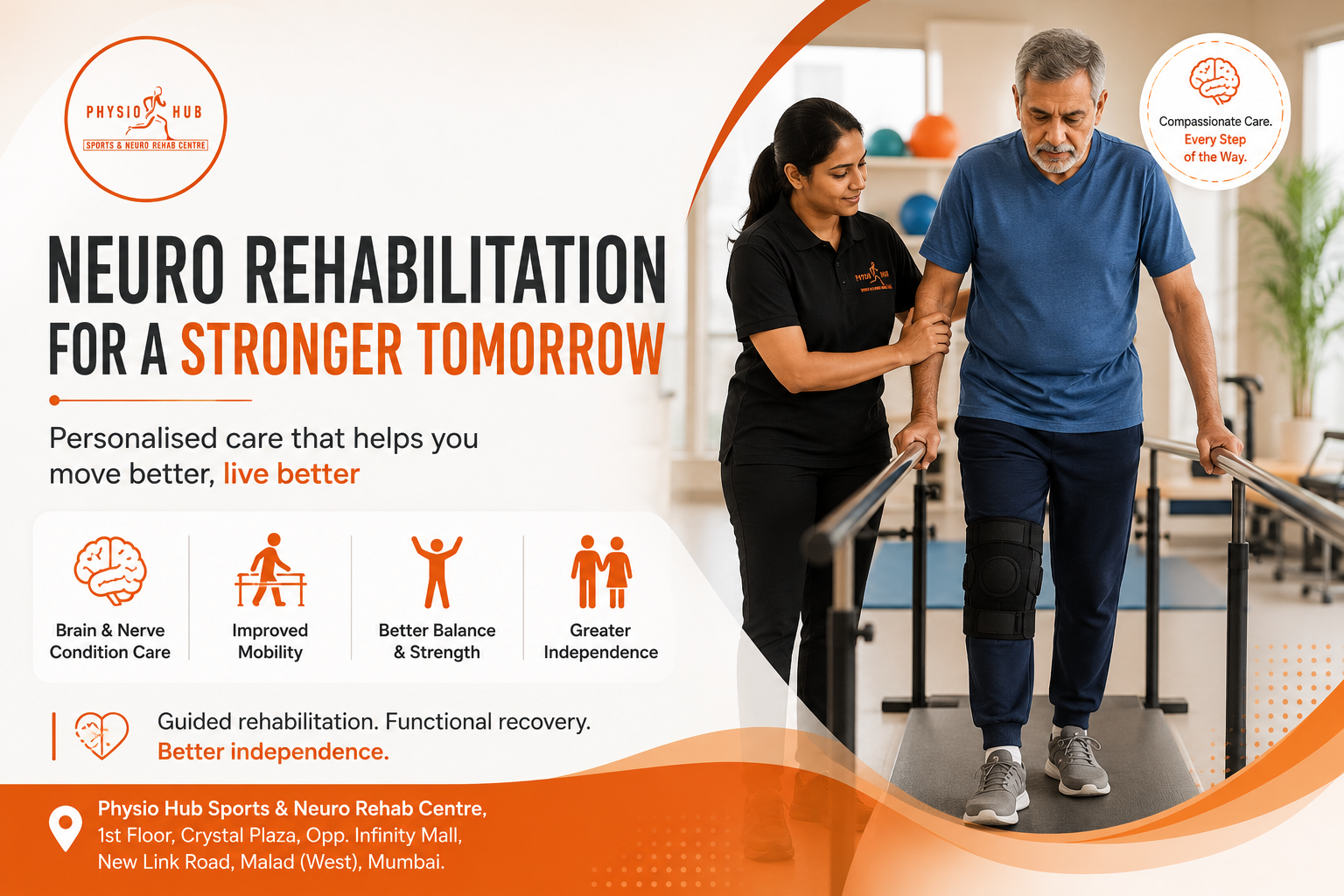
For people living with neurological conditions, Neuro physiotherapy in Malad may also focus on retraining movement patterns and improving functional independence.
What Causes Balance Problems and Frequent Falls?
There is rarely one reason that applies to everyone. Common factors include:
- Weakness in the legs, hips, or core muscles
- Reduced ankle or hip mobility
- Difficulty coordinating movements
- Changes after a stroke or neurological condition
- Parkinson’s disease and other movement disorders
- Peripheral nerve problems
- Reduced sensation in the feet
- Poor posture or altered walking patterns
- Joint pain that changes the way a person walks
- Vision or inner-ear problems
- Fear of falling after a previous fall
- Reduced activity following illness, surgery, or prolonged bed rest
- Certain medicines or multiple medical conditions
Current NICE guidance recommends considering factors such as gait, balance, mobility, muscle strength, neurological findings, vision, hearing, medication, footwear, long-term conditions, and concerns about falling when a comprehensive falls assessment is required.
This matters because giving everyone the same “balance exercises” may miss the actual reason they are struggling.
Imagine someone who feels fine walking straight ahead but becomes unsteady whenever they turn quickly. Another person may struggle mainly when getting out of a chair. Their rehabilitation needs may be very different.
How Does Physiotherapy for Balance Problems Work?

Treatment usually starts with understanding why you are losing balance.
Step 1: Discuss your symptoms and fall history
Your physiotherapist may ask:
- When did the balance problem begin?
- Have you fallen recently?
- Do you feel dizzy or simply unstable?
- Does the problem happen indoors, outdoors, or on stairs?
- Are you recovering from a stroke or another neurological condition?
- Has your confidence in walking changed?
Even a fall that did not cause an injury can be worth discussing.
Step 2: Assess your movement
The assessment may include:
- Walking pattern
- Standing balance
- Lower-limb strength
- Joint mobility
- Coordination
- Transfers such as sitting to standing
- Turning and changing direction
- Ability to step over obstacles
- Functional activities related to your daily routine
If neurological symptoms are present, a Neuro rehab centre in Malad may provide a more focused assessment of movement control and functional ability.
Step 3: Identify the main problems
For one person, weak hip muscles may be a major factor. For another, the challenge may be coordination after a stroke.
Understanding the cause allows rehabilitation to become more specific.
Step 4: Begin progressive exercises
Exercises may include:
- Supported standing activities
- Weight shifting
- Stepping exercises
- Strength training
- Walking practice
- Direction changes
- Coordination exercises
- Functional tasks
- Controlled obstacle practice
Modern falls guidance supports progressive exercise programmes tailored to a person’s abilities and goals, with attention to balance, coordination, strength, and power.
Step 5: Gradually increase difficulty
Holding onto a support may be appropriate at first. As control improves, the task may be progressed safely.
The goal is not to perform complicated exercises for the sake of it. The goal is to make daily movement easier and safer. Balance rehabilitation usually involves assessment, identifying the cause of instability, targeted exercises, walking practice, and regular progression. The programme should match the person’s condition, confidence, and everyday movement needs.
What Are the Benefits of Physiotherapy for Balance Problems?
A personalised Physiotherapy in Malad programme may help with:
- Improving leg and core strength
- Developing better standing control
- Improving coordination
- Practising safer walking
- Building confidence while turning or changing direction
- Improving sit-to-stand movements
- Practising stairs and everyday tasks
- Improving mobility after neurological conditions
- Reducing fear around movement
- Supporting greater independence
One important benefit is confidence.
Someone who has fallen before may begin avoiding activity because they are worried it will happen again. But less movement can sometimes lead to further weakness.
Professional rehabilitation can create a safer environment to gradually rebuild movement confidence rather than simply telling someone to “be more careful.”
Physiotherapy vs Other Options for Balance Problems
Different treatments serve different purposes.
| Approach | Main Focus | When It May Be Considered |
|---|---|---|
| Physiotherapy | Strength, balance, walking and functional movement | Weakness, reduced mobility, altered gait and movement problems |
| Neuro physiotherapy | Movement affected by neurological conditions | Stroke, Parkinson’s disease and other neurological problems |
| Medical assessment | Identifying medical causes | New symptoms, unexplained falls, dizziness or medication-related concerns |
| Occupational therapy | Daily activities and home safety | Difficulty managing daily tasks or environmental fall risks |
| Chiropractic care | Mainly musculoskeletal assessment and management | Selected joint or mechanical musculoskeletal concerns |
| Osteopathy | Musculoskeletal assessment and manual approaches | Selected mobility and musculoskeletal problems |
A Chiropractor in Malad,Mumbai or osteopathy in Malad may be appropriate for certain musculoskeletal concerns, but they are not automatically substitutes for neurological or falls assessment.
Similarly, a Sports Physiotherapist in Mumbai may be especially relevant when balance or movement problems are related to a sports injury rather than a neurological condition.
The right approach depends on what is actually causing the problem.
Who Needs Physiotherapy for Balance Problems?
Consider an assessment if you or a family member:
- Has fallen more than once
- Frequently trips or stumbles
- Feels unstable while walking
- Needs furniture or walls for support
- Has difficulty turning quickly
- Feels unsure on stairs
- Has become weaker after hospitalisation
- Has reduced mobility after stroke
- Has Parkinson’s disease or another neurological condition
- Avoids going outside because of fear of falling
- Has difficulty standing up from a chair
- Has noticed a major change in walking
The 2025 NICE falls guideline recommends comprehensive assessment for certain higher-risk people, including those with two or more falls in the previous year, and gait and balance assessment when impairment is present
However, sudden severe balance problems should not simply be treated as a physiotherapy issue. New one-sided weakness, facial drooping, speech difficulty, loss of consciousness, sudden severe headache, or sudden inability to walk requires urgent medical evaluation.
How Much Does Balance Physiotherapy Cost in Malad?
There is no single price that applies to every patient because rehabilitation needs can differ considerably.
Pricing may depend on:
- Initial assessment duration
- Complexity of the condition
- Whether neurological rehabilitation is required
- Length of each session
- Frequency of treatment
- Need for specialised equipment
- Home-based versus clinic-based sessions
- Duration of the rehabilitation programme
For example, someone with mild weakness after a period of inactivity may need a very different plan from someone recovering from a stroke.
A consultation with a physiotherapist in Malad, Mumbai can help determine the type and likely frequency of rehabilitation before committing to a longer programme.
Treatment packages should ideally follow an assessment rather than being chosen only by session count.
What Are the Balance Rehabilitation Trends in 2026?
Balance rehabilitation is becoming increasingly personalised rather than relying only on general exercise sheets.
1. More objective movement tracking
Wearable devices and movement sensors are being explored for monitoring mobility, balance, and fall-related movement patterns.
A 2026 review of fall-detection and prevention technologies highlighted growing use of wearable and environmental sensors for fall-related monitoring
2. Wearable feedback during rehabilitation
Research published in 2025 also described smart wearable systems that can provide movement data and real-time feedback during balance rehabilitation, although accessibility, accuracy, and cost remain important considerations.
3. More individualised exercise plans
Current clinical guidance emphasises progressive exercise based on a person’s specific needs, preferences, abilities, and goals rather than using the same programme for everyone
4. Greater focus on real-life movement
Modern rehabilitation increasingly connects exercises with daily tasks—getting out of a chair, turning, walking outdoors, climbing steps, or navigating obstacles.
Technology can support rehabilitation, but it does not replace clinical assessment. The person’s needs still come first.
Why Choose PhysioHub in Malad, Mumbai?
At PhysioHub, balance rehabilitation begins by understanding the person behind the symptoms.
Someone recovering after a stroke may want to walk independently around their home again. An older adult may simply want to feel confident visiting the market without worrying about falling. These goals matter because rehabilitation should connect with real life.
PhysioHub provides access to Physiotherapy in Malad and neurological rehabilitation with treatment plans based on assessment, movement ability, and individual goals.
Patients looking for a Neuro rehab centre in Malad , Mumbai or Neuro physio therapy in Malad can receive structured rehabilitation focused on mobility, strength, coordination, walking, and functional independence.
PhysioHub also provides broader rehabilitation services for people searching for a physiotherapist in Mumbai, including sports rehabilitation and ACL rehab in Malad,Mumbai Where appropriate for separate musculoskeletal concerns, services such as a Chiropractor in Malad and osteopathy in Malad, Mumbai may form part of a broader care approach.
The aim is not simply to complete exercises. It is to help patients use those improvements when standing, walking, working, exercising, or managing everyday activities.
FAQs
1. Can physiotherapy improve poor balance?
Yes. Physiotherapy can address movement-related factors such as weakness, coordination, walking difficulty, reduced mobility, and poor postural control. The treatment plan depends on the underlying cause.
2. What exercises are used for balance problems?
Exercises may include weight shifting, strengthening, stepping, controlled standing, walking practice, direction changes, coordination work, and functional activities. Exercises should be selected and progressed according to the individual’s ability.
3. When should I see a physiotherapist after a fall?
Consider an assessment if you have repeated falls, ongoing unsteadiness, difficulty walking, reduced confidence, or weakness after a fall. Falls involving injury, loss of consciousness, or sudden neurological symptoms require appropriate medical assessment.
4. Can neuro physiotherapy help after a stroke?
Neuro physiotherapy can support recovery of movement, strength, coordination, walking, balance, and functional activities after stroke. Progress varies depending on the type and severity of neurological impairment and other individual factors.
5. How long does balance rehabilitation take?
There is no fixed timeline. Someone with mild weakness may progress differently from a person recovering from a neurological condition. Your physiotherapist can reassess progress and adjust the programme as your abilities change.
Take the First Step Towards Better Balance
You should not have to accept repeated falls or constant unsteadiness as something you simply have to live with.
If walking feels less secure, you have experienced repeated falls, or a neurological condition has affected your movement, consider an assessment with a physiotherapist in Malad, Mumbai at PhysioHub.
A personalised rehabilitation plan can focus on the areas that matter most to you—whether that means walking more confidently, improving strength, managing stairs, or becoming more independent in everyday life.
Book an appointment with PhysioHub in Malad West, Mumbai, for personalised balance, mobility, and neuro rehabilitation support.