
Plot No. 5, Evershine Nagar, Next To Landmark, Link Road, Malad West
Blog Category

Sciatica can make everyday life surprisingly difficult. A short walk feels uncomfortable, sitting through a workday becomes tiring, and even getting out of bed may trigger pain that travels from the lower back into the hip or leg. This is where consulting a Physiotherapist in Malad, Mumbai can be useful. Physiotherapy focuses on understanding how your spine, hips, muscles, nerves and daily movement patterns are working together.

For some people, the discomfort is mild and occasional. For others, it may feel sharp, burning or electric, with tingling, numbness or weakness in the leg. When symptoms keep returning, simply resting or applying temporary pain relief may not address the movement problem behind them.

At PhysioHub in Malad, Mumbai, physiotherapy for sciatica begins with an individual assessment rather than a one-size-fits-all exercise routine. The goal is to understand your symptoms, improve comfortable movement, gradually rebuild strength and help you return to everyday activities with greater confidence.

With the right assessment and rehabilitation plan, many people can learn how to manage their symptoms more effectively and reduce unnecessary fear around movement.

 How Can Physiotherapy Help With Sciatica?

A physiotherapist can help manage sciatica by assessing spinal movement, muscle strength, nerve sensitivity, posture and daily activities. Treatment may include personalised exercises, mobility work, strengthening, nerve mobility exercises, manual therapy and activity guidance. The exact programme depends on the cause, severity and individual symptoms.

What Is Sciatica?

Sciatica describes symptoms caused when the sciatic nerve or the nerve roots that form it become irritated or compressed.

The sciatic nerve runs from the lower back through the buttock and down the leg. When it becomes irritated, symptoms commonly affect one side of the body.

A person may experience:

  • Sharp or burning pain travelling down the leg
  • Pain starting around the lower back or buttock
  • Tingling or pins and needles
  • Numbness
  • Leg or foot weakness
  • Discomfort that becomes worse with certain movements
  • Difficulty sitting, walking or standing for long periods

The NHS notes that sciatica commonly affects the buttock and back of one leg and may include pain, tingling, numbness or weakness.

It is also worth remembering that not every episode of lower back pain is sciatica. This is one reason a proper assessment matters.

What Causes Sciatica and Why Does It Need Attention?

Sciatica is a symptom rather than a single disease. Different problems can irritate or place pressure on the nerve.

Common causes may include:

  • Disc-related problems: A spinal disc may irritate or compress a nearby nerve root.
  • Spinal stenosis: Narrowing around the spaces where spinal nerves travel can contribute to symptoms.
  • Spondylolisthesis: One vertebra moving forward relative to another may sometimes affect nearby nerves.
  • Back injuries: Certain injuries may irritate structures around the sciatic nerve.
  • Reduced movement or deconditioning: Long periods of inactivity can sometimes make returning to normal movement more difficult.

Sciatica should also be assessed because leg pain can have different causes. A physiotherapist needs to determine whether the symptoms appear related to the spine, nerve irritation, hip movement, muscles or another condition.

According to the World Health Organization, low back pain affected around 619 million people worldwide in 2020 and remains the leading cause of disability globally. Rehabilitation plays an important role in helping people remain active and return to meaningful daily activities.

How Does Physiotherapy for Sciatica Work? Step by Step
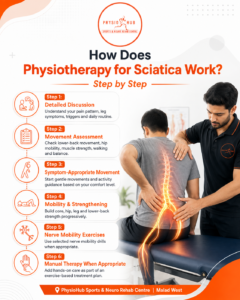
 Physiotheraphy in malad , mumbai | Physiohub|

At PhysioHub, Physiotherapy in Malad, Mumbai begins with a detailed assessment of your symptoms, spinal movement, hip mobility, muscle strength and nerve sensitivity.

Step 1: Detailed Discussion

Your physiotherapist may ask:

  • Where does the pain begin?
  • How far does it travel down the leg?
  • Do you experience numbness or tingling?
  • Which movements make symptoms better or worse?
  • Does sitting affect the pain?
  • Is your work physically demanding or desk-based?
  • Have you experienced similar symptoms before?

These small details can help identify patterns.

Step 2: Movement Assessment

The physiotherapist may then assess:

  • Lower-back movement
  • Hip mobility
  • Muscle strength
  • Leg movement
  • Balance
  • Walking pattern
  • Functional movements such as bending or standing
  • Nerve sensitivity where appropriate

Imaging is not automatically required for every person with back pain or sciatica. NICE guidance recommends that imaging should not routinely be offered in non-specialist settings unless the result is likely to change management.

Step 3: Symptom-Appropriate Movement

Early treatment may focus on movements that feel comfortable and help the patient gradually return to normal activity.

The aim is usually not complete bed rest.

NICE recommends advice on self-management and encourages people with low back pain with or without sciatica to continue normal activities where appropriate.

Step 4: Mobility and Strengthening

As symptoms allow, rehabilitation may include exercises for:

  • Core strength
  • Hip muscles
  • Lower-back control
  • Leg strength
  • Flexibility
  • Balance
  • Functional movement

The exercises should progress according to the patient’s response rather than following the same routine for everyone.

Step 5: Nerve Mobility Exercises

Some patients may benefit from carefully selected nerve mobility exercises.

These movements are designed to help the nervous system tolerate movement more comfortably. They should be prescribed after assessment because aggressive stretching is not appropriate for every case.

Step 6: Manual Therapy When Appropriate

Manual therapy may sometimes be used alongside exercise.

NICE recommends considering mobilisation, manipulation or soft-tissue techniques for low back pain with or without sciatica as part of a treatment package that includes exercise, rather than as a stand-alone solution.

What Are the Benefits of Physiotherapy for Sciatica?

Depending on the individual and the cause of symptoms, physiotherapy may help with:

  • Improving spinal and hip mobility
  • Building core and leg strength
  • Improving confidence during movement
  • Reducing stiffness
  • Improving walking tolerance
  • Improving sitting and standing strategies
  • Supporting a gradual return to work
  • Teaching safer lifting and movement techniques
  • Developing an exercise programme for long-term management
  • Helping patients understand which activities they can safely continue

One of the most valuable parts of physiotherapy is education.

When someone has experienced sharp pain down the leg, they may naturally become afraid to bend, walk or exercise. A gradual rehabilitation programme can help them understand which movements are safe and how to progress without rushing. Sciatica rehabilitation is not only about reducing pain. A good programme looks at movement, strength, nerve sensitivity, posture, daily habits and the activities you want to return to. Treatment should be personalised and adjusted according to how your symptoms respond.

Physiotherapy vs Chiropractic vs Osteopathy for Sciatica

Patients often wonder whether they should choose physiotherapy, chiropractic care or osteopathy.

Approach Main Focus May Include
Physiotherapy Movement, strength and functional recovery Exercise therapy, mobility work, manual therapy, education and activity progression
Chiropractic Care Joint and musculoskeletal function Selected manual techniques, mobility work and movement advice
Osteopathy Musculoskeletal movement and body mechanics Manual techniques, mobility-based approaches and movement assessment
Self-treatment alone Temporary symptom management Rest, activity modification or general exercises without personalised assessment

There is no universal answer for every patient.

Someone searching for a Chiropractor in Malad ,Mumbai or osteopathy in Malad Mumbai may benefit from first understanding what is actually causing or contributing to their symptoms.

At PhysioHub, different rehabilitation approaches can be considered according to the assessment rather than automatically choosing one technique.

Who Should Visit a Physiotherapist for Sciatica?

You may consider seeing a physiotherapist if:

  • Pain travels from your back or buttock into your leg
  • Sitting for long periods repeatedly triggers symptoms
  • You experience recurring episodes of sciatica
  • Your movement feels restricted
  • You have returned to work but symptoms keep interfering
  • Walking or standing tolerance has reduced
  • You feel uncertain about which exercises are safe
  • Symptoms are improving but you want structured rehabilitation

People involved in sport may also require a more performance-focused approach.

A Sports Physiotherapist in Mumbai may assess not only the painful area but also strength, movement control and the physical demands of returning to sport.

PhysioHub also provides sports rehabilitation services, including ACL rehab in Malad Mumbai, for individuals recovering from knee injuries who need structured return-to-activity training.

When Is Sciatica an Emergency?

Some symptoms require urgent medical attention rather than routine physiotherapy.

Seek urgent medical care if sciatica occurs with symptoms such as:

  • Severe or worsening weakness in both legs
  • Numbness around the genital or saddle region
  • New difficulty controlling urination
  • New loss of bowel control
  • Severe symptoms affecting both sides

These may indicate a serious spinal problem that needs immediate assessment.

How Much Does Physiotherapy for Sciatica Cost in Malad?

There is no single price for sciatica rehabilitation because treatment needs vary.

Pricing may depend on:

  • Initial assessment requirements
  • Complexity of the condition
  • Duration of each session
  • Number of sessions required
  • Whether manual therapy is included
  • Whether specialised rehabilitation is required
  • Individual recovery goals

Some people may need only guidance and a short rehabilitation programme, while others with persistent symptoms may require longer-term care.

Rather than choosing treatment based only on the lowest session price, consider whether the programme includes proper assessment, progression and follow-up.

What Are the Physiotherapy Trends for Sciatica in 2026?

Physiotherapy in 2026 is becoming increasingly focused on active, personalised and function-based rehabilitation.

Instead of relying only on passive treatments, rehabilitation programmes increasingly emphasise:

  • Individual exercise prescription
  • Strength and movement training
  • Patient education
  • Return-to-work planning
  • Sports-specific rehabilitation
  • Goal-based progress tracking
  • Combining manual therapy with active exercise when appropriate
  • Encouraging safe activity rather than prolonged rest

This approach is consistent with modern clinical guidance that places exercise, self-management and continued activity at the centre of rehabilitation for many people with low back pain and sciatica.

For people with more complex neurological movement problems, access to a Neuro rehab centre in Malad may also provide specialised assessment.

Neuro physiotherapy in Malad can be relevant when weakness, balance difficulties, walking problems or neurological conditions require a dedicated rehabilitation approach beyond routine musculoskeletal physiotherapy.

Why Choose PhysioHub in Malad, Mumbai?

At PhysioHub, rehabilitation starts with understanding the person behind the symptoms.

Dr. Pooja Mehta and the PhysioHub team focus on assessing movement, strength, mobility and functional limitations before planning treatment.

Depending on individual needs, services may include:

  • Physiotherapy in Malad
  • Sports physiotherapy and rehabilitation
  • Neuro rehabilitation
  • Chiropractic techniques where appropriate
  • Osteopathy in Malad
  • Post-surgical rehabilitation
  • ACL rehab in Malad
  • Strength and mobility programmes
  • Gait and movement rehabilitation

For someone looking for a physiotherapist in Mumbai, choosing a clinic close to home can also make consistent rehabilitation easier.

PhysioHub is located in Malad West, Mumbai, making it convenient for people looking for structured physiotherapy, sports rehabilitation or neurological rehabilitation in the area.

Frequently Asked Questions About Sciatica Physiotherapy

1. Can a physiotherapist help with sciatica?

Yes. A physiotherapist can assess movement, strength, nerve-related symptoms and daily activities before creating a personalised rehabilitation plan. Treatment may involve exercises, mobility work, education and manual therapy where appropriate.

2. What exercises are best for sciatica?

There is no single best exercise for everyone. The right exercise depends on the cause, symptom pattern, mobility and strength of the individual. Exercises should ideally be selected after an assessment.

3. Should I rest if I have sciatica?

Prolonged bed rest is generally not the preferred approach for most uncomplicated cases. Staying appropriately active and gradually returning to normal activities is commonly recommended, depending on symptoms and medical advice.

4. How long does sciatica take to improve with physiotherapy?

Recovery time varies. Some episodes improve within weeks, while persistent or complex cases can take longer. The cause of symptoms, severity, general health and consistency with rehabilitation can all affect recovery.

5. When should I visit a physiotherapist in Malad for sciatica?

Consider an assessment when pain repeatedly travels into the leg, affects walking or sitting, keeps returning or limits normal activities. Early assessment can help you understand your symptoms and determine an appropriate rehabilitation plan.

Take the Next Step Towards Comfortable Movement

Living with recurring leg and lower-back pain can affect work, sleep, exercise and even simple daily routines. You do not have to guess which stretches or online exercises are right for you.

If you are looking for a physiotherapist in Malad, Mumbai, PhysioHub can assess your symptoms and create a rehabilitation plan based on your movement, strength and individual goals.

Book an assessment with Dr. Pooja Mehta at PhysioHub Sports & Neuro Rehab Centre, Malad West, Mumbai, and take the first step towards moving with greater comfort and confidence.


Pain that settles with rest but returns again can feel confusing and frustrating. You rest for a couple of days, avoid heavy activity, use a hot pack, or even consider visiting a physiotherapist in Malad, Mumbai  and feel like things are finally getting better. Then you go back to work, climb stairs, lift a bag, sit for long hours, or restart exercise—and the same pain comes back.

This can happen with back pain, knee pain, neck stiffness, shoulder pain, sports injuries, and old injury areas. Many people think, “Maybe I just need more rest.” But if the pain keeps returning, rest may only be calming the symptoms for a short time. It may not be fixing the real reason behind the pain.

Your body may be trying to tell you something important. There may be muscle weakness, poor posture, joint stiffness, poor movement habits, overuse, nerve irritation, or incomplete recovery.

A trusted physiotherapist in Malad, Mumbai can help find out why your pain returns after rest and guide you with the right treatment plan. At Physio Hub in Malad, Mumbai, physiotherapy focuses on pain relief, movement correction, strengthening, and long-term recovery so you can get back to daily life with more confidence.

Pain may come back after rest because rest can reduce symptoms temporarily but may not correct the root cause. Recurring pain can be linked to muscle weakness, stiffness, poor posture, overuse, injury, nerve irritation or poor movement patterns. Physiotherapy helps by assessing the cause, improving strength, mobility and movement control.

What is Recurring Pain After Rest?

Recurring pain after rest means pain that improves when you stop activity but returns when you start moving again. It may feel like an ache, stiffness, sharp pain, tightness, burning, pulling, or weakness.

This type of pain can affect:

  • Lower back
  • Neck
  • Shoulder
  • Knee
  • Hip
  • Ankle
  • Wrist
  • Spine
  • Muscles and joints

Rest can calm irritation for some time. That is why you may feel better after sleeping, taking a break, or avoiding movement. But rest alone does not always improve strength, posture, joint mobility, flexibility, balance, or movement control.

For example, if your back pain is linked to weak core muscles, resting may reduce pain for a few days. But once you sit at work for long hours again, the same stress returns.

If knee pain is linked to weak hips or poor knee alignment, rest may feel helpful for a short time. But climbing stairs, walking fast, or returning to workouts can bring the pain back.

A physiotherapist in Malad, Mumbai looks beyond the painful spot. The goal is to understand how your whole body moves and why the same area keeps getting irritated. Recurring pain after rest means the symptoms reduce temporarily but return when your body faces load again. Physiotherapy helps find and treat the root cause.

Why Does Pain Come Back After Rest?

PhysioHub
PhysioHub

Pain often comes back after rest because the body has not fully rebuilt its ability to handle movement, load, and daily activity.

Rest may reduce irritation. But it may not solve weakness, stiffness, posture issues, or poor movement habits.

Common reasons include:

  • Weak muscles
  • Poor posture
  • Joint stiffness
  • Poor movement patterns
  • Reduced flexibility
  • Lack of strength training
  • Incomplete injury recovery
  • Overuse after returning too quickly
  • Nerve irritation
  • Poor sitting or lifting habits
  • Sports overload
  • Poor balance or coordination
  • Weak core muscles
  • Muscle imbalance
  • Reduced hip, shoulder, or ankle mobility
  • Old injuries that were never fully rehabilitated

Think about someone with neck pain from laptop work. They rest on Sunday and feel better. But by Monday evening, after six hours of screen time, the stiffness returns. The issue was not only tired muscles. It may also be posture, weak shoulder muscles, poor workstation setup, and lack of movement breaks.

Or imagine a runner with knee pain. They stop running for a week, feel better, and then restart with the same distance and speed. The pain comes back. Why? Because the knee may not have regained strength, control, or load tolerance yet.

The body needs gradual loading, not just rest.

Physical activity guidelines commonly recommend regular activity and muscle-strengthening exercises for adults because strength supports long-term movement health. Adults are advised to include muscle-strengthening activities involving major muscle groups on at least two days a week.

For low back pain, clinical guidance often encourages people to remain active within comfort instead of relying only on bed rest. Activity and exercise are commonly part of long-term recovery and recurrence prevention.

So, if pain keeps coming back after rest, your body may be saying, “I need strength, mobility, and better movement support.”

How Does Physiotherapy Help Step by Step?

Physiotherapy helps by finding why pain returns and then building a plan that helps your body tolerate daily movement again.

It is not about giving random exercises. It is about understanding your body, your routine, your pain triggers, and your recovery goals.

Step 1: Detailed Pain Assessment

The physiotherapist first understands your pain pattern.

They may ask:

  • When does the pain come back?
  • Does rest reduce it?
  • What activity triggers it?
  • Is pain worse after sitting, walking, lifting, or exercise?
  • Did it start after injury?
  • Is there tingling, numbness, or weakness?
  • Does the pain affect sleep or daily work?
  • Have you tried medicines, massage, or home remedies?

These questions help identify whether the pain may be linked to muscles, joints, nerves, posture, or movement habits.

For example, pain after sitting may point toward posture, weak core muscles, or spinal stiffness. Pain after stairs may suggest weak hips, poor knee control, or reduced ankle mobility. Pain after lifting may show poor lifting technique or lack of trunk stability.

Step 2: Movement and Posture Check

The therapist then checks how your body moves during simple daily actions.

This may include:

  • Walking
  • Sitting posture
  • Bending
  • Squatting
  • Lifting
  • Shoulder movement
  • Neck movement
  • Stair climbing
  • Balance testing
  • Core control

Sometimes, the pain is in one area, but the reason is somewhere else.

Knee pain may be linked to weak hips. Back pain may be linked to poor core strength. Shoulder pain may be linked to weak shoulder blade muscles or rounded posture.

This is why a full movement check matters. Without it, people often treat only the painful area and miss the actual cause.

Step 3: Pain Relief and Mobility Care

If pain is high, the first goal is to reduce discomfort and make movement easier.

Physiotherapy may include:

  • Manual therapy
  • Soft tissue release
  • Joint mobility work
  • Stretching guidance
  • Pain-relieving modalities
  • Posture correction
  • Activity modification

This stage helps calm pain and reduce stiffness.

But pain relief is not the final goal. It is the starting point. If the root cause is not corrected, the pain may return as soon as you increase activity again.

Step 4: Strengthening Weak Areas

Strengthening is often the missing piece in recurring pain.

If muscles are weak, the body may not support joints properly. Other muscles may overwork. This can create stress and repeated pain.

Exercises may focus on:

  • Core muscles
  • Glutes and hips
  • Thigh muscles
  • Calves
  • Shoulder stabilizers
  • Neck stabilizers
  • Back muscles
  • Foot and ankle muscles

Common exercises may include:

  • Bridges
  • Wall squats
  • Step-ups
  • Resistance band exercises
  • Calf raises
  • Core activation
  • Shoulder blade strengthening
  • Balance drills

A good physiotherapist in Malad, Mumbai will not give the same exercises to everyone. Your plan should match your pain, age, strength, activity level, lifestyle, and goals.

For example, an office worker with back pain needs a different plan than a runner with knee pain. A senior citizen with balance issues needs a different plan than a sportsperson returning after injury.

Step 5: Movement Correction

Pain often returns when the body keeps repeating the same poor movement pattern.

The therapist may correct:

  • Sitting posture
  • Lifting technique
  • Walking pattern
  • Knee alignment
  • Running form
  • Shoulder movement
  • Neck posture
  • Workstation habits
  • Exercise technique

Small changes can make a big difference.

Learning how to lift correctly can reduce back strain. Improving knee control while climbing stairs can reduce knee pain. Correcting laptop posture can reduce neck and shoulder discomfort.

The goal is to help your body move with less stress.

Step 6: Home Exercise and Prevention Plan

Physiotherapy works best when progress continues outside the clinic.

The therapist may guide you on:

  • Home exercises
  • Work breaks
  • Warm-up routines
  • Safe return to exercise
  • Sitting and standing habits
  • Load management
  • Prevention tips

This helps your body stay stronger even after the pain reduces.

Many people stop exercises once they feel better. But if recurring pain has been happening for months, consistency is important. A simple home plan can help maintain progress and reduce the chance of the pain coming back.

Physiotherapy helps recurring pain by assessing the cause, reducing pain, improving mobility, strengthening weak areas, correcting movement, and preventing repeated strain.

Benefits of Physiotherapy for Recurring Pain: Guidance from a Physiotherapist in Malad, Mumbai

Physiotherapy can help reduce repeated pain and improve how your body functions in daily life.

Key benefits include:

  • Identifies the root cause of pain
  • Reduces pain and stiffness
  • Improves muscle strength
  • Improves joint mobility
  • Corrects posture
  • Improves movement control
  • Reduces re-injury risk
  • Supports safe return to work
  • Helps with sports recovery
  • Improves balance and coordination
  • Reduces dependence on painkillers
  • Supports long-term pain management
  • Helps prevent pain from returning
  • Builds confidence in movement
  • Supports better daily function

Imagine an office worker who gets recurring back pain every week. Rest may help for a day or two. But if the real issue is long sitting, weak core muscles, and poor posture, the pain may keep returning.

A runner with recurring knee pain may need hip strengthening, calf loading, and training-load correction.

A senior citizen with repeated pain or balance problems may need strength and balance training. For neurological weakness or walking difficulty, care at a Neuro rehab centre in Malad or Neuro physio therapy in Malad may help improve movement and independence.

For athletes or active people, a Sports Physiotherapist in Mumbai can help plan safe strengthening, mobility, and return-to-sport progression.

The real benefit of physiotherapy is not just “less pain.” It is being able to trust your body again.

Physiotherapy vs Other Options for Recurring Pain

Care Option Main Focus Best For Limitation
Physiotherapy Pain relief, strength, mobility, movement correction Recurring pain, weakness, stiffness, injury rehab Needs consistency
Rest only Temporary symptom reduction Short-term flare-ups Does not correct root cause
Painkillers Temporary pain control Short-term pain relief Does not improve strength or movement
Massage Relaxation and tightness relief Muscle soreness May not prevent recurrence
General exercise Fitness Healthy individuals May worsen pain if not customized
Chiropractic care Spine and joint alignment focus Selected spine-related concerns Not suitable for every condition
Osteopathy Whole-body mobility and manual care Posture and movement concerns Needs proper assessment

Many people search for a Chiropractor in Malad or osteopathy in Malad when pain comes back after rest. These approaches may help in selected cases after proper evaluation.

However, Physiotherapy in malad is often more structured for recurring pain because it combines assessment, pain relief, strengthening, movement correction, and prevention.

Rest may make pain feel better for a few days. Painkillers may reduce discomfort. Massage may relax tight muscles. But if weakness, stiffness, or poor movement is still present, the same pain can return once you go back to normal activity.

Physiotherapy helps you understand why the pain is returning and what your body needs to recover better.

Who Needs Physiotherapy for Recurring Pain?

You may need physiotherapy if:

  • Pain improves with rest but returns again
  • Back pain comes back after sitting
  • Neck pain returns after laptop work
  • Knee pain returns after stairs
  • Shoulder pain returns after lifting
  • Pain keeps affecting work or sleep
  • You feel stiffness after inactivity
  • You have recurring sports injuries
  • You have weakness after surgery
  • You feel pain during workouts
  • You have poor posture
  • You have nerve symptoms like tingling or numbness
  • You are afraid to move after injury
  • You keep depending on painkillers
  • You want long-term recovery, not temporary relief

You do not have to wait until the pain becomes severe.

If pain keeps returning, changes how you move, or stops you from doing normal activities, it is worth getting assessed.

Athletes and active people may need support from a Sports Physiotherapist in Mumbai for safer return to sport.

Patients recovering from knee ligament injuries may need acl rehab in Malad for structured strengthening and stability training.

People recovering after stroke, neurological weakness, or balance problems may need care from a Neuro rehab centre in Malad.

A trusted physiotherapist in mumbai can help guide safe recovery based on the patient’s condition.

Cost and Pricing Factors for Physiotherapy

The cost of physiotherapy for recurring pain depends on the condition and the treatment plan.

Common pricing factors include:

  • Type of pain
  • Cause of recurring symptoms
  • Severity of pain
  • Duration of the problem
  • Need for manual therapy
  • Need for strengthening
  • Sports rehabilitation requirements
  • ACL rehab requirements
  • Neuro rehabilitation needs
  • Use of equipment or modalities
  • Clinic-based or home-based care
  • Number of sessions required
  • Therapist expertise
  • Patient goals and activity level

For example, mild posture-related pain may need fewer sessions. Long-standing back pain, sports injury, ACL recovery, or neuro rehabilitation may need a longer plan.

Some patients may need basic strengthening and posture correction. Others may need advanced balance training, gait training, or sport-specific rehabilitation.

The best way to understand expected cost is to book an assessment with a physiotherapist in Malad, Mumbai. After evaluation, the therapist can explain the treatment plan clearly.

Industry Trends in 2026

In 2026, physiotherapy is becoming more focused on prevention, strength, and personalized recovery.

Patients no longer want only temporary pain relief. They want to understand why pain keeps coming back and how to stop the cycle.

Important trends include:

  • Movement-based assessment
  • Strength-focused rehabilitation
  • Posture and ergonomic education
  • Sports-specific rehab
  • ACL recovery programs
  • Neuro rehab with gait training
  • Home exercise tracking
  • Wearable-supported progress monitoring
  • Patient education for prevention
  • Personalized exercise plans
  • Early physiotherapy for recurring pain

Technology is also becoming part of rehabilitation. Recent research has explored movement-analysis systems for low-back pain rehabilitation, showing how digital tools may support exercise monitoring and feedback in clinical rehab settings.

Still, technology cannot replace personal assessment. Pain is connected to lifestyle, movement habits, strength, stress, sleep, work routine, and confidence.

A good physiotherapy plan needs human understanding and safe progression. It should not only reduce pain today but also prepare your body for tomorrow.

Physiotherapy in 2026 focuses on finding root causes, improving strength, correcting movement, preventing recurrence, and using technology to support guided rehab.

Why Choose Physio Hub in Malad, Mumbai?

Physio Hub provides personalized physiotherapy care for recurring pain, muscle weakness, sports injuries, neuro rehabilitation, and movement recovery in Malad, Mumbai.

If you are searching for a trusted physiotherapist in Malad, Mumbai, Physio Hub offers assessment-based care focused on pain relief, strengthening, mobility, and long-term prevention.

Why patients choose Physio Hub:

  • Personalized assessment
  • Pain relief and mobility care
  • Strength-based rehabilitation
  • Posture and movement correction
  • Sports injury rehabilitation
  • ACL rehabilitation support
  • Neuro rehabilitation support
  • Balance and gait training
  • Patient-friendly approach
  • Convenient location in Malad, Mumbai

Physio Hub supports patients looking for Physiotherapy in malad, Sports Physiotherapist in Mumbai, acl rehab in Malad, physiotherapist in mumbai, Neuro rehab centre in malad, Neuro physio therapy in malad, osteopathy in malad, and Chiropractor in malad.

The goal is simple: help you understand why your pain returns, treat the cause, and move with more confidence.

At Physio Hub, the focus is not only on temporary relief. It is on helping you move better, recover stronger, and feel safer in daily life.

FAQs

1. Why does my pain come back after rest?

Pain may come back after rest because rest reduces symptoms temporarily but does not fix the root cause. Weak muscles, stiffness, poor posture, nerve irritation, or poor movement patterns can trigger pain again when activity starts.

2. Is rest enough for back pain or knee pain?

Rest may help during a short flare-up, but it is not always enough. If pain keeps returning, physiotherapy can help identify the cause and guide strengthening, mobility, and movement correction.

3. Can physiotherapy stop recurring pain?

Physiotherapy can help reduce recurring pain by treating the reason behind it. This may include muscle strengthening, posture correction, mobility work, balance training, and activity modification.

4.When Should I Visit a Physiotherapist in Malad, Mumbai, for Recurring Pain?

You should visit a physiotherapist if pain keeps returning, affects daily work, causes weakness, changes how you move, or does not improve with rest. Early care can prevent the problem from becoming worse.

5. Can pain return because of weak muscles?

Yes. Weak muscles can reduce joint support and increase pressure on other areas. This can cause repeated pain in the back, neck, shoulder, knee, hip, or ankle.

Does your pain feel better after rest but return again when you move?

Visit Physio Hub in Malad, Mumbai and consult a trusted physiotherapist in Malad, Mumbai for personalized assessment, strengthening, and rehabilitation.

Book your consultation today and take the first step toward long-term pain relief, better movement, and stronger recovery.

A stroke can be a life-changing event, leaving individuals with physical, emotional, and cognitive challenges. One of the most common struggles stroke patients face is the difficulty in walking again. For many, even after the acute phase of recovery, returning to normal movement can seem impossible. But why does this happen?

Walking involves a complex combination of brain and muscle coordination. When a stroke disrupts the brain’s ability to communicate with the muscles, walking becomes a monumental challenge. This is where neuro physiotherapy in Malad comes in, offering tailored rehabilitation therapies to help patients regain their mobility. Additionally, incorporating a chiropractor in Malad for spinal alignment and posture corrections can further assist stroke recovery, improving balance and muscle coordination.

At Physio Hub, we understand that stroke rehabilitation can be a long and difficult journey. In this blog, we will break down the reasons why stroke patients struggle to walk again, and how the right neuro rehab process and adjunct treatments like chiropractic care can help them overcome these challenges.

Stroke patients often struggle to walk again due to impaired brain-muscle communication, muscle weakness, and loss of coordination. The neuro rehab process in Mumbai, especially through neuro physiotherapy, helps patients retrain the brain and muscles to restore mobility. Integrating care from a chiropractor near me can also enhance recovery by addressing spinal alignment issues.

What is Stroke Rehabilitation?

Stroke rehabilitation In Malad or neuro physiotherapy is the process of helping a stroke survivor regain lost abilities, such as walking, speaking, and daily living activities. After a stroke, the brain’s normal function is disrupted, often resulting in motor impairments such as weakness or paralysis on one side of the body.

In neuro physiotherapy Mumbai, therapists use a range of exercises and techniques aimed at retraining the brain’s ability to communicate with the muscles and restore normal movement.

Stroke rehab focuses on:

  • Rebuilding muscle strength
  • Improving balance and coordination
  • Enhancing functional mobility (walking, sitting, standing)
  • Regaining the independence to perform everyday tasks

Additionally, a chiropractor in Mumbai can support stroke recovery by correcting spinal misalignments that affect posture and movement, further aiding the restoration of mobility.

Neuro rehab retrains the brain to regain lost mobility, with a focus on restoring function after a stroke. Chiropractic care complements this process by improving spinal health.

Why Do Stroke Patients Struggle to Walk Again? (Causes / Importance)

Stroke patients struggle with walking due to several factors that impact both their brain function and physical abilities. Here are the main reasons:

  • Brain-muscle disconnect: A stroke damages brain cells, disrupting signals between the brain and muscles. This can impair motor skills needed for walking.
  • Weak muscles: Post-stroke muscle weakness or paralysis, often on one side, can prevent proper movement and walking.
  • Impaired balance: Stroke survivors may suffer from poor balance, making walking unsafe or impossible without support.
  • Spasticity or muscle stiffness: Stiff, tight muscles, known as spasticity, can make it difficult to move limbs, affecting walking.
  • Gait abnormalities: Changes in how one walks (gait issues) can occur post-stroke, leading to inefficient movement and difficulty walking.

The importance of early stroke therapy steps is crucial to overcoming these challenges. The sooner a patient starts rehabilitation, the better the chances of regaining mobility.

For patients with ongoing balance or spinal alignment issues, consulting a chiropractor near me can help address musculoskeletal imbalances that may be contributing to walking difficulties.

Brain damage and muscle weakness are the main reasons stroke patients struggle to walk again. Early rehabilitation is key to improving mobility, and chiropractic care can help with balance and spinal health.

How Stroke Rehabilitation Works (Process / Step-by-step)
neuro physiotherapy Mumbai

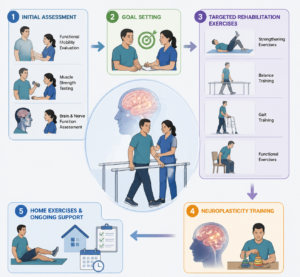
The neuro rehab process follows a structured approach to help stroke patients regain their walking ability. Here’s a step-by-step breakdown of how neuro physiotherapy in Malad West works:

 1: Initial Assessment

  • Functional mobility evaluation: Assess how the stroke has affected movement, coordination, and balance.
  • Muscle strength testing: Identify weaknesses and areas that need improvement.
  • Brain and nerve function assessment: Check how the brain communicates with the muscles.

 2: Goal Setting

  • Work with the patient to set realistic, personalized goals for walking and mobility.

 3: Targeted Rehabilitation Exercises

  • Strengthening exercises: Focus on regaining muscle strength in the legs, core, and upper body.
  • Balance training: Use various exercises to improve coordination and stability during walking.
  • Gait training: Teach patients how to walk correctly, often using assistive devices like walkers or canes.
  • Functional exercises: Train patients to perform everyday activities such as standing up, sitting down, and walking short distances.

 4: Neuroplasticity Training

  • Neuroplasticity is the brain’s ability to rewire itself after injury. Rehabilitation exercises focus on enhancing this process to help the brain regain control over affected body parts.

 5: Home Exercises and Ongoing Support

  • Patients are often given exercises to do at home, along with follow-up therapy sessions to track progress and make adjustments to the rehabilitation plan.

Additionally, many stroke survivors benefit from seeing a chiropractor in Mumbai to address any musculoskeletal issues that may be hindering their recovery.

Rehabilitation starts with an assessment, followed by strength, balance, and gait training, and ongoing support to ensure progress. Chiropractic care complements this by addressing spinal health.

Benefits of Stroke Rehabilitation (Bullet Format)
neuro and sports rehab centre

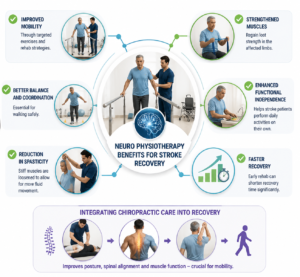
Neuro physiotherapy in Mumbai offers several benefits for stroke survivors who are working to regain their ability to walk:

  • Improved mobility: Through targeted exercises and rehab strategies.
  • Strengthened muscles: Regain lost strength in the affected limbs.
  • Better balance and coordination: Essential for walking safely.
  • Enhanced functional independence: Helps stroke patients perform daily activities on their own.
  • Reduction in spasticity: Stiff muscles are loosened to allow for more fluid movement.
  • Faster recovery: Early rehab can shorten recovery time significantly.

In addition, integrating chiropractic care into the recovery plan can aid in improving posture, spinal alignment, and muscle function, which are crucial for mobility.

Neuro rehab leads to better mobility, balance, and strength key components of walking again. Chiropractic care enhances overall spinal health and posture.

Neuro Rehab vs General Physiotherapy (Comparison)

Feature Neuro Rehab General Physiotherapy
Focus Neuro rehabilitation (stroke, brain injury) Musculoskeletal conditions (pain, injury)
Methods Gait training, balance, neuroplasticity Strengthening, flexibility
Target Audience Stroke survivors, neurological patients Sports injuries, joint pain
Equipment Neuro-specific devices (e.g., gait trainers) Standard physio tools (e.g., resistance bands)
Recovery Goal Restoring functional movement Symptom relief and mobility

Neuro rehab is specialized for stroke recovery, whereas general physiotherapy targets more common musculoskeletal issues.

Who Needs Stroke Rehabilitation?

The following individuals are good candidates for neuro physiotherapy in Malad West:

  • Stroke survivors: Those who have had a stroke and are struggling with mobility.
  • Brain injury patients: Individuals who have experienced traumatic brain injury.
  • Paralysis patients: Those who have lost the use of limbs or certain body parts due to stroke.
  • Older adults: Those with a higher risk of stroke or fall-related injuries.
  • Patients with balance and coordination problems: Often due to stroke or neurological damage.

Anyone with stroke-related movement issues should consider neuro rehab to restore mobility and independence. Chiropractic care may also benefit individuals with posture and balance issues.

Cost of Stroke Rehabilitation (Pricing Factors)

The cost of neuro rehab process in Malad Mumbai depends on:

  • Type of treatment (intensive or general rehabilitation)
  • Session frequency (daily, weekly)
  • Length of treatment (short-term or long-term)
  • Therapist expertise
  • Technology and equipment used

Average cost in Malad:

  • ₹1000 – ₹3000 per session (depending on treatment complexity). Chiropractic care typically ranges from ₹1000 – ₹2000 per session.

Costs vary based on therapy intensity, frequency, and duration. Adding chiropractic sessions may slightly increase the cost but provides additional benefits for mobility.

Industry Trends in 2026

By 2026, neuro rehab will continue to evolve with technology and advancements in stroke recovery. Key trends include:

  • AI-assisted rehabilitation: Robotics and AI will help patients regain mobility more quickly.
  • Neuroplasticity-focused therapies: More therapies aimed at harnessing the brain’s ability to heal itself.
  • Tele-rehabilitation: Online therapy sessions for at-home support.
  • Personalized rehab plans: More tailored treatments for individuals based on their recovery pace.
  • Chiropractic integration: Increased use of chiropractic care to improve spinal health and aid mobility.

In 2026, expect faster, tech-driven, and highly personalized stroke rehab treatments, with chiropractic care playing a bigger role.

Why Choose Physio Hub in Malad?

If you’re looking for a neuro rehab centre in Malad, Physio Hub is the right choice due to:

  • Specialized stroke rehabilitation with experienced therapists.
  • Personalized rehab plans designed to restore mobility.
  • State-of-the-art equipment and technologies to aid recovery.
  • Convenient location in Malad West, close to key transport hubs.

Additionally, we offer chiropractic care to help address spinal misalignments, which can significantly improve recovery outcomes.

Choose Physio Hub for expert stroke rehab and faster recovery in Malad Mumbai, with the added benefit of chiropractic care.

FAQs

1. How soon can stroke patients start rehabilitation?

Patients should start rehab as soon as medically cleared, often within days or weeks post-stroke for the best results.

2. What exercises do stroke patients do in physiotherapy?

Stroke physiotherapy includes strengthening exercises, balance training, gait practice, and neuroplasticity exercises.

3. How long does it take for stroke patients to walk again?

Walking recovery time varies, but patients often see improvements within 6–12 weeks with consistent therapy.

4. Can physiotherapy cure paralysis after stroke?

While physiotherapy can’t cure paralysis, it can significantly improve function and movement in affected limbs.

5. Is home physiotherapy effective for stroke patients?

Yes, home physiotherapy can complement in-clinic sessions and help maintain progress.

Are you or a loved one struggling to regain mobility after a stroke? Early intervention is crucial. Start your recovery journey with Physio Hub today!

Book your consultation now and take the first step toward reclaiming your life.
 Visit us in Malad, Mumbai or call for more information.

Get back on your feet with expert neuro rehab at Physio Hub!

Recovering from a neurological condition is not just physical — it’s deeply emotional too. One day, everything feels normal. The next, even simple tasks like walking, holding a cup, or buttoning a shirt can become a challenge.

If you or your loved one is going through this, you’ve probably asked yourself — “Will things get better?”
The answer is yes… but recovery needs the right support, patience, and expert care.

This is where a Sports and Neuro rehab centre in Malad can truly make a difference. It’s not just about exercises. It’s about helping your brain relearn what it once knew. Step by step. Day by day.

At Physio Hub, we often see patients come in feeling unsure, even scared. But with the right neuro physiotherapy Mumbai approach, we also see something powerful — progress. A hand that starts to move again. A step that feels steadier. A smile that slowly returns.

Because recovery isn’t instant… but it is possible.


Neuro physiotherapy at a Neuro rehab centre in Malad helps patients recover from conditions like stroke, paralysis, and brain injury by improving movement, balance, and coordination. It uses targeted exercises, neuroplasticity techniques, and personalized therapy plans to restore independence and enhance quality of life.


What is Neuro Physiotherapy?

Neuro physiotherapy is a specialized form of physiotherapy designed for people dealing with conditions affecting the brain, spinal cord, or nerves.

But here’s a simpler way to understand it — it helps your brain and body reconnect.

After a stroke or injury, the brain struggles to send the right signals to muscles. That’s why movements feel weak, slow, or uncoordinated. Through neurological physiotherapy, we train the brain to create new pathways. This process is called neuroplasticity.

Over time, these new pathways help restore movement and control.

Common conditions treated include:

  • Stroke recovery
  • Paralysis
  • Brain injury
  • Parkinson’s disease
  • Multiple sclerosis
  • Spinal cord injuries

In a neuro physiotherapy setup, therapy is focused, repetitive, and goal-oriented — because that’s how the brain learns best.


Causes / Importance / Need

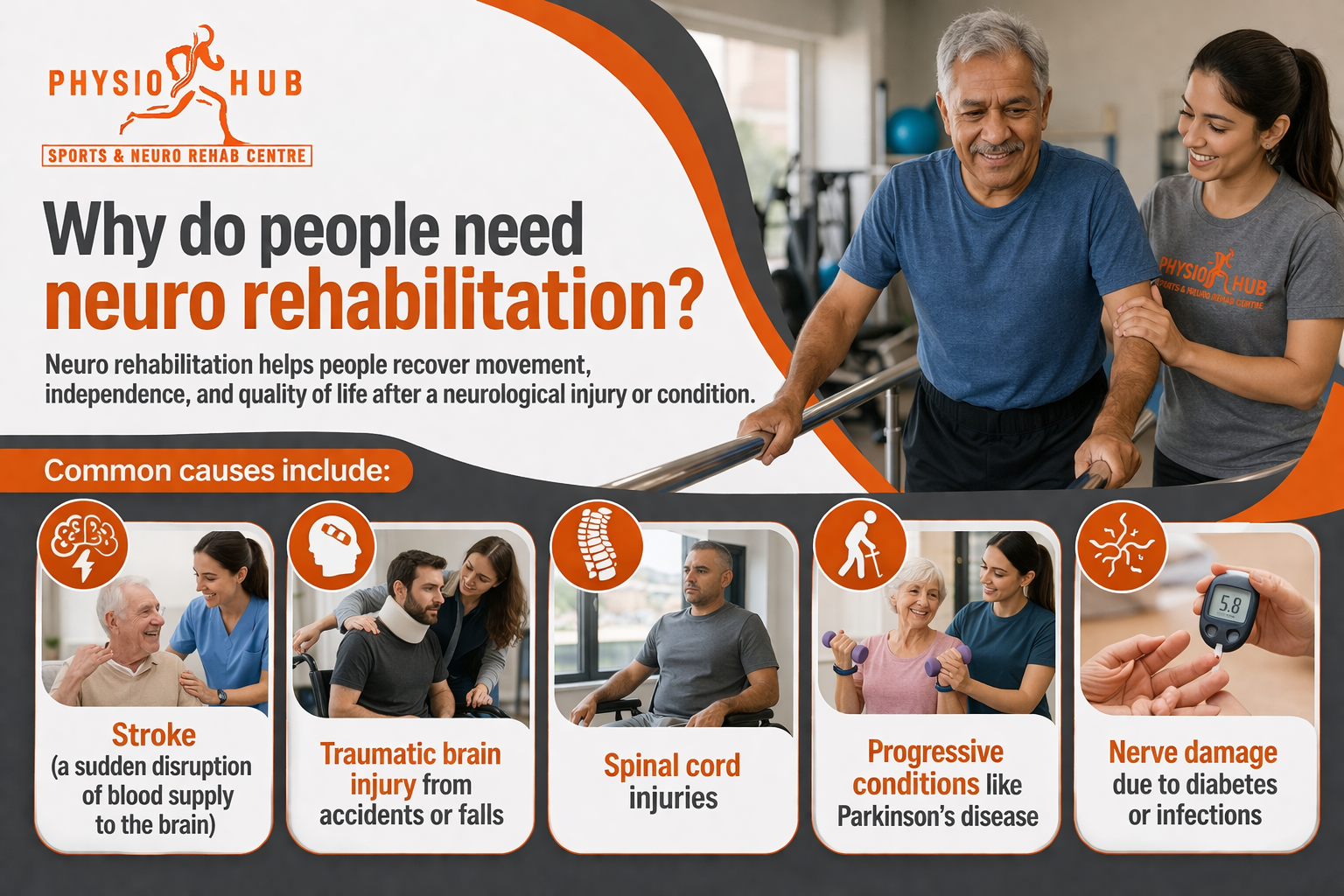
Why do people need neuro rehabilitation?

Neurological conditions don’t always come with a warning. Sometimes, they happen suddenly.

Common causes include:

  • Stroke (a sudden disruption of blood supply to the brain)
  • Traumatic brain injury from accidents or falls
  • Spinal cord injuries
  • Progressive conditions like Parkinson’s disease
  • Nerve damage due to diabetes or infections

Now think about this — what happens if recovery is delayed?

Why is early neuro rehab important?

  • Prevents stiffness and muscle tightness
  • Keeps joints flexible and active
  • Helps the brain relearn movements faster
  • Reduces the risk of long-term disability
  • Improves independence in daily life

A patient once shared this at Physio Hub
“I waited too long thinking it would get better on its own… I wish I had started earlier.”

Early treatment at a post-stroke rehab centre can make a huge difference. The earlier you start, the better your chances of regaining movement and independence.


How it Works / Process

What actually happens inside a Neuro Rehab Centre in Malad?

Many people imagine therapy as just basic exercises. But it’s much more structured and purposeful than that.

At Physio Hub, every journey begins with understanding the patient — not just the condition.

1. Detailed Assessment

We first evaluate:

  • Muscle strength
  • Balance and posture
  • Ability to perform daily activities

2. Personalized Treatment Plan

No two patients are the same.
A therapy plan is created based on:

  • Severity of condition
  • Individual goals (walking, hand movement, independence)

3. Targeted Therapy Sessions

This is where progress begins:

  • Movement therapy clinic exercises
  • Walking and balance training
  • Coordination improvement drills

4. Advanced Neuro Techniques

We use techniques that actively retrain the brain:

  • Neurofacilitation
  • Task-specific training (like picking objects)
  • Functional electrical stimulation (if needed)

5. Continuous Monitoring

Recovery is not linear. Some days are better than others.
That’s why we constantly track progress and adjust therapy.

At a neuro rehab centre in Malad, recovery is personalized. Every small improvement is tracked, encouraged, and built upon.


Benefits of Neuro Physiotherapy

What changes can you expect with therapy?

Recovery may start small — maybe a finger movement, a better grip, or standing without support. But these small wins matter.

Over time, neuro physiotherapy can help:

  • ✔ Improve muscle strength and control
  • ✔ Restore balance and coordination
  • ✔ Reduce stiffness and spasticity
  • ✔ Help you walk more confidently
  • ✔ Improve hand and finger movements
  • ✔ Make daily tasks easier
  • ✔ Bring back a sense of independence

Emotional & Mental Benefits

Let’s not ignore this part — recovery affects the mind too.

  • Builds confidence
  • Reduces fear of movement
  • Improves motivation
  • Gives hope during difficult days

One patient once said, “The day I walked without support, I felt like I got my life back.”

Neuro physiotherapy doesn’t just heal the body — it rebuilds confidence, independence, and hope.


Comparison with Alternatives

Treatment Option Focus Area Effectiveness Personalization Long-term Results
Neuro Physiotherapy Brain-body connection High Highly tailored Excellent
General Physiotherapy Muscles & joints Moderate Limited Moderate
Medication Only Symptom control Low No Temporary relief
Surgery (if required cases) Structural correction Case-based Limited Depends

For long-term recovery, neurological physiotherapy focuses on rebuilding function — not just managing symptoms.


Who is a Good Candidate?

How do you know if you need neuro rehab?

Ask yourself:

  • Is walking becoming difficult or unstable?
  • Do you feel weakness in your arms or legs?
  • Are daily tasks like dressing or eating harder than before?
  • Has there been a recent stroke or brain injury?

If yes, it’s time to consider visiting a neuro rehab centre in Malad, Mumbai.

Ideal candidates include:

  • Stroke survivors
  • Brain injury patients
  • Individuals with paralysis
  • Elderly patients with mobility issues
  • Patients with neurological disorders

If your body isn’t responding the way it used to, early intervention at a movement therapy clinic can change the outcome.


Cost / Pricing Factors

What determines the cost of treatment?

Costs can vary depending on:

  • Severity of the condition
  • Type of therapy required
  • Duration of the rehabilitation program
  • Frequency of sessions
  • Use of advanced equipment

Here’s something worth thinking about — delaying treatment may seem like saving money, but it often leads to longer recovery and higher costs later.

General insight:

  • Regular sessions are affordable and structured
  • Advanced programs may cost more due to specialized care

Investing early in a neuro rehab centre in Malad can reduce long-term medical expenses and improve recovery speed.


Industry Trends in 2026

Neuro rehabilitation is evolving quickly. And that’s good news for patients.

Here’s what’s changing:

  • AI-supported therapy plans for better accuracy
  • Robotics helping patients relearn walking
  • Virtual reality for engaging movement training
  • Non-invasive stimulation techniques like rPMS
  • Digital progress tracking for better results

Clinics like Physio Hub in Malad, Mumbai are adopting these innovations to make recovery more effective and engaging.

Modern neuro rehab is becoming smarter, faster, and more personalized in 2026.


Why Choose Physio Hub in Malad?

Choosing the right Neuro rehab centre in Malad can shape your recovery journey.

At Physio Hub, care goes beyond treatment.

What makes it different?

  • ✔ Expertise in neuro physiotherapy Mumbai
  • ✔ Experienced therapists in neurological recovery
  • ✔ Personalized treatment plans
  • ✔ Advanced therapy techniques
  • ✔ Patient-focused approach
  • ✔ Convenient Malad, Mumbai location

Most importantly, patients are not treated like cases — they are treated like people with goals, emotions, and a story.

Physio Hub focuses on real recovery — helping patients regain independence, confidence, and control over their lives.


FAQs

1. How long does neuro physiotherapy take to show results?

It depends on the condition, but many patients start noticing small improvements within a few weeks of consistent therapy.

2. Can stroke patients fully recover?

Recovery varies, but with the right care at a post-stroke rehab centre, many patients regain significant independence.

3. Is neuro physiotherapy painful?

No, therapy is designed to be safe and comfortable, adjusted to each patient’s tolerance.

4. How often should therapy sessions be done?

Usually 3–5 sessions per week are recommended for effective recovery.

5. Can elderly patients benefit from neuro rehab?

Absolutely. Neuro physiotherapy helps improve balance, mobility, and independence in elderly patients.

Recovery may feel uncertain right now… but you don’t have to go through it alone.

If you or your loved one is facing difficulty with movement, balance, or coordination — take that first step.

Begin your recovery journey with Physio Hub – Neuro Rehab Centre in Malad
Personalized care. Expert guidance. Real progress.