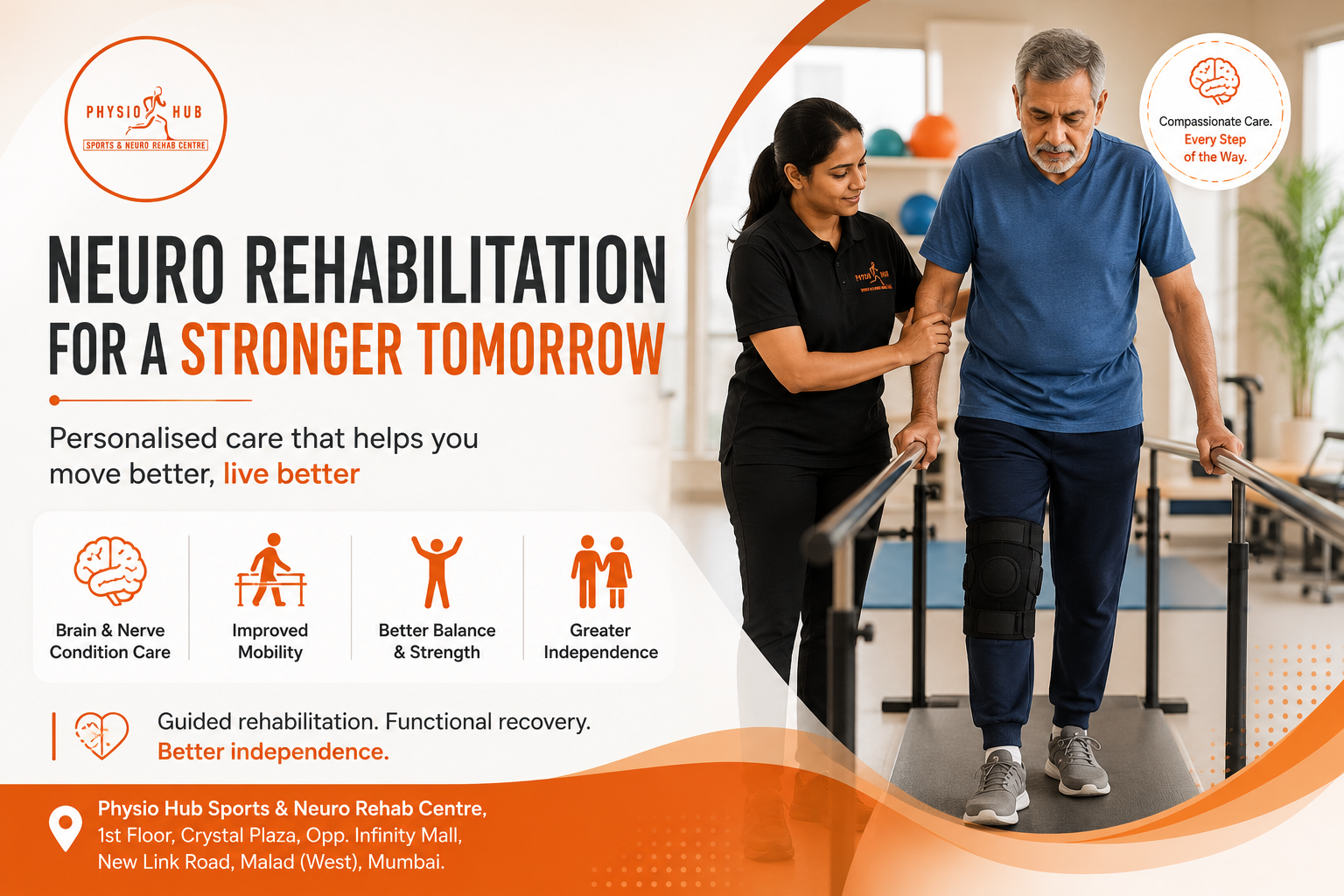
A stroke, brain injury or neurological condition can change daily life in ways that are difficult to prepare for. Simple activities such as sitting up in bed, standing from a chair, walking across a room or holding a cup may suddenly need more effort and support. For families looking for neuro rehabilitation in Malad, the right guidance can help create a safer, more structured path towards improved movement, confidence and everyday independence.
For the patient, this can feel frustrating and exhausting. For the family, it can be equally difficult to watch someone they care about struggle with movements that once felt automatic. Questions often come quickly. Will they walk again? How much support will they need? Are the exercises safe?
Neuro rehabilitation offers a structured and personalised way to work through these challenges. Rather than giving every patient the same routine, treatment focuses on the movements that matter most in that person’s life.
Recovery may not always be fast or predictable. Some days feel encouraging, while others feel slower. Still, regular practice, realistic goals and the right professional guidance can help patients move more safely and work towards greater independence.
How Does Neuro Rehabilitation Help Patients Regain Independence?
Neuro rehabilitation helps people with neurological conditions improve movement, balance, strength, coordination and daily function. A personalised programme may include walking practice, functional exercises, posture training and caregiver guidance, helping patients perform everyday activities more safely and with less assistance.
What Is Neuro Rehabilitation?
Neuro rehabilitation is a structured treatment programme for people whose movement or daily function has been affected by a condition involving the brain, spinal cord or nerves.
It may support people living with or recovering from:
- Stroke
- Traumatic brain injury
- Spinal cord injury
- Parkinson’s disease
- Multiple sclerosis
- Peripheral nerve injuries
- Balance and coordination disorders
- Other neurological conditions affecting movement
Rehabilitation is not only about doing exercises. It is about helping a person improve function, reduce limitations and take part in daily life as fully as possible.
A patient recovering from a stroke, for example, may need help learning how to stand safely or use one arm again. Someone with Parkinson’s disease may need support with balance, posture, turning or walking with more confidence.
Even when two people have the same diagnosis, their difficulties may be completely different. One person may struggle to sit without support. Another may be able to walk but feel unsteady while turning or climbing stairs.
That is why treatment should never be based on the diagnosis alone. A personalised assessment helps the physiotherapist understand what the patient can do now, what feels difficult and what matters most in daily life.
Neuro rehabilitation focuses on meaningful movement. It helps patients practise everyday activities, manage physical limitations and build confidence step by step.
Why Is Neuro Rehabilitation Important?
Neurological conditions can affect much more than muscle strength. They may also change balance, sensation, posture, coordination, walking and confidence.
A person may need neuro rehabilitation because of:
- Weakness on one side of the body
- Difficulty sitting or standing independently
- Poor balance or repeated falls
- Muscle stiffness or tightness
- Reduced coordination
- Difficulty using an arm or hand
- Changes in walking pattern
- Fear of movement or falling
- Dependence during daily activities
- Reduced stamina after illness or hospitalisation
Imagine wanting to walk to the bathroom but feeling unsure whether your leg will support you. Or needing help every time you want to get out of bed. These challenges can affect confidence just as much as physical ability.
Neuro rehabilitation is important because it gives patients a safe and guided way to practise movement. It can also help prevent people from becoming more inactive because of fear, weakness or stiffness.
When movement is avoided for too long, muscles may become weaker and joints may feel stiffer. Confidence can also drop. The aim of rehabilitation is not to push the patient too hard. It is to help them practise at the right level, with the right amount of support.
How Does Neuro Rehabilitation Work Step by Step?
Step 1: Understanding the Patient’s Condition
The process begins with a conversation.
The physiotherapist asks about the patient’s diagnosis, medical history, symptoms and daily challenges. This is also a chance for the patient and family to explain what has changed since the illness or injury.
The physiotherapist may ask:
- What activities have become difficult?
- Does the patient need help at home?
- Has the patient fallen or nearly fallen?
- Is there pain, stiffness or fatigue?
- Which movements matter most to the patient?
These questions help the therapist understand the person behind the diagnosis.
For example, a patient may say, “I want to walk to the kitchen without holding the wall,” or “I want to use my hand while eating.” These personal goals help make rehabilitation more practical and meaningful.
Step 2: Assessing Movement and Functional Ability
The next step is a detailed movement assessment.
A neuro physiotherapist may check:
- Muscle strength
- Joint movement
- Sitting and standing balance
- Posture
- Coordination
- Walking pattern
- Transfers between bed and chair
- Ability to use the arms and legs
- Risk of falling
- Ability to perform daily activities
The assessment is not about judging the patient. It is about understanding their current abilities and finding the safest place to begin.
A person may be able to stand but need help shifting weight from one leg to the other. Another may have good strength but struggle with balance. These small details guide the treatment plan.
Step 3: Setting Practical Recovery Goals
Goals should feel useful, realistic and connected to daily life.
Examples may include:
- Sitting without support
- Standing with less assistance
- Walking safely inside the home
- Using the affected hand during meals
- Managing a step
- Moving from the bed to a chair
- Returning to work or social activities
A goal does not always need to be big.
For one patient, walking independently may be the long-term aim. For another, standing safely for 30 seconds may already be a meaningful first step.
When patients are involved in goal setting, they often feel more connected to the rehabilitation process. It gives them something clear to work towards.
Step 4: Creating a Personalised Treatment Plan
Once the assessment is complete, the physiotherapist creates a plan based on the patient’s needs.
The programme may include:
- Strengthening exercises
- Balance training
- Walking and gait practice
- Posture correction
- Coordination exercises
- Functional movement training
- Flexibility and mobility work
- Task-specific practice
- Home exercise guidance
- Caregiver education
No two plans should look exactly the same.
A patient with weak leg control may focus more on standing and stepping. Someone with poor arm function may spend more time practising reaching, gripping or using the hand during daily tasks.
The plan should also change over time. As the patient improves, the exercises may become more challenging. If fatigue or pain increases, the programme may need to be adjusted.
Step 5: Practising Real-Life Movements
Functional practice is an important part of neuro physiotherapy in Malad.
Rather than doing only isolated exercises, the patient may practise movements that are used in real life.
These may include:
- Rolling and sitting up in bed
- Standing from a chair
- Reaching for an object
- Walking through a doorway
- Turning safely
- Climbing a step
- Using the affected arm
- Moving safely in the bathroom or kitchen
Why does this matter?
Because lifting a leg during an exercise is useful, but learning how to place that foot safely while walking may be even more important. Strengthening the arm helps, but using it to hold a spoon or button a shirt may be the real goal.
Rehabilitation becomes more meaningful when the patient can connect the exercise to daily life.
Step 6: Reviewing Progress Regularly
Progress is not always dramatic.
Sometimes it is seen in small but important changes, such as:
- Needing less physical support
- Standing for longer
- Taking more controlled steps
- Using an affected limb more often
- Feeling less afraid while moving
- Completing a daily activity with greater ease
A patient who once needed two people to help them stand may later need only one. Someone who avoided walking may begin taking a few steps with confidence.
These changes deserve to be noticed.
Regular reviews help the physiotherapist understand what is improving, what still needs support and how the exercises should be changed.
Neuro rehabilitation usually includes assessment, goal setting, personalised treatment, real-life movement practice and regular progress reviews.
What Are the Benefits of Neuro Rehabilitation?
A personalised programme may support:
- Better sitting and standing balance
- Improved muscle strength
- Safer walking
- Better coordination
- Improved posture and body control
- Greater confidence during movement
- Increased participation in daily activities
- Reduced dependence on caregivers
- Better understanding of safe movement
- Practical guidance for family members
The benefits are not limited to what happens inside the clinic.
A patient may begin moving more safely at home. They may need less help getting out of bed, feel more confident walking to the bathroom or start using an affected hand during meals.
Family members may also feel more prepared because they learn how to assist without doing everything for the patient.
Results vary from person to person. The condition, its severity, the patient’s general health and regularity of practice all play a role. In some cases, a chiropractor in Malad may also be consulted as part of a wider movement and pain-management plan, depending on the patient’s condition and medical suitability.
Neuro rehabilitation should not be seen as a quick fix or guaranteed cure. It is a guided process that helps patients work towards practical and realistic improvements.
Neuro Rehabilitation vs General Exercise: What Is the Difference?
| Factor | Neuro rehabilitation | General exercise programme |
|---|---|---|
| Main purpose | Improve movement affected by a neurological condition | Improve general fitness and strength |
| Assessment | Detailed neurological and functional assessment | Basic fitness or movement assessment |
| Exercise selection | Based on balance, coordination, tone, weakness and function | Usually based on fitness goals |
| Daily activities | Includes task-specific practice | May not focus on everyday activities |
| Progression | Adjusted according to neurological response and safety | Progressed mainly by repetitions or resistance |
| Caregiver guidance | Often included | Usually not included |
| Supervision | Led by a trained rehabilitation professional | May be supervised or performed independently |
General exercise can be helpful for fitness and overall health. However, it may not address the specific movement problems caused by a neurological condition.
For example, a standard leg exercise may improve strength, but it may not teach a stroke patient how to shift weight safely before taking a step.
This is why patients should not replace a prescribed rehabilitation plan with random online exercises. A movement that is safe for one person may not be suitable for another.
Who Needs Neuro Rehabilitation?
Neuro rehabilitation may be suitable for people who experience movement or functional difficulty following:
- Stroke
- Brain injury
- Spinal cord injury
- Parkinson’s disease
- Multiple sclerosis
- Nerve injury
- Neurological surgery
- Prolonged hospitalisation linked to a neurological condition
- Balance or coordination disorders
An assessment may also be useful when a person has:
- New or continuing weakness
- Difficulty walking
- Repeated loss of balance
- Muscle stiffness affecting movement
- Difficulty using one arm or leg
- Reduced independence at home
- Fear of falling
- Trouble completing routine activities
Many families start by searching for physiotherapy in malad. Location is important, especially when regular sessions are needed, but it should not be the only factor.
The physiotherapist should also take time to assess the patient properly, explain the plan, set realistic goals and review progress regularly.
It is also important to know when physiotherapy is not the first step.
Sudden weakness, facial drooping, speech difficulty, severe dizziness or sudden loss of coordination may be signs of a medical emergency such as a stroke. In such cases, emergency medical care is needed immediately.
How Much Does Neuro Rehabilitation Cost?
The cost of neuro rehabilitation in Malad can vary because every patient needs a different level of care.
Pricing may depend on:
- Complexity of the neurological condition
- Length of each session
- Frequency of treatment
- One-to-one supervision required
- Clinic-based or home-based sessions
- Use of specialised equipment
- Duration of the rehabilitation programme
- Need for caregiver training
- Number of areas requiring treatment
- Reassessment and progress-tracking requirements
A patient who needs basic balance and strengthening support may have a different plan from someone who requires help with walking, transfers and caregiver training.
Because of this, the total cost is difficult to estimate before an assessment.
Patients and families should ask what is included in the session, how progress will be measured and whether a home programme will be provided.
A clear treatment plan can help families understand both the clinical approach and the expected time commitment.
What Are the Neuro Rehabilitation Trends in 2026?
Neuro rehabilitation in 2026 is becoming more personalised, measurable and connected to daily life.
Greater Use of Data and Outcome Tracking
Clinicians are using more structured assessments and functional goals to track progress.
This means progress may be measured through practical changes, such as how long a person can stand, how safely they can walk or how much help they need during a transfer.
The focus is moving beyond simply counting sessions.
Growth of Telerehabilitation and Hybrid Care
Some rehabilitation programmes now combine in-clinic sessions with remote guidance, home exercise reviews or digital follow-ups.
This can be useful for patients who find travel difficult. However, remote care is not suitable for everyone, especially when hands-on support or close supervision is needed.
Safety and individual suitability remain important.
Wearable Sensors and Movement Technology
Wearable devices may help track walking, joint movement, balance or activity levels.
These tools can provide helpful information, but they do not replace the observation, judgement and encouragement of a trained physiotherapist.
Technology may show how many steps a person takes. A therapist still needs to understand whether those steps are safe and well controlled.
Robotics, Virtual Reality and AI-Assisted Rehabilitation
Robotic devices, virtual reality and AI-supported tools are becoming more visible in neurological rehabilitation.
They may help patients repeat movements, receive feedback and stay engaged during exercises. Still, they are not suitable for every patient or every stage of recovery.
Their use should depend on the patient’s condition, safety, goals and access to trained supervision.
Stronger Focus on Home Independence
Modern rehabilitation is placing more attention on what happens outside the clinic.
Can the patient move safely around the home? Can they get out of bed? Can they use the bathroom with less help? Can the family assist without causing strain?
Treatment may now include home safety advice, caregiver guidance, fatigue management and practice of real-life movements.
Key trends in 2026 include personalised goal tracking, hybrid care, wearable technology and carefully supervised use of robotics, virtual reality and AI-assisted tools.
Why Choose PhysioHub Sports & Neuro Rehab Centre in Malad?
At PhysioHub Sports & Neuro Rehab Centre, treatment begins by understanding the person, not just the diagnosis.
The team looks at the patient’s movement difficulties, daily routine, safety concerns and personal goals before planning rehabilitation.
A programme may include:
- Balance and coordination training
- Guided strengthening
- Walking practice
- Posture and movement control
- Functional activity training
- Home exercise guidance
- Education for caregivers
- Regular progress reviews
The aim is to make rehabilitation practical.
For one patient, this may mean learning to stand more safely. For another, it may mean walking indoors, using an affected hand or feeling less afraid of falling.
Patients searching for a neuro rehab centre in Malad, stroke rehabilitation in Malad or a qualified physiotherapist in Malad can begin with an assessment to understand which areas need attention.
The focus remains on safe movement, realistic goals and personalised support without making unrealistic promises.
Frequently Asked Questions
1. Can neuro rehabilitation help a patient walk again?
Neuro rehabilitation may help patients work on balance, leg strength, weight shifting, posture and stepping. Improvement depends on the diagnosis, severity of the condition, general health and individual response to treatment. A physiotherapist can assess what level of walking practice is safe and realistic.
2. When should neuro physiotherapy begin after a stroke?
Neuro physiotherapy should begin when the medical team confirms that the patient is stable and ready for rehabilitation. The timing and intensity depend on the person’s condition. Early guidance can help patients begin safe movement practice without being pushed beyond their current ability.
3. How long does neuro rehabilitation take?
There is no fixed timeline. Some people may need rehabilitation for a few weeks, while others may need longer support. Progress depends on the neurological condition, treatment goals, general health and consistency with practice. Every recovery journey is different.
4. Can family members help during neuro rehabilitation?
Yes. Family members can encourage regular practice, help maintain a safe environment and follow the physiotherapist’s guidance. They should avoid forcing movements or doing everything for the patient, as this may reduce opportunities for independent practice.
5. How do I choose a neuro physiotherapist near me?
Look for a physiotherapist who carries out a detailed assessment, explains realistic goals, provides a personalised plan and reviews progress regularly. Experience with neurological conditions and caregiver guidance can also be important when choosing a neuro physiotherapist near me.
Take the Next Step Towards Safer Movement
Living with a neurological condition can make everyday movement feel uncertain. Even simple tasks may take longer, and both patients and families may feel unsure about what to do next.
The right assessment can bring clarity.
It can help identify the patient’s current abilities, safety concerns and practical recovery goals. More importantly, it can provide a structured way forward.
For personalised neuro rehabilitation in Malad, connect with PhysioHub Sports & Neuro Rehab Centre and take the next step towards safer movement, greater confidence and better participation in daily life.