Plot No. 5, Evershine Nagar, Next To Landmark, Link Road, Malad West
Blog Category

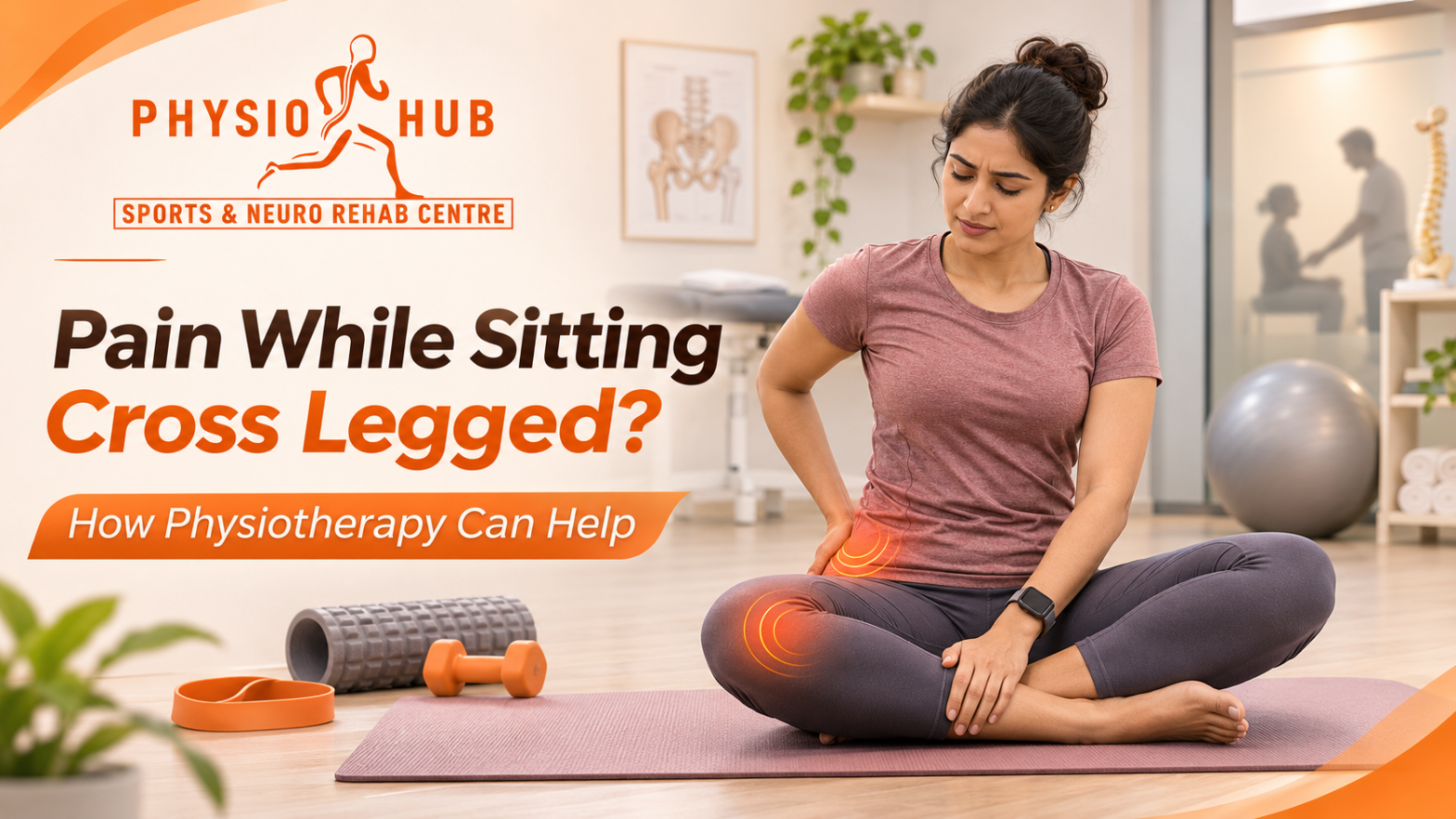
Pain while sitting cross legged is a common concern experienced by individuals of different age groups. In India, sitting on the floor is often a part of everyday activities such as eating, praying, practising yoga, meditating and attending family gatherings. However, these simple activities may become uncomfortable when stiffness or pain is experienced in the hips, knees or lower back.

For many individuals, discomfort may initially be noticed after sitting for a few minutes. Over time, difficulty folding the legs, maintaining the position or getting up from the floor may also be experienced.

These limitations may be associated with reduced joint mobility, muscle tightness, prolonged sitting, previous injuries or age-related changes. Although temporary relief may be obtained through rest or stretching, the underlying cause may remain unaddressed.

By consulting a physiotherapist in Malad, movement restrictions can be assessed, and a personalised rehabilitation programme can be recommended. Through appropriate physiotherapy, joint mobility, muscle flexibility and functional strength may be improved, making everyday activities more comfortable and manageable.

How Can Physiotherapy Help With Pain While Sitting Cross Legged?

Pain while sitting cross legged can be managed through physiotherapy by addressing restricted hip mobility, knee stiffness, muscle tightness and reduced joint stability. Through targeted exercises, gentle joint mobilisation, muscle strengthening and functional movement training, discomfort may be reduced and the ability to sit comfortably on the floor may be improved.

What Is Pain While Sitting Cross Legged?

Pain while sitting cross legged refers to discomfort experienced around the hips, knees, ankles or lower back when the legs are folded in a seated position.

A combination of hip rotation, knee flexion, pelvic stability and muscle flexibility is required to maintain this posture comfortably.

When movement is restricted in one or more joints, additional stress may be placed on surrounding muscles and tissues.

Common symptoms include:

  • Hip pain while sitting on the floor

  • Knee pain when folding the legs

  • Tightness around the inner thighs

  • Lower back discomfort

  • Difficulty lowering the knees towards the floor

  • Stiffness when getting up

  • Discomfort on one side of the body

The location and intensity of discomfort may vary depending on the underlying condition.

What Causes Pain While Sitting Cross Legged?

Several factors may contribute to discomfort during cross-legged sitting.

  • Restricted hip mobility: When outward hip rotation is limited, additional pressure may be placed on the knees and surrounding tissues.

  • Muscle tightness: Tightness in the inner thighs, gluteal muscles and hip flexors may restrict comfortable movement.

  • Knee joint problems: Arthritis, meniscus injuries or previous ligament injuries may cause discomfort when the knees are folded.

  • Prolonged sitting: Reduced movement variety associated with desk jobs and sedentary lifestyles may contribute to joint stiffness.

  • Weak hip and core muscles: Reduced muscular support may affect pelvic stability and sitting comfort.

  • Previous injuries: Movement restrictions may remain following sports injuries, accidents or surgical procedures.

  • Age-related joint changes: Reduced flexibility and joint mobility may gradually be experienced with ageing.

  • Lower back problems: Certain spinal or muscular conditions may contribute to discomfort during floor sitting.

An individual physical assessment is recommended to identify which factors are responsible for the pain.

How Is Pain While Sitting Cross Legged Treated Through Physiotherapy?

A systematic rehabilitation approach is followed to address the underlying causes of discomfort rather than providing temporary pain relief alone.

Step 1: Detailed Physical Assessment

A physical examination is performed to understand the patient’s movement limitations, medical history and symptoms.

The following areas are assessed:

  • Hip and knee range of motion

  • Muscle strength and flexibility

  • Joint stability

  • Pelvic alignment

  • Sitting posture and movement patterns

Based on the findings, an appropriate treatment programme is developed.

Step 2: Hip Mobility Exercises

Controlled hip mobility exercises may be introduced to improve joint movement and outward rotation.

Through gradual practice, movement restrictions may be reduced without placing unnecessary pressure on the knees.

Step 3: Targeted Muscle Stretching

Gentle stretching exercises may be recommended for the inner thighs, hip flexors, hamstrings and gluteal muscles.

The intensity of stretching is adjusted according to individual flexibility, pain levels and joint health.

Step 4: Muscle Strengthening Exercises

Targeted exercises are prescribed to strengthen the muscles surrounding the hips, knees and lower back.

Improved muscular support may help reduce excessive stress on the joints during everyday movements.

Step 5: Manual Therapy and Joint Mobilisation

Where clinically appropriate, manual therapy and gentle joint mobilisation may be included to address stiffness and improve movement.

These techniques are generally combined with active rehabilitation exercises.

Step 6: Functional Movement Training

Supported floor sitting, gradual leg folding and controlled sit-to-stand movements may be introduced.

Through personalised physiotherapy in Malad, progress can be monitored and exercises can be modified according to individual recovery.

Quick Summary: How Physiotherapy Helps

Problem Physiotherapy approach
Hip stiffness Hip mobility exercises
Knee discomfort Joint mobility and strengthening
Muscle tightness Targeted stretching
Reduced stability Hip and core strengthening
Difficulty sitting on the floor Functional movement training

Important: Cross-legged sitting should not be forced through sharp or persistent pain.

What Are the Benefits of Physiotherapy for Pain While Sitting Cross Legged?

When an appropriate rehabilitation programme is followed, several functional benefits may be experienced.

  • Improved hip and knee mobility

  • Reduced muscle stiffness and tightness

  • Better flexibility and movement control

  • Improved muscular strength and joint stability

  • Reduced discomfort during floor-sitting activities

  • Improved ability to get up from the floor

  • Greater independence during everyday activities

  • Better understanding of safe movement techniques

Rather than focusing only on pain reduction, greater importance is placed on restoring comfortable and functional movement.

Physiotherapy vs Other Treatments for Cross-Legged Sitting Pain

Different approaches may be considered for managing discomfort. However, treatment suitability is determined by the underlying cause.

Treatment approach Primary purpose Considerations
Physiotherapy Improves mobility, strength and functional movement Personalised assessment and regular practice are required
Pain medication Provides symptom relief Underlying movement restrictions may remain
Massage therapy Helps relieve muscle tension Joint mobility and strength may not be adequately addressed
General stretching Improves muscle flexibility May not address specific joint conditions
Yoga Supports flexibility and body awareness Certain postures may need modification
Chiropractic care Provides manual treatment for selected musculoskeletal conditions Suitability depends on the clinical condition

When a chiropractor in Malad or physiotherapy services are being considered, the treatment approach should be selected according to individual symptoms and assessment findings.

Who Should Consider Physiotherapy for Cross-Legged Sitting Pain?
neurophysio therapy in malad | Physio Hub

Physiotherapy may be beneficial for individuals experiencing persistent discomfort or restricted movement during floor-sitting activities.

It may be considered by:

  • Office professionals experiencing hip stiffness

  • Senior citizens with reduced joint mobility

  • Individuals experiencing knee pain while folding their legs

  • Athletes recovering from lower limb injuries

  • Individuals with sedentary lifestyles

  • Yoga practitioners experiencing restricted flexibility

  • Individuals recovering from hip or knee surgery, following medical clearance

For injury-related movement restrictions, rehabilitation may be provided by a sports physiotherapist in Malad.

When mobility limitations are associated with neurological conditions, specialised neuro physiotherapy in malad may also be considered.

Medical attention should be sought if sudden swelling, severe pain, joint locking or an inability to bear weight is experienced.

How Much Does Physiotherapy for Cross-Legged Sitting Pain Cost?

The cost of physiotherapy may vary according to the severity of symptoms and individual rehabilitation requirements.

Pricing is generally influenced by the following factors:

  • Initial physical assessment

  • Underlying medical condition

  • Number of sessions required

  • Treatment techniques recommended

  • Previous injuries or surgical history

  • Duration of rehabilitation

While searching for physiotherapy near me, importance should be given to professional qualifications, personalised treatment and clinical assessment rather than cost alone.

An accurate treatment estimate can be provided following an initial consultation.

What Are the Latest Physiotherapy Trends in 2026?

In 2026, physiotherapy continues to be influenced by personalised rehabilitation, functional movement assessment and emerging healthcare technologies.

Some important approaches include:

  • Functional movement assessment: Everyday movements are assessed alongside joint mobility and pain levels.

  • Personalised rehabilitation: Exercises are selected according to individual physical abilities and recovery goals.

  • Preventive physiotherapy: Movement restrictions are addressed before further functional limitations develop.

  • Digital rehabilitation: Home exercise programmes and progress monitoring may be supported through digital platforms.

  • AI-assisted physiotherapy: Emerging technologies are being explored to support clinical assessment and rehabilitation planning.

In October 2026, World Physiotherapy held a global summit on artificial intelligence and subsequently developed guiding principles for its responsible use in physiotherapy.

World Physiotherapy+1

Professional assessment and patient-specific treatment remain essential components of rehabilitation.

Why Choose Physio Hub – Dr. Pooja Mehta in Malad?

At Physio Hub – Dr. Pooja Mehta, emphasis is placed on understanding the underlying causes of pain, stiffness and restricted movement.

Personalised physiotherapy programmes are designed according to individual physical conditions, lifestyle requirements and functional goals.

Specialised services include:

  • Musculoskeletal physiotherapy

  • Sports injury rehabilitation

  • Neurological rehabilitation

  • Chiropractic care

  • Joint mobility and strengthening exercises

  • Neck and shoulder pain treatment

  • Functional rehabilitation

Whether discomfort is experienced while sitting cross-legged, walking, exercising or performing everyday activities, appropriate treatment options can be recommended following a detailed physical assessment.

Frequently Asked Questions (FAQs)

1. Why do I experience knee pain while sitting cross legged?

Knee pain may be caused by restricted hip mobility, knee stiffness, previous injuries or joint conditions such as arthritis. The underlying cause can be identified through a physical assessment.

2. Why does my hip hurt when I sit cross legged?

Hip discomfort may be associated with restricted outward rotation, muscle tightness or hip joint problems. Physiotherapy may help improve mobility and address suitable movement-related causes.

3. Can physiotherapy reduce pain while sitting cross legged?

Yes, discomfort may be reduced through targeted mobility exercises, muscle strengthening, stretching and functional rehabilitation, depending on the underlying condition.

4. Is pain while sitting cross legged a sign of arthritis?

Not necessarily. Although arthritis may contribute to discomfort, muscle tightness, reduced flexibility, previous injuries and joint stiffness may also be responsible.

5. How can I make cross-legged sitting more comfortable?

Discomfort may be reduced by using a supportive cushion, avoiding prolonged sitting and gradually improving hip mobility. Persistent pain should be assessed by a qualified physiotherapist near me before specific exercises are attempted.

Take the First Step Towards Pain-Free Movement

Pain while sitting cross legged should not be ignored, especially when everyday activities are affected.

Through timely assessment, personalised exercises and appropriate rehabilitation, movement restrictions may be addressed and everyday mobility may be improved.

Consult a physiotherapist in Malad at Physio Hub – Dr. Pooja Mehta and take the first step towards more comfortable and confident movement.
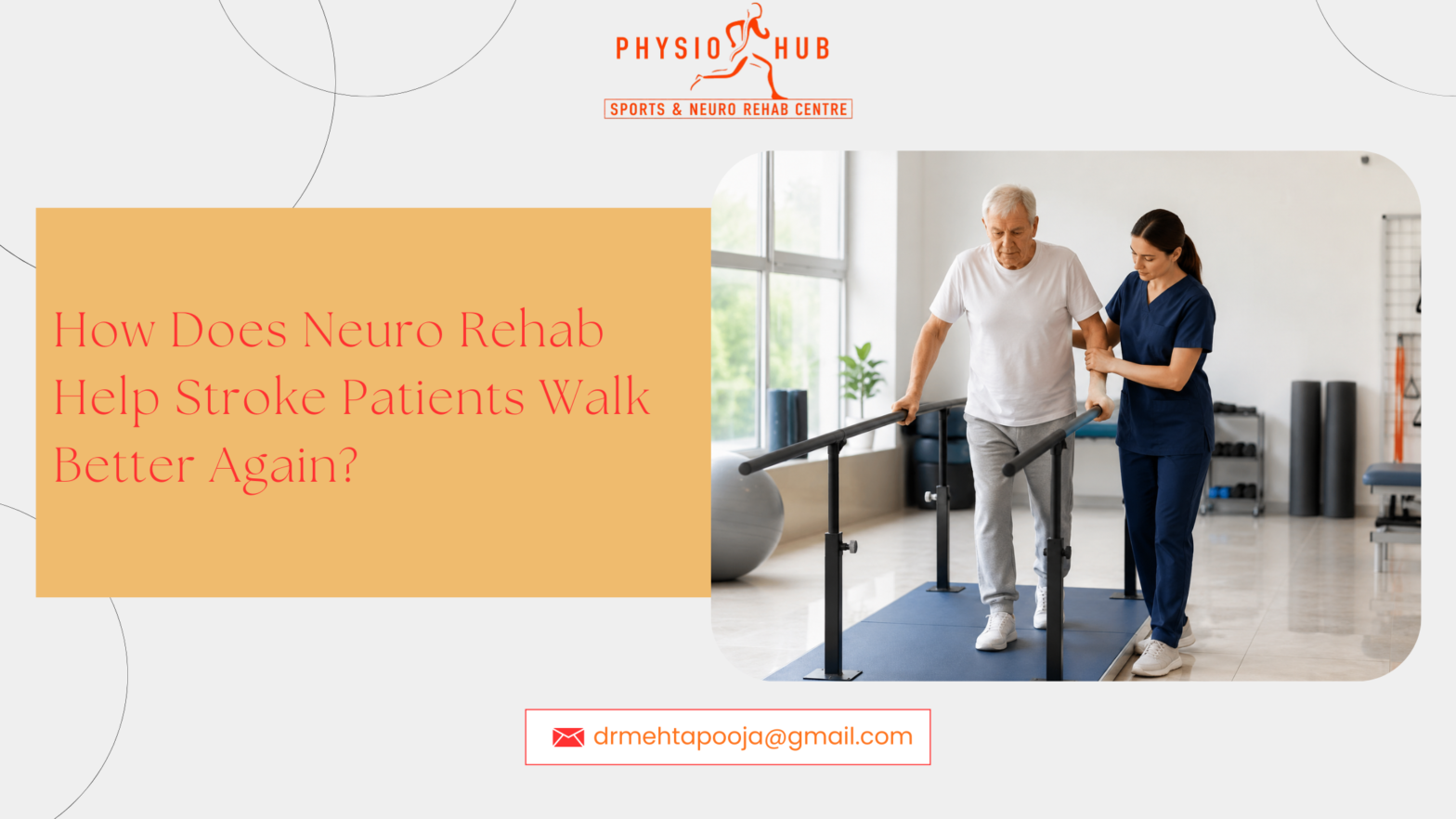
After a stroke, walking can suddenly feel difficult, unsafe, or completely different. Some patients drag one foot, lose balance, walk slowly, depend on support, or feel scared of falling. For families, this can be emotionally challenging because walking is directly connected to independence, confidence, and daily life.

Neuro rehab focuses on retraining the brain, muscles, balance system, and walking pattern after stroke. Unlike general exercise, it is planned according to the patient’s weakness, coordination, muscle tightness, balance, posture, and walking ability.

If you are searching for a physiotherapist in Malad, choosing a specialised neuro rehabilitation approach can make a meaningful difference in stroke recovery. At PhysioHub, the goal is not only to help stroke patients “move more,” but to help them walk safer, better, and with more control.

Stroke rehabilitation should ideally begin once the patient is medically stable, and it often continues after hospital discharge for better functional recovery. The World Health Organization notes that stroke rehab helps improve mobility, strength, balance, coordination, independence, and quality of life.

Neuro rehab helps stroke patients walk better by retraining the brain and body through repetitive walking practice, balance exercises, strength training, posture correction, gait training, and task-specific movements. It improves muscle control, coordination, walking speed, confidence, and safety, helping patients regain independence step by step after stroke.

What is Neuro Rehab for Stroke Walking Recovery?

Neuro rehab is a specialised physiotherapy-based rehabilitation program designed for people with nervous system conditions such as stroke, brain injury, Parkinson’s disease, spinal cord injury, and neurological weakness.

For stroke patients, neuro rehab works on neuroplasticity, which is the brain’s ability to form new pathways and relearn lost functions. After stroke, one side of the body may become weak, stiff, uncoordinated, or poorly controlled. Neuro rehab uses structured exercises and repeated practice to help the brain reconnect with the affected muscles.

In walking recovery, neuro rehab focuses on:

  • Standing balance
  • Weight shifting
  • Leg strength
  • Foot clearance
  • Knee control
  • Hip stability
  • Core activation
  • Gait correction
  • Safe walking confidence

A specialised Neuro rehab centre in Malad can assess these walking problems and create a personalised plan instead of giving random exercises.

Why Do Stroke Patients Need Neuro Rehab to Walk Again?

Stroke can affect walking because it damages the brain areas responsible for movement, balance, posture, and coordination. The problem is not always “weak legs.” Often, the issue is poor communication between the brain and muscles.

Common reasons stroke patients struggle to walk include:

  • Muscle weakness: One side of the body may not generate enough force.
  • Foot drop: The foot may drag while walking, increasing fall risk.
  • Poor balance: Patients may lean to one side or feel unstable.
  • Spasticity: Muscles may become tight, stiff, or difficult to control.
  • Reduced coordination: The leg may move at the wrong time or in the wrong pattern.
  • Fear of falling: Confidence drops after one or more near-falls.
  • Poor weight transfer: The patient may avoid putting weight on the affected side.
  • Low endurance: Walking even short distances may feel exhausting.

Walking difficulty after stroke is common. Cochrane notes that around 60% of people after stroke experience walking problems, making walking recovery one of the main goals of rehabilitation.

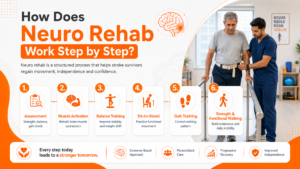
How Does Neuro Rehab Work Step by Step?

Neuro rehab is not one exercise. It is a structured process that progresses according to the patient’s recovery level.

Step 1: Detailed Assessment

The physiotherapist checks:

  • Muscle strength
  • Balance
  • Joint mobility
  • Walking pattern
  • Foot position
  • Knee and hip control
  • Spasticity
  • Functional independence
  • Fall risk

This helps create a safe and realistic walking recovery plan.

Step 2: Muscle Activation and Control

Many stroke patients cannot activate the affected muscles properly. Rehab begins with controlled movements to improve brain-muscle connection.

This may include:

  • Assisted leg movements
  • Core activation
  • Hip control drills
  • Ankle movement practice
  • Sitting and standing control

Step 3: Balance and Weight Shifting

Before walking improves, standing must improve. Patients are trained to shift weight safely from one leg to another.

This helps reduce overdependence on the stronger side.

Step 4: Sit-to-Stand Training

Getting up from a chair is one of the most important functional skills. It builds leg strength, confidence, and balance.

NICE recommends repetitive task training for lower limb weakness, including sit-to-stand, walking, and stair-related activities after stroke.

Step 5: Gait Training

Gait training teaches the patient how to walk with better rhythm, control, and safety.

It may include:

  • Step practice
  • Parallel bar walking
  • Assisted walking
  • Treadmill training
  • Cue-based walking
  • Mirror feedback
  • Obstacle practice
  • Turning practice

AHA/ASA stroke rehab guidance recommends intensive, repetitive, mobility-task training for people with gait limitations after stroke.

Step 6: Strength and Endurance Training

Stroke patients often need progressive strengthening for the hip, knee, ankle, and core.

Endurance training helps patients walk longer distances without fatigue.

Step 7: Functional Walking Practice

The final goal is not only clinic walking. The patient must walk better in real life.

This includes:

  • Walking at home
  • Walking outdoors
  • Climbing steps
  • Turning safely
  • Getting in and out of bed
  • Moving through crowded areas
  • Reducing fall risk

Mini Summary Box:
Neuro rehab improves walking after stroke by combining brain retraining, muscle activation, balance work, repetitive gait practice, strengthening, and real-life movement training. The more specific and consistent the practice, the better the walking control can become.

Physiotherapist in malad

Benefits of Neuro Rehab for Stroke Patients

Neuro rehab provides physical, functional, and emotional benefits.

Key benefits include:

  • Improved walking balance
  • Better control of the affected leg
  • Reduced foot dragging
  • Improved posture while walking
  • Better confidence during movement
  • Lower fall risk
  • Improved walking speed
  • Better step length and rhythm
  • Increased independence at home
  • Improved ability to climb stairs
  • Reduced fear of movement
  • Better participation in daily activities

The American Stroke Association states that stroke rehabilitation helps people relearn lost skills and improve independence, including mobility, walking, self-care, strength, and daily functioning.

For patients searching for Physiotherapy in Malad, neuro rehab can be especially useful when walking difficulty is affecting daily life after stroke.

Neuro Rehab vs General Exercise: What is Better for Stroke Walking Recovery?

Approach Main Focus Best For Limitation
General exercise Strength and fitness Mild weakness or maintenance May not correct neurological walking patterns
Neuro rehab Brain-muscle retraining Stroke walking recovery Needs specialised assessment and consistency
Treadmill training Repetitive walking practice Patients who can walk with or without support Not suitable for every patient
Balance training Stability and fall prevention Patients with poor balance Must be supervised if fall risk is high
Chiropractic care Joint and spine-focused care Some musculoskeletal pain cases Not a replacement for stroke gait rehab
Osteopathy Manual therapy and body mechanics Pain, mobility, posture support Stroke walking recovery still needs neuro rehab

Treadmill training may improve walking speed and endurance in some stroke patients who are already able to walk, but evidence is more limited for helping fully dependent walkers become independent.

So, if someone is searching for a Chiropractor in Malad or osteopathy in Malad after stroke, it is important to understand that stroke walking recovery usually needs specialised neuro physiotherapy and gait retraining first.

Who Needs Neuro Rehab After Stroke?

Neuro rehab may help stroke patients who have:

  • Difficulty standing independently
  • Poor balance while walking
  • Foot drop or toe dragging
  • One-sided weakness
  • Slow or uneven walking
  • Fear of falling
  • Knee buckling while walking
  • Difficulty climbing stairs
  • Reduced confidence outdoors
  • Trouble getting up from a chair
  • Muscle stiffness or spasticity
  • Walking dependence on a stick, walker, or caregiver

It is also helpful for patients who completed hospital rehabilitation but still struggle with walking at home.

People looking for a physiotherapist in Mumbai or Best physiotherapist in Malad for stroke recovery should choose a clinic that understands neurological movement patterns, not just strengthening exercises.

Cost and Pricing Factors for Neuro Rehab in Malad Mumbai

The cost of neuro rehab may vary based on the patient’s condition and therapy needs.

Common pricing factors include:

  • Severity of stroke weakness
  • Patient’s walking ability
  • Need for one-on-one supervision
  • Frequency of sessions per week
  • Duration of each session
  • Use of equipment or assisted gait training
  • Home program requirements
  • Balance and fall-risk level
  • Need for long-term rehab planning

A patient who can already walk with mild imbalance may need a different plan than a patient who requires full support for standing or stepping.

In Malad Mumbai, stroke rehab pricing should not be judged only by session cost. The better question is: “Is the therapy personalised, goal-based, and focused on functional walking improvement?”

Industry Trends in Neuro Rehab in 2026

Stroke rehabilitation is becoming more personalised, technology-assisted, and outcome-focused.

Important trends in 2026 include:

  • Task-specific gait training: More focus on real walking tasks instead of only bed exercises.
  • Wearable tracking: Sensors can help monitor walking speed, steps, balance, and symmetry.
  • AI-assisted rehab planning: Emerging tools may help predict recovery patterns and personalise therapy.
  • Home exercise monitoring: Patients are encouraged to continue guided exercises beyond clinic sessions.
  • Fall-prevention programs: Rehab now focuses strongly on safety, confidence, and home mobility.
  • Multidisciplinary care: Physiotherapy, occupational therapy, speech therapy, and psychological support often work together.
  • Circuit-based rehab: NICE recommends considering group circuit training with education and peer support in addition to one-to-one walking therapy for suitable stroke patients.

The future of neuro rehab is not only about advanced machines. It is about combining science, repetition, personalised care, and real-life functional goals.

Why Choose PhysioHub in Malad Mumbai?

PhysioHub is positioned as a specialised rehabilitation centre for people looking for neuro and sports recovery support in Malad Mumbai.

For stroke walking recovery, PhysioHub focuses on:

  • Personalised neuro assessment
  • Goal-based walking rehabilitation
  • Balance and fall-risk training
  • Gait correction exercises
  • Strength and coordination training
  • Functional mobility practice
  • Patient and family education
  • Progress-based rehab planning

PhysioHub also supports people searching for related services such as best sports spine rehab in Malad, best ACL rehab in Malad, and ACL rehab in Malad. However, for stroke patients, the priority remains neurological recovery, safe walking, and independence.

If you are searching for a physiotherapist in Malad for stroke rehabilitation, choose a centre that understands how the brain and body relearn movement after stroke.

FAQs

1. Can stroke patients walk normally again?

Some stroke patients regain near-normal walking, while others improve enough to walk safely with support or assistive devices. Recovery depends on stroke severity, age, medical stability, rehab consistency, balance, strength, and neurological recovery.

2. How soon should neuro rehab start after stroke?

Stroke rehab should begin as soon as the patient is medically stable, often during the hospital phase. WHO states that rehabilitation should ideally begin within the first few days after stroke when medically safe.

3. How does a physiotherapist help with walking after stroke?

A physiotherapist helps by improving balance, strength, posture, coordination, leg control, foot clearance, walking rhythm, and confidence. They also train safe transfers, stair climbing, and fall prevention.

4. Is treadmill training useful after stroke?

Treadmill training can help some stroke patients improve walking speed and endurance, especially those who can already walk with or without assistance. It should be used only after proper assessment and supervision.

5. Which is better after stroke: general exercise or neuro rehab?

Neuro rehab is usually better for stroke walking recovery because it targets brain-muscle retraining, balance, gait correction, and functional movement. General exercise may improve fitness but may not correct stroke-related walking patterns.

Walking after stroke can improve with the right guidance, repetition, and specialised care.

If you or your loved one is struggling with balance, foot dragging, slow walking, or fear of falling after stroke, consult PhysioHub – Neuro Rehab Centre in Malad Mumbai for a personalised stroke walking recovery plan with an experienced physiotherapist in Malad.

An ACL tear can feel like a sudden halt to your active life, but at

Continue reading “Beyond Surgery: Mastering ACL Recovery at PhysioHub Mumbai”