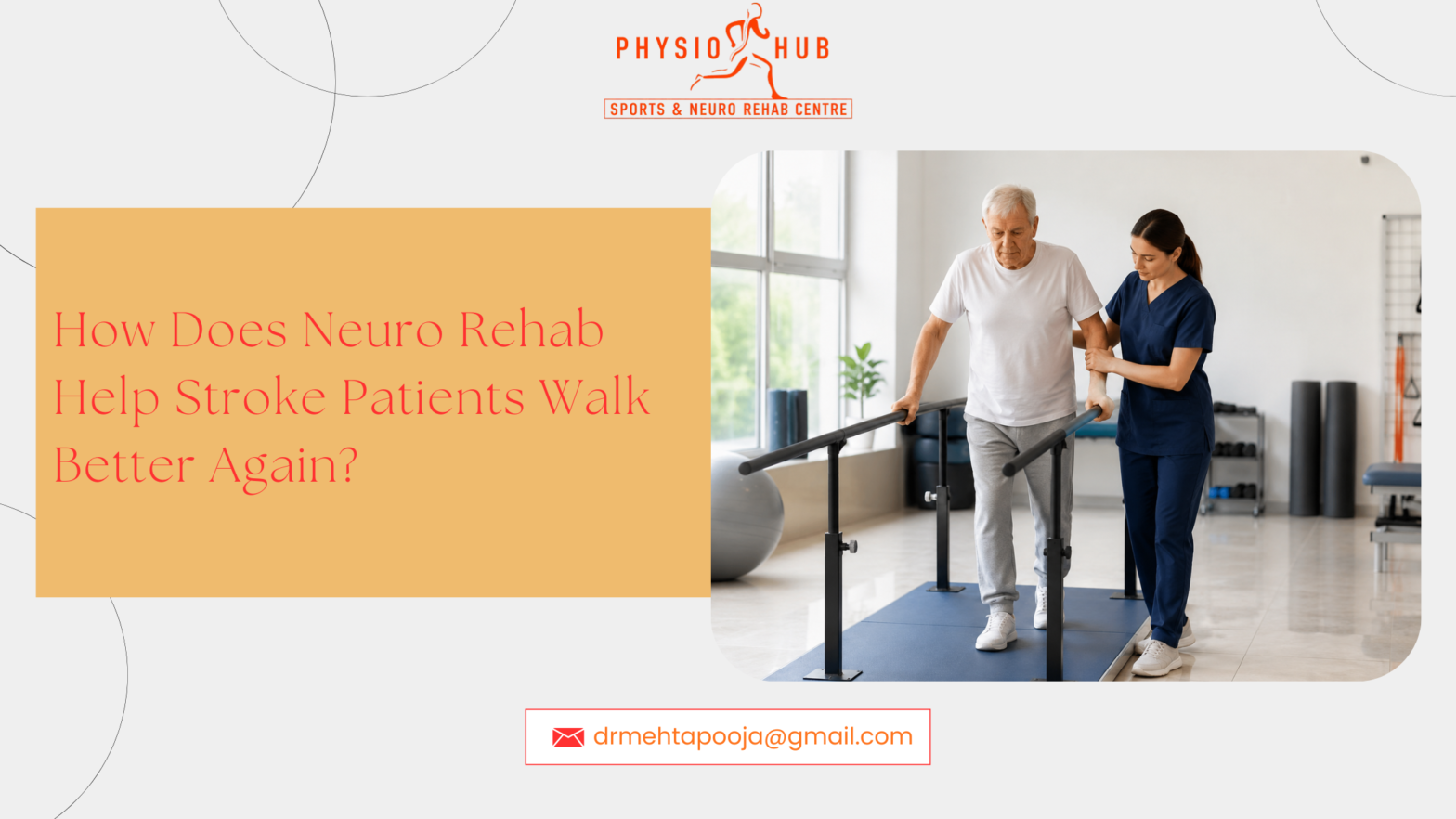
After a stroke, walking can suddenly feel difficult, unsafe, or completely different. Some patients drag one foot, lose balance, walk slowly, depend on support, or feel scared of falling. For families, this can be emotionally challenging because walking is directly connected to independence, confidence, and daily life.
Neuro rehab focuses on retraining the brain, muscles, balance system, and walking pattern after stroke. Unlike general exercise, it is planned according to the patient’s weakness, coordination, muscle tightness, balance, posture, and walking ability.
If you are searching for a physiotherapist in Malad, choosing a specialised neuro rehabilitation approach can make a meaningful difference in stroke recovery. At PhysioHub, the goal is not only to help stroke patients “move more,” but to help them walk safer, better, and with more control.
Stroke rehabilitation should ideally begin once the patient is medically stable, and it often continues after hospital discharge for better functional recovery. The World Health Organization notes that stroke rehab helps improve mobility, strength, balance, coordination, independence, and quality of life.
Neuro rehab helps stroke patients walk better by retraining the brain and body through repetitive walking practice, balance exercises, strength training, posture correction, gait training, and task-specific movements. It improves muscle control, coordination, walking speed, confidence, and safety, helping patients regain independence step by step after stroke.
What is Neuro Rehab for Stroke Walking Recovery?
Neuro rehab is a specialised physiotherapy-based rehabilitation program designed for people with nervous system conditions such as stroke, brain injury, Parkinson’s disease, spinal cord injury, and neurological weakness.
For stroke patients, neuro rehab works on neuroplasticity, which is the brain’s ability to form new pathways and relearn lost functions. After stroke, one side of the body may become weak, stiff, uncoordinated, or poorly controlled. Neuro rehab uses structured exercises and repeated practice to help the brain reconnect with the affected muscles.
In walking recovery, neuro rehab focuses on:
- Standing balance
- Weight shifting
- Leg strength
- Foot clearance
- Knee control
- Hip stability
- Core activation
- Gait correction
- Safe walking confidence
A specialised Neuro rehab centre in Malad can assess these walking problems and create a personalised plan instead of giving random exercises.
Why Do Stroke Patients Need Neuro Rehab to Walk Again?
Stroke can affect walking because it damages the brain areas responsible for movement, balance, posture, and coordination. The problem is not always “weak legs.” Often, the issue is poor communication between the brain and muscles.
Common reasons stroke patients struggle to walk include:
- Muscle weakness: One side of the body may not generate enough force.
- Foot drop: The foot may drag while walking, increasing fall risk.
- Poor balance: Patients may lean to one side or feel unstable.
- Spasticity: Muscles may become tight, stiff, or difficult to control.
- Reduced coordination: The leg may move at the wrong time or in the wrong pattern.
- Fear of falling: Confidence drops after one or more near-falls.
- Poor weight transfer: The patient may avoid putting weight on the affected side.
- Low endurance: Walking even short distances may feel exhausting.
Walking difficulty after stroke is common. Cochrane notes that around 60% of people after stroke experience walking problems, making walking recovery one of the main goals of rehabilitation.
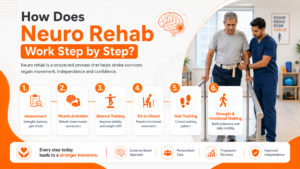
How Does Neuro Rehab Work Step by Step?
Neuro rehab is not one exercise. It is a structured process that progresses according to the patient’s recovery level.
Step 1: Detailed Assessment
The physiotherapist checks:
- Muscle strength
- Balance
- Joint mobility
- Walking pattern
- Foot position
- Knee and hip control
- Spasticity
- Functional independence
- Fall risk
This helps create a safe and realistic walking recovery plan.
Step 2: Muscle Activation and Control
Many stroke patients cannot activate the affected muscles properly. Rehab begins with controlled movements to improve brain-muscle connection.
This may include:
- Assisted leg movements
- Core activation
- Hip control drills
- Ankle movement practice
- Sitting and standing control
Step 3: Balance and Weight Shifting
Before walking improves, standing must improve. Patients are trained to shift weight safely from one leg to another.
This helps reduce overdependence on the stronger side.
Step 4: Sit-to-Stand Training
Getting up from a chair is one of the most important functional skills. It builds leg strength, confidence, and balance.
NICE recommends repetitive task training for lower limb weakness, including sit-to-stand, walking, and stair-related activities after stroke.
Step 5: Gait Training
Gait training teaches the patient how to walk with better rhythm, control, and safety.
It may include:
- Step practice
- Parallel bar walking
- Assisted walking
- Treadmill training
- Cue-based walking
- Mirror feedback
- Obstacle practice
- Turning practice
AHA/ASA stroke rehab guidance recommends intensive, repetitive, mobility-task training for people with gait limitations after stroke.
Step 6: Strength and Endurance Training
Stroke patients often need progressive strengthening for the hip, knee, ankle, and core.
Endurance training helps patients walk longer distances without fatigue.
Step 7: Functional Walking Practice
The final goal is not only clinic walking. The patient must walk better in real life.
This includes:
- Walking at home
- Walking outdoors
- Climbing steps
- Turning safely
- Getting in and out of bed
- Moving through crowded areas
- Reducing fall risk
Mini Summary Box:
Neuro rehab improves walking after stroke by combining brain retraining, muscle activation, balance work, repetitive gait practice, strengthening, and real-life movement training. The more specific and consistent the practice, the better the walking control can become.
Benefits of Neuro Rehab for Stroke Patients
Neuro rehab provides physical, functional, and emotional benefits.
Key benefits include:
- Improved walking balance
- Better control of the affected leg
- Reduced foot dragging
- Improved posture while walking
- Better confidence during movement
- Lower fall risk
- Improved walking speed
- Better step length and rhythm
- Increased independence at home
- Improved ability to climb stairs
- Reduced fear of movement
- Better participation in daily activities
The American Stroke Association states that stroke rehabilitation helps people relearn lost skills and improve independence, including mobility, walking, self-care, strength, and daily functioning.
For patients searching for Physiotherapy in Malad, neuro rehab can be especially useful when walking difficulty is affecting daily life after stroke.
Neuro Rehab vs General Exercise: What is Better for Stroke Walking Recovery?
| Approach | Main Focus | Best For | Limitation |
|---|---|---|---|
| General exercise | Strength and fitness | Mild weakness or maintenance | May not correct neurological walking patterns |
| Neuro rehab | Brain-muscle retraining | Stroke walking recovery | Needs specialised assessment and consistency |
| Treadmill training | Repetitive walking practice | Patients who can walk with or without support | Not suitable for every patient |
| Balance training | Stability and fall prevention | Patients with poor balance | Must be supervised if fall risk is high |
| Chiropractic care | Joint and spine-focused care | Some musculoskeletal pain cases | Not a replacement for stroke gait rehab |
| Osteopathy | Manual therapy and body mechanics | Pain, mobility, posture support | Stroke walking recovery still needs neuro rehab |
Treadmill training may improve walking speed and endurance in some stroke patients who are already able to walk, but evidence is more limited for helping fully dependent walkers become independent.
So, if someone is searching for a Chiropractor in Malad or osteopathy in Malad after stroke, it is important to understand that stroke walking recovery usually needs specialised neuro physiotherapy and gait retraining first.
Who Needs Neuro Rehab After Stroke?
Neuro rehab may help stroke patients who have:
- Difficulty standing independently
- Poor balance while walking
- Foot drop or toe dragging
- One-sided weakness
- Slow or uneven walking
- Fear of falling
- Knee buckling while walking
- Difficulty climbing stairs
- Reduced confidence outdoors
- Trouble getting up from a chair
- Muscle stiffness or spasticity
- Walking dependence on a stick, walker, or caregiver
It is also helpful for patients who completed hospital rehabilitation but still struggle with walking at home.
People looking for a physiotherapist in Mumbai or Best physiotherapist in Malad for stroke recovery should choose a clinic that understands neurological movement patterns, not just strengthening exercises.
Cost and Pricing Factors for Neuro Rehab in Malad Mumbai
The cost of neuro rehab may vary based on the patient’s condition and therapy needs.
Common pricing factors include:
- Severity of stroke weakness
- Patient’s walking ability
- Need for one-on-one supervision
- Frequency of sessions per week
- Duration of each session
- Use of equipment or assisted gait training
- Home program requirements
- Balance and fall-risk level
- Need for long-term rehab planning
A patient who can already walk with mild imbalance may need a different plan than a patient who requires full support for standing or stepping.
In Malad Mumbai, stroke rehab pricing should not be judged only by session cost. The better question is: “Is the therapy personalised, goal-based, and focused on functional walking improvement?”
Industry Trends in Neuro Rehab in 2026
Stroke rehabilitation is becoming more personalised, technology-assisted, and outcome-focused.
Important trends in 2026 include:
- Task-specific gait training: More focus on real walking tasks instead of only bed exercises.
- Wearable tracking: Sensors can help monitor walking speed, steps, balance, and symmetry.
- AI-assisted rehab planning: Emerging tools may help predict recovery patterns and personalise therapy.
- Home exercise monitoring: Patients are encouraged to continue guided exercises beyond clinic sessions.
- Fall-prevention programs: Rehab now focuses strongly on safety, confidence, and home mobility.
- Multidisciplinary care: Physiotherapy, occupational therapy, speech therapy, and psychological support often work together.
- Circuit-based rehab: NICE recommends considering group circuit training with education and peer support in addition to one-to-one walking therapy for suitable stroke patients.
The future of neuro rehab is not only about advanced machines. It is about combining science, repetition, personalised care, and real-life functional goals.
Why Choose PhysioHub in Malad Mumbai?
PhysioHub is positioned as a specialised rehabilitation centre for people looking for neuro and sports recovery support in Malad Mumbai.
For stroke walking recovery, PhysioHub focuses on:
- Personalised neuro assessment
- Goal-based walking rehabilitation
- Balance and fall-risk training
- Gait correction exercises
- Strength and coordination training
- Functional mobility practice
- Patient and family education
- Progress-based rehab planning
PhysioHub also supports people searching for related services such as best sports spine rehab in Malad, best ACL rehab in Malad, and ACL rehab in Malad. However, for stroke patients, the priority remains neurological recovery, safe walking, and independence.
If you are searching for a physiotherapist in Malad for stroke rehabilitation, choose a centre that understands how the brain and body relearn movement after stroke.
FAQs
1. Can stroke patients walk normally again?
Some stroke patients regain near-normal walking, while others improve enough to walk safely with support or assistive devices. Recovery depends on stroke severity, age, medical stability, rehab consistency, balance, strength, and neurological recovery.
2. How soon should neuro rehab start after stroke?
Stroke rehab should begin as soon as the patient is medically stable, often during the hospital phase. WHO states that rehabilitation should ideally begin within the first few days after stroke when medically safe.
3. How does a physiotherapist help with walking after stroke?
A physiotherapist helps by improving balance, strength, posture, coordination, leg control, foot clearance, walking rhythm, and confidence. They also train safe transfers, stair climbing, and fall prevention.
4. Is treadmill training useful after stroke?
Treadmill training can help some stroke patients improve walking speed and endurance, especially those who can already walk with or without assistance. It should be used only after proper assessment and supervision.
5. Which is better after stroke: general exercise or neuro rehab?
Neuro rehab is usually better for stroke walking recovery because it targets brain-muscle retraining, balance, gait correction, and functional movement. General exercise may improve fitness but may not correct stroke-related walking patterns.
Walking after stroke can improve with the right guidance, repetition, and specialised care.
If you or your loved one is struggling with balance, foot dragging, slow walking, or fear of falling after stroke, consult PhysioHub – Neuro Rehab Centre in Malad Mumbai for a personalised stroke walking recovery plan with an experienced physiotherapist in Malad.