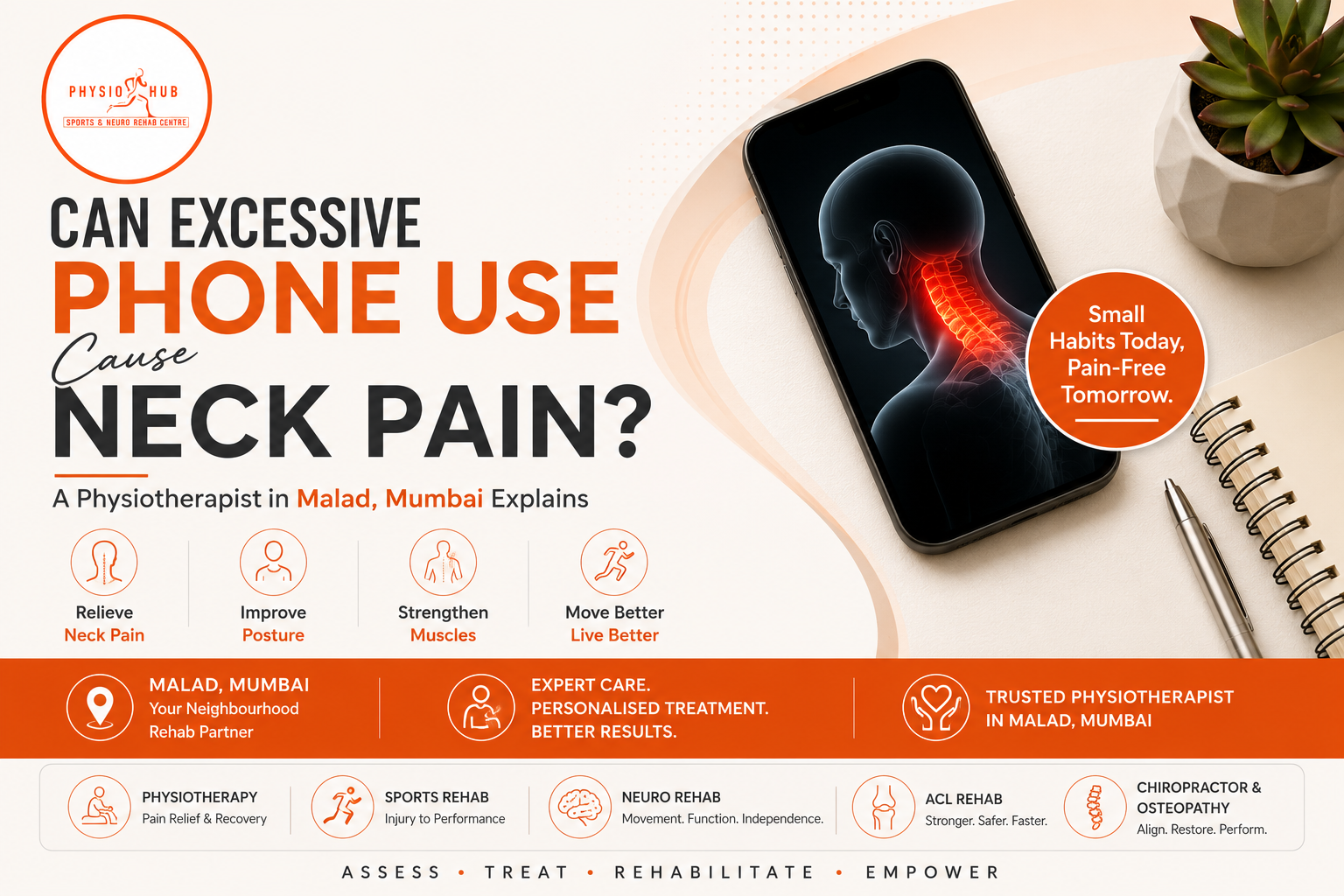
You pick up your phone to answer one message, check social media or finish a work task. A few minutes later, your head is still bent forward, your shoulders feel tight and your neck begins to ache.
This is common among students, office workers, business owners and anyone who spends long hours on screens. The phone itself is not always the only cause. Long screen time, limited movement, weak muscles, stress and poor sleep may all contribute.
A physiotherapist in Malad, Mumbai can help identify why the pain keeps returning. Instead of simply asking you to “sit straight,” the assessment looks at your neck, shoulders, upper back, strength, mobility and daily routine.
At PhysioHub, treatment is personalised because two people with similar neck pain may need different approaches.
Can Excessive Phone Use Cause Neck Pain?

Yes, excessive phone use may contribute to neck pain, especially when you look down for long periods without changing position. It can increase fatigue in the neck and shoulder muscles. However, phone use is rarely the only cause. Strength, activity levels, sleep, stress and previous injuries may also influence symptoms.
What Is Phone-Related Neck Pain?
Phone-related neck pain is discomfort that begins or becomes worse after prolonged smartphone use. It is often called “tech neck” or “text neck,” although these are common descriptions rather than formal medical diagnoses.
When you look down, the muscles supporting your head remain active. Holding this position briefly is usually manageable. Staying there for a long time and taking few movement breaks may lead to fatigue and stiffness.
A physiotherapist in Malad, Mumbai will assess how long you remain in one position, how your body moves and whether your muscles have enough endurance for daily demands.
Phone-related neck pain is usually linked to screen time, limited movement, muscle fatigue, stress and individual physical factors—not one “bad” posture alone.
Why Does Your Neck Hurt After Using Your Phone?
Several everyday factors may contribute:
- Long periods in one position: Even a comfortable posture can become tiring.
- Repeated downward viewing: Looking towards your lap increases the work done by the muscles behind your neck.
- Low screen position: Holding your phone near your waist encourages more neck bending.
- Limited movement breaks: Muscles often feel better when positions change regularly.
- Weak neck and upper-back muscles: Low endurance can make your neck tire quickly.
- Upper-back stiffness: A stiff upper back may cause the neck to work harder.
- Stress and poor sleep: Both may increase tension and pain sensitivity.
- Previous injury: An old neck or shoulder problem may become irritated.
- Combined screen exposure: Laptop work followed by phone use increases total static time.
How Does Physiotherapy for Phone-Related Neck Pain Work?
Visiting a physiotherapist in Malad, Mumbai begins with understanding your symptoms and routine.
Step 1: Discussing your symptoms
Your physiotherapist may ask when the pain started, what makes it worse, whether it affects sleep or driving and how much time you spend using your phone or computer.
For example, does your discomfort begin after ten minutes of scrolling, or only after a full day of desk work? These details help identify the activities contributing to your symptoms.
Step 2: Assessing movement
The assessment may include:
- Neck rotation and bending
- Upper-back mobility
- Shoulder movement
- Shoulder-blade control
- Muscle strength and endurance
- Nerve-related symptoms when relevant
The aim is not to force you into one “perfect” posture. It is to identify restrictions, weakness and movements that trigger symptoms.
Step 3: Creating a personalised plan
Depending on the findings, Physiotherapy in Malad may include:
- Neck and upper-back mobility exercises
- Neck and shoulder strengthening
- Shoulder-blade control exercises
- Movement and posture education
- Ergonomic changes
- Manual therapy when appropriate
- A personalised home exercise programme
Step 4: Building strength and endurance
Your neck may feel comfortable for a few minutes but become painful after several hours. This may be an endurance problem rather than simple muscle tightness.
A physiotherapist in Malad, Mumbai may gradually strengthen your neck, shoulders and upper back so they can manage work, travel and phone use more comfortably.
Step 5: Returning to normal activity
The goal is not to stop using your phone. That would be unrealistic for most people.
Rehabilitation helps you change positions more often, notice early warning signs and build enough physical capacity for work, study and everyday life.
Effective treatment combines assessment, strengthening, mobility work, education and practical changes to daily screen habits.
What Are the Benefits of Physiotherapy for Tech Neck?
Working with a physiotherapist in Malad, Mumbai may help you:
- Reduce neck and shoulder discomfort
- Improve neck movement
- Build muscle strength and endurance
- Improve upper-back mobility
- Develop better shoulder control
- Understand which habits trigger symptoms
- Return to work and exercise with confidence
- Reduce dependence on temporary relief
- Learn exercises suited to your condition
- Manage discomfort before it becomes more limiting
Physiotherapy is not simply about correcting how you sit. It helps your body become stronger and better prepared for the demands of modern screen use.
Physiotherapy vs Other Options for Phone-Related Neck Pain
| Option | Main purpose | Possible benefit | Limitation |
|---|---|---|---|
| Physiotherapy | Assessment, exercise and rehabilitation | Addresses mobility, strength and habits | Requires active participation |
| Rest | Temporarily reduces activity | May calm a flare-up | Does not build strength |
| Massage | Relaxes tight muscles | May provide short-term comfort | Relief may not last |
| Online exercises | Offers general movement ideas | Convenient and accessible | May not suit your condition |
| Chiropractor in Malad | Hands-on care for selected problems | Some people prefer manual treatment | Requires proper assessment and screening |
| Osteopathy in Malad | Broader movement assessment | May support mobility | Should not replace medical evaluation |
| Pain medication | Temporary symptom relief | May help during a flare-up | Does not address movement habits |
The right option depends on your symptoms, medical history and personal goals. In many cases, active rehabilitation is more useful than relying only on temporary relief.
Who Needs Physiotherapy for Phone-Related Neck Pain?
You may benefit from consulting a physiotherapist in Malad, Mumbai if:
- Neck pain keeps returning after phone use
- Your shoulders feel heavy by evening
- Pain affects work, study or sleep
- You struggle to turn your head while driving
- You experience headaches with neck stiffness
- Pain travels into the shoulder blade or arm
- You notice tingling or numbness
- Home stretches provide only temporary relief
- Symptoms continue despite changing your phone position
Students, office workers, gamers, drivers, healthcare professionals and content creators may be more likely to experience problems because of prolonged screen use.
How Much Does Neck Pain Physiotherapy Cost in Malad?
The cost of treatment with a physiotherapist in Malad, Mumbai depends on:
- Severity and duration of symptoms
- Length of the initial assessment
- Number of sessions required
- Type of treatment used
- Need for specialised rehabilitation
- Clinic appointments or home sessions
- Follow-up and exercise progression
Someone with mild stiffness may need a short programme. A person with long-term pain, headaches or arm symptoms may require a more detailed assessment and gradual rehabilitation.
The cheapest session is not always the best value. A clear assessment and practical home programme may help reduce repeated spending on temporary treatments.
What Are the Neck-Pain Physiotherapy Trends in 2026?
Physiotherapy in 2026 is becoming more personalised, active and connected to everyday life.
Less fear around posture
Modern rehabilitation is moving away from the idea that one posture is always harmful. The focus is now on changing positions, improving strength and gradually building tolerance.
More active rehabilitation
Exercise, education and a gradual return to activity are central parts of treatment. Hands-on techniques may still be used, but they are often combined with strengthening and self-management.
Whole-body assessment
A physiotherapist in Malad, Mumbai may assess the upper back, shoulders, work habits, sleep and physical activity instead of looking only at the painful area.
This whole-body approach is important because neck discomfort may be influenced by more than one joint or muscle.
Why Choose PhysioHub in Malad, Mumbai?
PhysioHub begins by listening to your experience. Does the pain start after a few minutes of scrolling, after a long workday or only when you are tired and stressed?
Dr. Pooja Mehta, Sports Physiotherapist, focuses on personalised assessment and practical rehabilitation. Treatment may include mobility work, strengthening, movement correction, hands-on techniques and guided home exercises.
People looking for a physiotherapist in Malad, Mumbai can receive care for neck pain, back pain, sports injuries and post-operative recovery.
PhysioHub also supports patients searching for ACL rehab in Malad or a Sports Physiotherapist in Mumbai. Its wider rehabilitation services may be helpful for people looking for a Neuro rehab centre in Malad or Neuro physio therapy in Malad for movement, balance and walking difficulties.
Whether you are comparing a physiotherapist in Mumbai, a Chiropractor in Malad or osteopathy in Malad, the first step should be a careful assessment based on your symptoms and goals.
Frequently Asked Questions About Phone-Related Neck Pain
1. Can excessive phone use permanently damage your neck?
Phone use does not automatically cause permanent damage. However, long periods without movement may contribute to recurring discomfort, stiffness and muscle fatigue.
2. How should I hold my phone to reduce neck pain?
Bring the screen closer to eye level, support your arms and change position regularly. You do not need to maintain one rigid posture throughout the day.
3. Can a physiotherapist in Malad, Mumbai treat tech neck?
Yes. A physiotherapist in Malad, Mumbai can assess your neck, upper back, shoulders, muscle endurance and screen habits before creating a personalised treatment plan.
4. Are neck stretches enough for phone-related pain?
Not always. Some people need mobility exercises, while others may need strengthening, endurance exercises or changes to their daily routine.
5. When should I see a physiotherapist for neck pain?
Book an assessment when pain keeps returning, affects sleep or work, or occurs with headaches, tingling, numbness or arm discomfort.
Book Your Neck Pain Assessment at PhysioHub
Your phone is an important part of modern life, but neck pain does not have to become part of your routine.
A qualified physiotherapist in Malad, Mumbai can help identify why your symptoms keep returning and guide you through a practical recovery plan.
Book your consultation at PhysioHub Sports Rehab Centre in Malad, Mumbai and take the first step towards more comfortable movement.