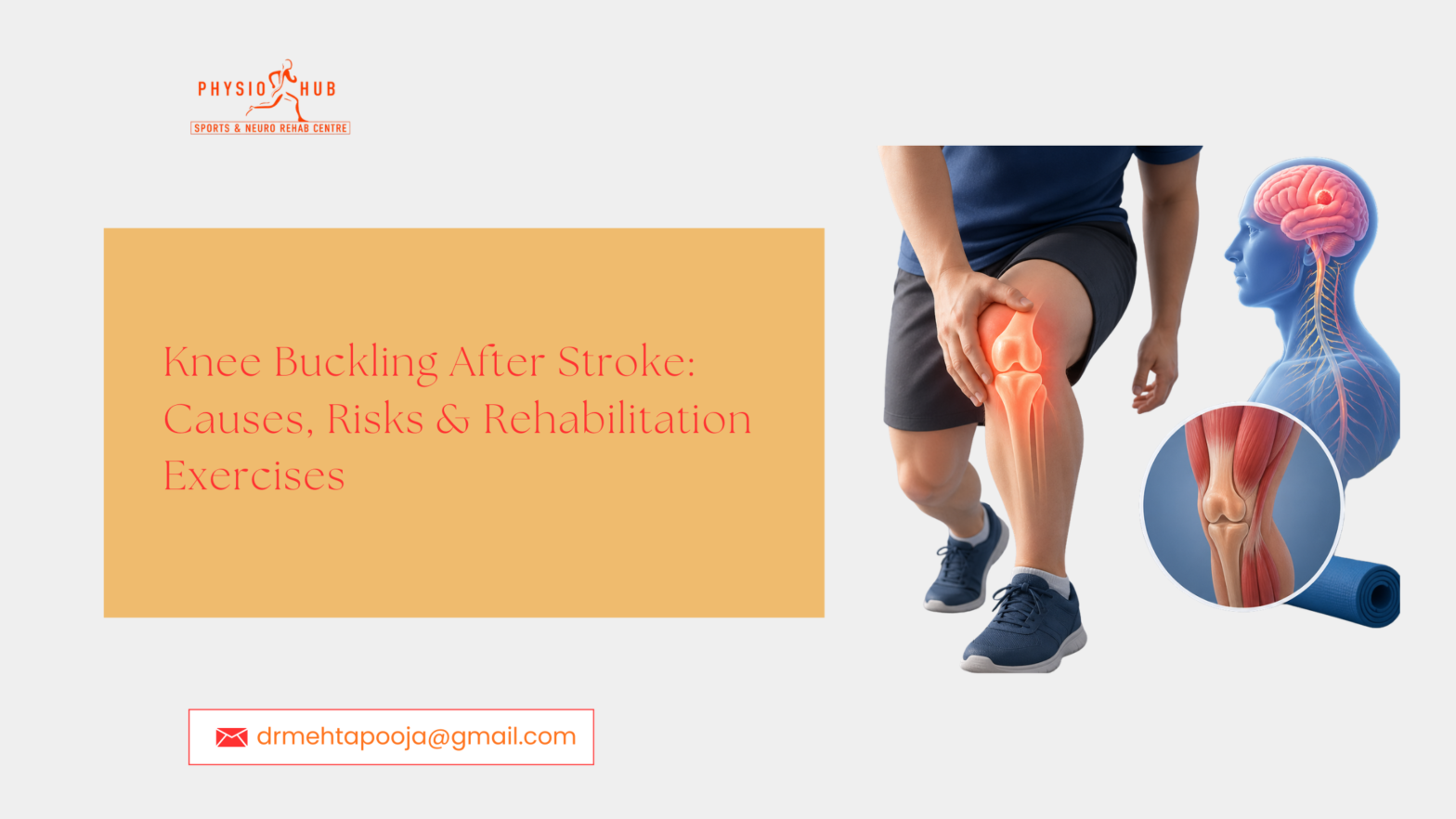
Knee buckling after stroke is a sudden loss of knee stability that can happen within seconds while walking or standing. With the right rehab plan at neuro and sports rehab centre in malad, patients can improve control in 2–6 weeks, reduce fall risk, and regain confident walking.
What is Knee Buckling After Stroke?
Have you ever felt like your leg just “gave up” while walking?
That sudden dip or collapse in your knee… that’s called knee buckling.
After a stroke, this becomes quite common. Not because your knee is damaged—but because your brain and muscles are not fully in sync.
Think of it this way:
Your brain sends a signal
Your muscles respond… but with delay or weakness
And in that tiny moment, the knee loses control.
This is something we often see in patients coming for neuro physiotherapy in malad.
Who Needs This Treatment?
You might relate to this more than you think.
You may need rehab if:
- You’ve had a stroke recently or even years ago
- Your knee feels shaky while walking
- You hold onto walls or furniture for support
- You’ve had a fall—or you’re scared it might happen
- One side of your body feels weaker
Many patients visiting a physiotherapist in malad west say something like:
“I’m okay when sitting… but walking feels unpredictable.”
That fear is real. And it’s exactly what rehab aims to fix.
Symptoms & Causes of Knee Buckling After Stroke
Common Symptoms
It doesn’t always look dramatic. Sometimes it’s subtle.
- Your knee suddenly dips while walking
- You feel like your leg won’t support your weight
- Standing for long feels tiring
- Balance feels “off”
- You walk slower… just to stay safe
Main Causes
Let’s break it down simply.
- Muscle Weakness (Quadriceps)
Your thigh muscle is like a support pillar.
If it’s weak, the knee struggles to stay stable. - Poor Motor Control
The brain is still relearning how to send signals.
Sometimes, the timing is just not right. - Spasticity (Muscle Tightness)
Muscles may feel stiff and resist smooth movement. - Balance Issues
Your body finds it harder to stay upright and steady. - Sensory Loss
You may not fully “feel” where your leg is placed.
Why Knee Buckling is Dangerous
At first, it may seem manageable.
But over time?
- Risk of falls increases
- Confidence drops
- Walking becomes limited
- Daily life feels restricted
We’ve seen patients in Mumbai who stopped going out… just because they didn’t trust their legs anymore.
That’s why early rehab at a neuro and sports rehab centre in malad matters so much.
Benefits of Physiotherapy for Knee Buckling
The right therapy doesn’t just treat the knee it retrains your whole system.
Here’s what patients usually notice:
- Stronger leg muscles within 2–4 weeks
- Better balance and coordination
- More stable walking pattern
- Reduced fear of falling
- Increased independence
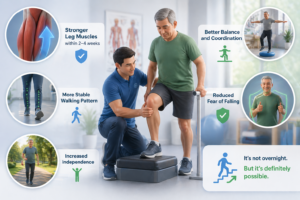
It’s not overnight. But it’s definitely possible.
Rehabilitation Process
A clear plan makes all the difference. Let’s walk through it.
Step 1: Detailed Assessment (Day 1)
This is where everything begins.
- Muscle strength testing
- Walking pattern analysis
- Balance evaluation
Sometimes patients are surprised here.
The actual issue isn’t always what they assumed.
Step 2: Muscle Activation Phase (Week 1–2)
Before building strength, we wake up the muscles.
- Assisted movements
- Basic activation exercises
- Gentle range of motion
It may feel simple… but it’s essential.
Step 3: Strength Training (Week 2–4)
Now the real work begins.
- Resistance exercises
- Sit-to-stand practice
- Step-up movements
Slow progress? Yes.
But steady—and that’s what matters.
Step 4: Gait & Balance Training (Week 3–6)
This is where patients often say,
“I feel more confident walking now.”
- Walking with guidance
- Balance drills
- Coordination training
Small improvements here make a big difference in daily life.
Step 5: Functional Training
Because life isn’t just about exercises.
- Climbing stairs
- Standing for daily tasks
- Moving around the house
Recovery becomes real here.
Step 6: Home Exercise Plan
What you do at home matters just as much.
- 15–20 minutes daily
- Simple guided exercises
- Focus on consistency
Miss this step… and progress slows down.
Best Exercises for Knee Stability
Some exercises are commonly used in sports physiotherapy in malad:
- Straight leg raises
- Mini squats (with support)
- Heel slides
- Step-ups
- Supported balance standing
But here’s something important
Not every exercise suits everyone.
That’s why guidance from the best physiotherapist in malad Mumbai is key.
Recovery Time for Knee Buckling
One question everyone asks: “How long will it take?”
Here’s a realistic idea:
- Mild cases: 2–4 weeks
- Moderate cases: 4–8 weeks
- Severe cases: 2–3 months
Consistency plays a huge role here.
Even 15–20 minutes daily can change outcomes.
Physiotherapy vs No Treatment
| Factor | With Physiotherapy | Without Treatment |
|---|---|---|
| Walking ability | Improves steadily | Worsens over time |
| Fall risk | Reduced | High |
| Muscle strength | Increases | Decreases |
| Independence | Regained | Lost |
Sometimes the biggest risk… is doing nothing.
Role of Spinal & Advanced Therapies
In some cases, additional support helps.
- spinal decompression in malad
- Advanced neuro rehab techniques
- Electrical stimulation
These can enhance recovery when combined with core therapy.
Risks & Safety
Physiotherapy is safe when done correctly.
You might feel:
- Mild soreness (especially in early sessions)
- Slight fatigue
That’s normal.
What’s not safe?
Trying random exercises without guidance.
FAQs
1. Is knee buckling after stroke normal?
Yes, it’s quite common. It usually happens because muscles are weak and the brain is still relearning control.
2. Can knee buckling be cured?
In many cases, yes. With consistent physiotherapy, patients see clear improvement within 4–8 weeks.
3. Which muscle causes knee buckling?
The quadriceps (front thigh muscle) is mainly responsible for keeping the knee stable.
4. Can I walk normally again after knee buckling?
Many patients do regain normal or near-normal walking with proper rehab at a neuro physiotherapy in malad centre.
5. Is surgery required for knee buckling?
Usually not. For stroke-related knee buckling, physiotherapy is the primary and most effective treatment.
6. What is the best exercise for knee stability?
Exercises like straight leg raises and supported squats help—but they should always be personalized.
Conclusion
Knee buckling after stroke can feel scary. That sudden loss of control… the fear of falling… it’s not easy to deal with.
But here’s the good part—recovery is possible.
With the right rehab, guided exercises, and a bit of patience, you can rebuild strength, improve balance, and walk with confidence again.
If you or someone in your family is going through this, don’t ignore it.
Visit Physio Hub neuro and sports rehab centre in malad
Get support from the best physiotherapist in malad Mumbai and take the first step towards safe, confident movement again.