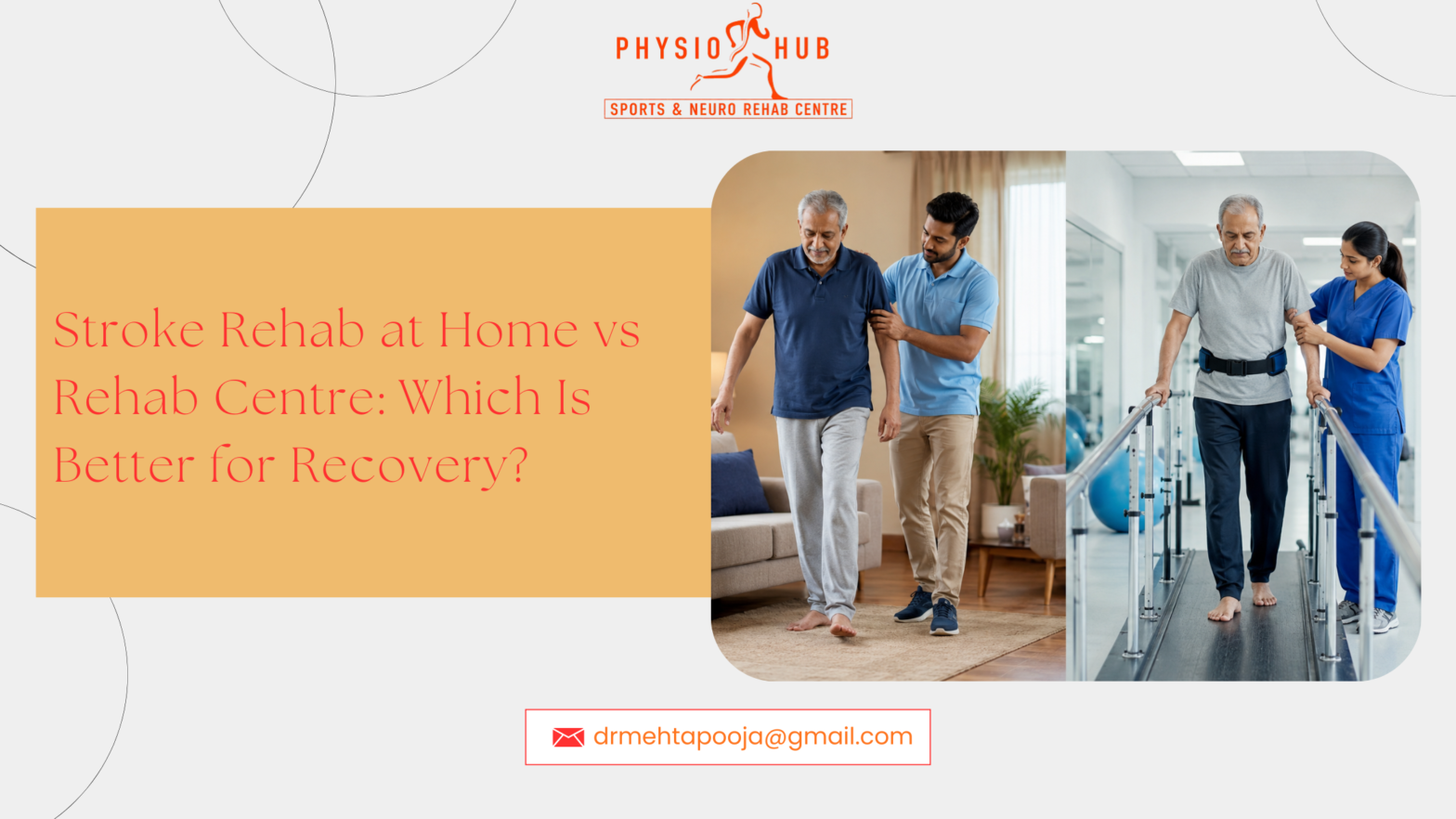
Stroke recovery can feel confusing for both patients and families. After hospital discharge, one of the biggest questions is: should the patient continue stroke rehab at home, or is a rehab centre better? Consulting an experienced physiotherapist in Malad can help families understand the safest and most effective recovery option based on the patient’s condition.
The answer depends on the patient’s mobility level, balance, speech difficulty, family support, and recovery goals. Some stroke patients need supervised care at a neuro rehab centre, while others may benefit from home-based physiotherapy once they are medically stable.
For families in Malad Mumbai, choosing the right recovery setup is important because stroke rehabilitation is not only about exercise. It includes balance training, walking practice, muscle control, posture correction, daily activity training, fall prevention, and caregiver education.
At PhysioHub, stroke rehab focuses on helping patients regain movement, confidence, and independence through structured physiotherapy. Whether the patient needs clinic-based care or guided home support, the goal remains the same: safe, steady, and meaningful recovery.
Mini Summary Box
Stroke rehab at home is useful for comfort and daily routine practice. A rehab centre is better for structured supervision, advanced assessment, and complex recovery needs. Many patients benefit most from a combination of both.
Stroke Rehab at Home vs Rehab Centre — Which Is Better?
A rehab centre is usually better for early, complex, or high-risk stroke recovery because it offers supervised physiotherapy, equipment, and structured neuro rehab. Home stroke rehab is useful when the patient is stable and needs daily functional practice. The best option is often a personalized plan combining both.
What Is Stroke Rehab at Home vs Rehab Centre?
Stroke rehab is a structured recovery program that helps patients regain movement, balance, walking ability, strength, coordination, and independence after a stroke.
Stroke rehab at home means the patient receives physiotherapy and guided exercises in their home environment. It is helpful for practicing real-life activities such as walking inside the house, getting up from bed, using the bathroom safely, and improving daily independence.
Stroke rehab at a rehab centre means the patient visits a specialized facility where trained physiotherapists use assessment-based therapy, neuro rehab techniques, balance tools, gait training, strengthening exercises, and movement retraining.
For many patients searching for a physiotherapist in Malad, the right choice depends on recovery stage and safety level.
Why Is Stroke Rehabilitation Needed After a Stroke?
Stroke can affect the brain’s ability to control movement, balance, speech, posture, sensation, and coordination. Without proper rehabilitation, patients may develop stiffness, weakness, poor walking pattern, fear of falling, and long-term dependence.
Stroke rehab is important because it helps with:
- Relearning movement through repetition
- Improving walking and balance
- Reducing stiffness and abnormal muscle tone
- Preventing falls and secondary complications
- Improving hand, leg, and trunk control
- Training safe transfers from bed to chair
- Improving confidence in daily activities
- Supporting family members with safe handling techniques
- Helping patients become more independent
Common post-stroke concerns include:
- One-sided weakness
- Difficulty walking
- Poor balance
- Shoulder pain
- Hand stiffness
- Foot drop
- Poor sitting or standing posture
- Reduced coordination
- Fatigue
- Fear of movement
This is why early guidance from a trained physiotherapist in Mumbai or a neuro rehab centre in Malad can make recovery more organized and safer.
Mini Summary Box
Stroke rehab is needed because the brain and body must relearn movement after stroke. Proper physiotherapy helps improve walking, balance, strength, and daily independence.
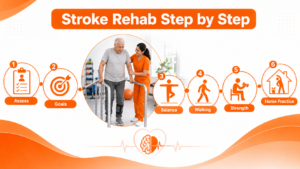
How Does Stroke Rehab Work Step by Step?
Stroke rehabilitation should always begin with proper assessment. The treatment plan should not be based only on random exercises or online videos.
Step 1: Detailed Assessment
The physiotherapist checks:
- Muscle strength
- Balance
- Walking pattern
- Sitting and standing control
- Joint stiffness
- Hand and leg movement
- Pain areas
- Fall risk
- Daily activity limitations
- Family support at home
This helps decide whether home rehab, centre-based rehab, or a mixed approach is better.
Step 2: Goal Setting
Every stroke patient has different goals.
Some may want to walk independently. Others may want to sit without support, climb stairs, improve hand use, reduce stiffness, or return to daily activities.
Clear goals make therapy more focused.
Step 3: Mobility and Balance Training
Patients are trained to improve:
- Sitting balance
- Standing balance
- Weight shifting
- Walking confidence
- Turning safely
- Step control
- Fall prevention
Balance training is especially important for patients who feel unstable while standing or walking.
Step 4: Gait Training
Gait training helps improve walking pattern after stroke.
It may include:
- Assisted walking
- Step training
- Knee control exercises
- Foot placement correction
- Posture correction
- Walking with support when needed
- Gradual walking distance improvement
Step 5: Strength and Motor Control
Stroke rehab is not only about strengthening weak muscles. It also focuses on motor control, which means helping the brain and body coordinate movement better.
Exercises may focus on:
- Core control
- Hip and knee strength
- Ankle control
- Shoulder stability
- Arm and hand movement
- Trunk stability
Step 6: Functional Training
Functional training prepares the patient for real-life movement.
This may include:
- Getting up from bed
- Standing from a chair
- Walking to the bathroom
- Climbing steps
- Reaching and gripping
- Dressing support
- Safe turning
- Daily movement confidence
Step 7: Home Exercise and Caregiver Training
Families are taught how to support the patient safely without overhelping.
Caregiver training may include:
- Safe transfer methods
- Fall prevention tips
- Correct walking support
- Home safety changes
- Exercise supervision
- Motivation and routine planning
Benefits of Stroke Rehab at Home and Rehab Centre
Both options have benefits. The right choice depends on the patient’s recovery stage.
Benefits of Stroke Rehab at Home
- Comfortable and familiar environment
- Easier for patients with travel difficulty
- Helps practice real daily activities
- Family members can observe and learn
- Useful for long-term recovery routines
- Reduces stress for elderly patients
- Helps identify home safety challenges
Benefits of Rehab Centre-Based Stroke Rehab
- Better structured assessment
- Supervised movement training
- Access to rehab equipment
- Safer for high-risk patients
- Better for balance and gait training
- Helpful for complex neurological recovery
- More focused therapy environment
- Easier progress tracking
Benefits of a Hybrid Rehab Plan
Many patients do best with a combination of both.
A rehab centre helps build foundation, strength, balance, and confidence. Home rehab helps apply those improvements in daily life.
Mini Summary Box
Home rehab improves comfort and real-life practice. Rehab centre care improves supervision, structure, and safety. A hybrid plan often gives the most balanced recovery.
Stroke Rehab at Home vs Rehab Centre: Comparison Table
| Factor | Stroke Rehab at Home | Stroke Rehab Centre |
|---|---|---|
| Best for | Stable patients needing daily practice | Patients needing structured supervision |
| Safety | Depends on home setup and caregiver support | More controlled and supervised |
| Equipment | Limited | Better access to rehab tools |
| Family involvement | High | Moderate to high |
| Travel need | No travel required | Patient must visit centre |
| Progress tracking | Depends on therapist visits | More structured tracking |
| Balance training | Possible but space may be limited | Better for supervised balance work |
| Gait training | Useful for home walking practice | Better for advanced walking correction |
| Ideal stage | Later or stable recovery phase | Early, complex, or moderate recovery phase |
| Best approach | Good for functional carryover | Good for clinical improvement |
Who Needs Stroke Rehab at Home or a Rehab Centre?
Stroke rehabilitation is useful for anyone facing movement, balance, walking, or daily activity difficulty after stroke.
A rehab centre may be better if the patient has:
- Poor balance
- High fall risk
- Difficulty standing
- Severe weakness
- Poor walking pattern
- Need for close supervision
- Stiffness or abnormal tone
- Shoulder or limb pain
- Difficulty following exercises safely
- Need for structured neuro rehab
Home stroke rehab may be better if the patient:
- Is medically stable
- Finds travel difficult
- Needs daily activity training
- Has family support at home
- Can follow instructions safely
- Needs help with home mobility
- Has already completed early rehab
A hybrid plan may be best if the patient:
- Needs expert assessment and home practice
- Has moderate walking difficulty
- Wants long-term functional improvement
- Needs family training
- Needs both supervised therapy and daily repetition
For patients in Malad Mumbai, consulting an experienced physiotherapist in Malad can help decide the safest option.
Cost and Pricing Factors for Stroke Rehabilitation
The cost of stroke rehab can vary depending on the patient’s condition and treatment needs.
Important pricing factors include:
- Severity of stroke impact
- Number of therapy sessions required
- Home visit or centre-based session
- Need for advanced neuro rehab
- Duration of each session
- Frequency of therapy
- Need for caregiver training
- Need for gait or balance equipment
- Long-term recovery goals
- Associated pain, stiffness, or posture issues
Home rehab may cost more per visit because of travel and therapist time. Rehab centre sessions may be more structured and equipment-based.
However, the best decision should not be based only on cost. Stroke recovery needs proper planning because delayed or incorrect rehabilitation can affect long-term independence.
Industry Trends in Stroke Rehabilitation in 2026
Stroke rehab in 2026 is becoming more personalized, technology-supported, and function-focused.
Important trends include:
1. Personalized Neuro Rehab
Therapy is moving away from one-size-fits-all exercises. Patients now need customized plans based on strength, balance, walking ability, fatigue, and daily goals.
2. Hybrid Rehab Models
Many patients are choosing a mix of rehab centre sessions and home-based follow-up. This improves both clinical progress and real-life functional practice.
3. Technology-Assisted Recovery
Wearables, movement tracking, balance tools, and digital exercise monitoring are becoming more common in neuro rehab.
4. Early Functional Training
Stroke rehab is focusing more on practical movement like walking, transfers, sitting balance, and hand function instead of only basic bed exercises.
5. Family and Caregiver Education
Caregiver involvement is now seen as an important part of stroke recovery. Families need to know how to support without making the patient fully dependent.
6. Long-Term Recovery Planning
Stroke recovery does not end after a few weeks. Many patients need continued physiotherapy for months to improve walking, balance, endurance, and independence.
Why Choose PhysioHub in Malad Mumbai?
PhysioHub offers structured physiotherapy and neuro rehab support for patients recovering from stroke, pain, injury, and movement-related conditions.
For families looking for a best sports spine rehab in malad, PhysioHub focuses on assessment-based care rather than random exercise plans.
At PhysioHub, stroke rehab may include:
- Neuro physiotherapy assessment
- Balance and gait training
- Strength and mobility exercises
- Posture correction
- Functional movement training
- Fall prevention guidance
- Caregiver education
- Home exercise planning
- Progress-based therapy upgrades
PhysioHub is also known by people searching for Physiotherapy in Malad, neuro rehab centre in Malad, osteopathy in Malad, chiropractor in Malad, best sports spine rehab in Malad, best ACL rehab in Malad, ACL rehab in Malad, and best physiotherapist in Malad.
While stroke rehab is different from sports or ACL rehab, the core approach remains the same: proper assessment, guided movement, and personalized recovery planning.
For patients in Malad Mumbai, PhysioHub provides a patient-friendly environment focused on safe movement, better function, and long-term recovery confidence.
FAQs
1. Is stroke rehab at home enough for recovery?
Stroke rehab at home can be helpful if the patient is medically stable and can exercise safely. However, patients with poor balance, severe weakness, or high fall risk may need supervised rehab centre care first.
2. When should stroke rehabilitation start?
Stroke rehabilitation should begin as early as medically safe after hospital guidance. Early assessment by a trained physiotherapist helps prevent stiffness, weakness, falls, and poor movement patterns.
3. Which is better: home physiotherapy or neuro rehab centre?
A neuro rehab centre is better for structured assessment, balance training, gait correction, and supervised recovery. Home physiotherapy is better for practicing daily activities in a familiar environment. Many patients need both.
4. Can physiotherapy help stroke patients walk again?
Physiotherapy can help many stroke patients improve walking ability through balance training, gait training, strengthening, posture correction, and repeated functional practice. Recovery depends on stroke severity, consistency, and medical condition.
5. How do I find the best physiotherapist in Malad for stroke recovery?
Look for a physiotherapist in Malad who provides detailed assessment, neuro rehab experience, personalized treatment plans, gait training, balance work, family education, and progress tracking.
Stroke recovery needs the right guidance, consistency, and a safe rehabilitation plan.
If your loved one is recovering after a stroke and you are confused between home rehab and rehab centre care, visit PhysioHub in Malad Mumbai for a detailed physiotherapy assessment.
Book a consultation with PhysioHub today and take the next step toward safer movement, better balance, and confident recovery.