Have you started dropping your phone more often? Does opening a bottle, holding a cup, turning a key or buttoning a shirt feel harder than it used to? These may seem like small inconveniences, but when hand weakness or poor grip begins affecting everyday tasks, it deserves attention.
Hand function depends on more than muscle strength. Your brain, nerves, muscles, joints and coordination all need to work together. A change anywhere in this system may affect how firmly you grip an object or how accurately you move your fingers.
At PhysioHub, a physiotherapist in Malad, Mumbai assesses how your hand and arm are functioning rather than looking only at the symptom. For people with neurological movement difficulties, Neuro physio therapy in Malad may focus on strength, coordination, movement control and functional activities.
The aim is practical: helping you use your hand more confidently during the activities that matter in everyday life.
Can Neuro Physiotherapy Help With Hand Weakness and Poor Grip?
Neuro physiotherapy may help improve hand strength, coordination and functional movement when weakness or poor grip is associated with a neurological or nerve-related condition. Treatment begins with an assessment and may include strengthening, coordination exercises, task-specific practice and movement retraining based on the person’s abilities and rehabilitation goals.
What Is Neuro Physiotherapy for Hand Weakness?
Neuro physiotherapy is rehabilitation designed for people whose movement and physical function have been affected by the nervous system.
When the hand is involved, the problem may not simply be that the muscles are “weak.” A person may have difficulty activating certain muscles, coordinating the fingers, controlling the wrist or performing a precise movement.
For example, someone may have enough strength to squeeze a therapy ball but still struggle to pick up a coin or hold a spoon steadily.
A physiotherapist in Malad West may therefore assess the whole upper limb, including the shoulder, elbow, wrist, hand and fingers. The therapist may also look at sensation, coordination and how the hand performs during real tasks.
This helps create a rehabilitation programme based on what the person actually needs.
Hand weakness is not always only a strength problem. Neuro physiotherapy looks at strength, coordination, movement control and the ability to perform everyday tasks.
What Can Cause Weak Grip or Difficulty Holding Objects?
There are many possible reasons for changes in hand function. This is why an assessment matters before starting exercises on your own.
Possible factors may include:
- Neurological conditions affecting movement and coordination
- Recovery after a stroke or other neurological event
- Peripheral nerve involvement
- Reduced muscle activation or strength
- Poor hand and finger coordination
- Changes in sensation
- Reduced wrist or finger mobility
- Long periods of reduced hand use
- Injury or recovery after surgery
- Difficulty controlling the arm and hand together
You might first notice the problem during ordinary activities. A coffee mug suddenly feels heavier. Writing for several minutes becomes tiring. You struggle with buttons or zips. Objects occasionally slip from your hand.
These changes do not automatically indicate a serious neurological condition. However, persistent or worsening weakness should be medically assessed, particularly when it appears suddenly or occurs with other neurological symptoms.
How Does Neuro Physiotherapy for Hand Function Work?
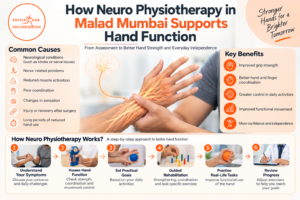
At a Neuro rehab centre in Malad Mumbai, rehabilitation should begin by understanding what the patient can currently do and which activities are difficult.
Step 1: Understanding Your Symptoms
Your physiotherapist may ask when the weakness started, whether one or both hands are affected and which everyday activities have become difficult.
Your medical history, previous injuries and neurological diagnosis, when applicable, are also important.
Step 2: Assessing Hand and Arm Function
The assessment may look at:
- Grip and hand strength
- Finger and wrist movement
- Coordination
- Muscle control
- Upper-limb mobility
- Functional use of the hand
- Ability to grasp and release objects
- Everyday activities that matter to the patient
Step 3: Setting Practical Goals
Goals should connect rehabilitation to daily life.
For one person, the goal might be holding a glass safely. For another, it could be writing, using a computer, cooking or returning to work.
Step 4: Guided Rehabilitation
Depending on the findings, Physiotherapy in Malad, Mumbai may involve strengthening exercises, coordination activities, repetitive task practice and functional movement training.
Exercises should be adjusted to the person rather than following the same routine for everyone.
Step 5: Practising Real-Life Tasks
Rehabilitation becomes more meaningful when it connects with everyday activities.
A therapist may incorporate safe practice involving gripping, reaching, holding, releasing or manipulating suitable objects. This can help bridge the gap between an exercise session and daily independence.
Step 6: Reviewing Progress
Hand function may change gradually. Regular reassessment allows the physiotherapist to adjust the difficulty and type of exercises according to progress.
Neuro rehabilitation usually follows a simple pathway: assess the problem, identify meaningful goals, practise targeted movements and gradually progress toward everyday activities.
What Are the Benefits of Neuro Physiotherapy for Hand Weakness?
The potential benefits depend on the underlying condition and severity of impairment. A personalised programme may support:
- Better grip strength
- Improved hand and finger coordination
- Better control while grasping and releasing
- Improved upper-limb movement
- Greater confidence during daily activities
- Better ability to practise functional tasks
- Improved independence where achievable
- Structured progression instead of random exercises
A Neuro rehab centre in Mumbai may also address other movement difficulties when hand weakness occurs alongside problems with walking, balance or general mobility.
Neuro Physiotherapy vs General Exercise: What’s the Difference?
| Approach | Neuro Physiotherapy | General Exercise |
|---|---|---|
| Assessment | Based on neurological and functional movement needs | Usually general fitness focused |
| Programme | Personalised to specific limitations | Often follows a standard routine |
| Main focus | Movement control, coordination and function | General strength and fitness |
| Daily tasks | Can include task-specific practice | Usually not the main focus |
| Progression | Adjusted according to response and goals | Often based on exercise difficulty |
| Supervision | Guided by a trained professional | May be independent |
General exercise can still play an important role in staying active. However, someone experiencing neurological hand weakness may need a more targeted approach.
Who May Need Neuro Physiotherapy for Hand Weakness?
Consider seeking professional assessment if you notice:
- Your grip has become noticeably weaker
- Objects frequently slip from your hand
- One hand is harder to use than the other
- Buttoning clothes has become difficult
- Writing or typing has become harder
- Holding cutlery or a cup feels challenging
- Your fingers feel difficult to coordinate
- Hand weakness is affecting work or hobbies
- Hand function has changed after a neurological condition
Searching online for a Physiotherapist near me or Physiotheraphy near me may be a starting point, but the important part is finding care appropriate for your specific condition.
Sudden new weakness, particularly with facial drooping, speech difficulty, severe headache, confusion or weakness on one side of the body, requires urgent medical attention rather than waiting for a routine physiotherapy appointment.
How Much Does Neuro Physiotherapy Cost?
There is no single cost that applies to every neuro rehabilitation programme. The overall cost may vary depending on:
- Initial assessment requirements
- Complexity of the condition
- Duration of each session
- Frequency of therapy
- Number of sessions required
- Individual rehabilitation goals
- Additional rehabilitation techniques required
Rather than choosing treatment based only on the lowest session price, consider whether the programme includes a detailed assessment, personalised goals and progress reviews.
For current pricing at PhysioHub, patients can contact the clinic directly before booking an assessment.
What Are the Neuro Physiotherapy Trends in 2026?
Neuro rehabilitation continues to move toward more personalised and function-focused care.
One important direction is task-specific rehabilitation. Instead of practising movement only in isolation, rehabilitation increasingly connects exercises with activities the patient actually wants or needs to perform.
Progressive strengthening, repetitive practice and measurable functional goals also remain important parts of modern rehabilitation.
Technology can support rehabilitation in selected settings, but it does not replace clinical assessment. The most useful programme is still one designed around the individual’s condition, abilities and goals.
For patients exploring physiotherapy in Mumbai, this means looking beyond equipment alone and asking how treatment will translate into better everyday function.
Why Choose PhysioHub in Malad Mumbai?
PhysioHub provides Physiotherapy Services in Malad, Mumbai for people with neurological, musculoskeletal and sports rehabilitation needs.
Care begins with an assessment so the rehabilitation plan can reflect the person’s movement difficulties and goals.
Depending on individual requirements, services include:
- Neuro physiotherapy in Malad
- Physiotherapy in Malad
- Sports Physiotherapist in Malad
- ACL rehab in Malad
- osteopathy in Malad
- Chiropractor in Malad, Mumbai
- Neurological rehabilitation at a Neuro rehab centre in Malad, Mumbai
People searching for a physiotherapist in Malad, Sports Physiotherapist in Mumbai, Chiropractor in Mumbai, Chiropractor Near me or physiotherapy in Mumbai can consult PhysioHub in Malad West for an assessment based on their individual needs.
FAQs About Hand Weakness and Neuro Physiotherapy
1. Can neuro physiotherapy improve weak hand grip?
Neuro physiotherapy may help improve strength, coordination and functional hand use when weakness is related to a neurological or nerve-related condition. Results depend on the underlying cause, severity and individual response to rehabilitation.
2. Why do I keep dropping things from my hand?
Dropping objects can have several causes, including weakness, reduced coordination, sensory changes, pain or nerve-related problems. A professional assessment can help identify what may be affecting your grip.
3. What exercises are used for poor hand coordination?
Exercises vary according to the condition. They may include controlled gripping and releasing, finger movements, strengthening, coordination tasks and practice of everyday activities. Exercises should be selected after assessment.
4. How long does neuro physiotherapy take to improve hand function?
There is no fixed timeline. Recovery depends on the diagnosis, severity of impairment, general health, rehabilitation goals and response to therapy. Progress should be reviewed regularly.
5. When should I see a physiotherapist for hand weakness?
Consider an assessment when weakness persists, worsens or starts interfering with daily activities such as eating, dressing, writing or holding objects. Sudden weakness accompanied by other neurological symptoms requires urgent medical evaluation.
Take the Next Step Towards Better Hand Function
Small hand movements have a big role in everyday independence. If poor grip, weakness or reduced coordination is making routine tasks harder, getting the problem assessed can help you understand what is happening and what rehabilitation may be appropriate.
Visit PhysioHub, Malad West, Mumbai for personalised neurological rehabilitation with a physiotherapist in Malad, Mumbai. A structured assessment can help establish realistic goals and a rehabilitation plan focused on the activities that matter to you.
For more information contact
PhysioHub